
The idea is to establish a robust and forward-looking legal framework that addresses the financial stress of power distribution companies, which are facing losses of over 6.9 trillion, while curbing high industrial tariffs that, according to the government, have affected competitiveness, constrained economic growth, and slowed the transition to clean energy.

If TVK MLAs and ministers are perceived as clean, or demonstrably cleaner than their predecessors, the credibility dividend will be enormous. The voter will feel rewarded, points out Ramesh Menon.
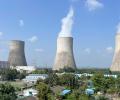
The Bill is likely to pave the way for amending two existing legislations -- the Atomic Energy Act 1962, and the Civil Liability for Nuclear Damage Act 2010.

CERC, which has a key role in India's power sector, has also set up a committee to gather further evidence in the matter and take suitable action.

As the political uncertainty settles down, investors are reviewing their assumptions about the power sector. Demand here is likely to continue to grow strongly in the long-term at around 5-6 per cent CAGR (compounded annual growth rate) during the next 6-7 years. Given policy continuity, several trends will persist.

Power Minister P M Sayeed on Tuesday assured full autonomy to electricity regulatory commissions and said he would talk to state governments for providing administrative and infrastructure support to the regulators.

The Delhi Pollution Control Committee (DPCC) reports improved air quality in Delhi compared to the same period last year, attributing it to coordinated efforts by government departments. Officials aim to avoid implementing GRAP Stage III restrictions through proactive measures and public participation.
CERC keeping an eye on movement of prices.
India's electricity regulator, the Central Electricity Regulatory Commission, has proposed a new tariff scheme for power generated from hydroelectric stations, whereby the risks associated with changes in water flow would now be borne by producers. This is a move that is likely to bring down the price being paid by users, usually the state electricity boards.
The power regulator's office may have been functioning "normally" without a chairperson for almost a year, but industry executives see this as the Central government's lack of seriousness towards the body and the power sector.

It would be a good idea to create independent oversight committees for each regulatory institution and indeed, even for their appellate bodies, says A K Bhattacharya.

Moving from pricing control to a free market means stiff competition.
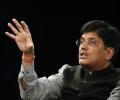
Pointing at regulation of environment sector as a case in point, Goyal said the sector suffered due to "over regulation as regulators are not able to justify many decisions"

Power Grid Corporation (PGCIL) intends to ramp up its capex substantially through the next two financial years. The Public Sector Undertaking (PSU) utility posted flat consolidated revenues of Rs 10,700 crore in the third quarter of the current financial year (Q3FY24) and reported 7 per cent year on year (Y-o-Y) growth in net profit to Rs 4,000 crore. The Q3FY24 capex stood at Rs 3,440 crore and capitalisation at Rs 1,780 crore, taking the 9MFY24 total to Rs 8,700 crore capex and Rs 5,800 crore capitalisation, respectively.
The Central Electricity Regulatory Commission, the nation's Power regulator, has allowed Ratnagiri Gas and Power Private Ltd, the new owner of Dabhol power project, to sell electricity to Maharashtra government.
Power plant load factors are at historic lows of around 60 per cent.
Regulator sets up panel to work out compensatory rates in a month; stocks of all power firms light up

On paper, only 8,000 villages remain to be electrified in the country, but the situation on the ground shows euphoria over numbers is misplaced
Government auditor CAG has rapped five regulators, including Sebi, Irda and PNGRB, for keeping their surplus funds worth over Rs 2,142 crore collected through fee and penalty outside the government accounts.

Regulator's nod assumed more importance after the Maggi issue.

While power utilities and traders have generally welcomed the Central Electricity Regulatory Commission's draft regulations on renewable energy certificates (RECs), they have warned that the short supply of renewable energy (RE) may encourage speculative activity and volatility in the already tight market.
The Central Electricity Regulatory Commission on Tuesday said it was pressing the Centre for introducing open competitive bidding for power projects and indicated that it may review norms for returns.
The power tariff will rise by Re 1 a unit due to hike in gas prices, Sushil Kumar Shinde, Union Minister of Power said.
In a major blow to Reliance Energy's plans to expand its business in power sector, the Central Electricity Regulatory Commission has rejected the application of the Anil Ambani-controlled company for a transmission licence.

Delhi faces a severe financial crunch and the deficit is largely due to numerous welfare schemes without adequate revenue flowing in. The success of welfare schemes and electoral promises will need careful financial planning and out of the box thinking to whip up additional revenue, notes Ramesh Menon.

The court's direction came after being informed that the Ministry of Defence has granted the approval for electricity connections to the migrants living in north Delhi's Adarsh Nagar area.

The Central Electricity Regulatory Commission (CERC) has said the first 660-Mw unit of Reliance Power's 3,960-Mw Sasan ultra mega power project (UMPP) could not achieve its "full load" in March 2013 and rejected the company's plea to appoint an independent technical committee to look into the readiness of that unit.
JNU vice chancellor M Jagadesh Kumar, whose tenure was marred by controversies, has been appointed as chairman of the University Grants Commission.
NTPC has served notice of power suspension from February 11 to BSES Rajdhani, an electricity distributor in the national capital, due to payment issues.
The government's agenda also includes the Cryptocurrency and Regulation of Official Digital Currency Bill, 2021.

The decision would help provide ease of doing business and also lead to larger FDI inflows contributing to growth of investment, income and employment.

To bring in transparency and curb corruption, the government has put in place a Public Services Guarantee system in the state.
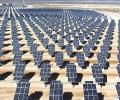
The idea is to set up renewable energy generation capacity, including both solar and wind, along with the associated evacuation infrastructure, at a mega scale in the four Indian deserts -- Thar in Rajasthan, Rann of Kutch in Gujarat, Lahul & Spiti in Himachal Pradesh and Ladakh in Jammu & Kashmir.

The Supreme Court on Monday asked Delhi Chief Minister Arvind Kejriwal and Lieutenant Governor V K Saxena to rise above 'political bickering' and discuss who could head the national capital's power regulator Delhi Electricity Regulatory Commission (DERC), saying the two constitutional functionaries should get down to 'serious work of governance' away from glare of publicity.
