
Chinese President Xi Jinping's first visit to India in seven years for the BRICS Summit and bilateral talks with Prime Minister Narendra Modi is set to address crucial aspects of India-China relations, including trade, investment, and persistent border tensions.

Chinese President Xi Jinping is in New Delhi for the 18th BRICS Summit, where he is scheduled to hold bilateral talks with Prime Minister Narendra Modi. This visit, his first to India in nearly seven years, comes amidst efforts to normalise India-China relations following the 2020 Eastern Ladakh standoff and is expected to have significant implications for bilateral ties and BRICS cooperation.

During the 18th BRICS Summit in New Delhi, Chinese President Xi Jinping and Prime Minister Narendra Modi held a bilateral meeting, outlining a four-point approach for the steady and long-term development of China-India relations. The leaders stressed strategic understanding, win-win cooperation, mutual respect, and inclusive multilateral engagement, reaffirming their commitment to resolving the boundary question and addressing economic concerns. They also discussed global challenges and strengthening people-to-people ties.
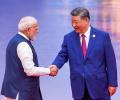
A senior Chinese Communist Party official stated that the meeting between Prime Minister Narendra Modi and President Xi Jinping was fruitful, leading to a new consensus on developing bilateral relations. Both countries aim to enhance cooperation and manage differences.
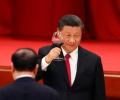
A high-profile conclave of the ruling Communist Party of China (CPC) has adopted a "landmark resolution" of the party's major achievements in the last 100 years besides paving the way for a record third term for President Xi Jinping next year.

Doval briefed his counterparts in the United States, United Kingdom, Saudi Arabia and Japan about India's missile strikes against terror infrastructure in Pakistan and Pakistan-occupied Jammu and Kashmir. He also established contact with Russia and France, officials said.

China's ruling Communist Party on Monday unveiled a new generation of leadership, including Xi Jinping and Li Keqiang, as members of the key Central Committee of CPC to lead the party and country for the next five years.

Xi, 68, holds China's all three power centres -- General-Secretary of the CPC, Chairman of the powerful Central Military Commission which is the overall high command of the military, and the Presidency is set to complete his second five-year tenure next year.

China would strive to build a fair market system to attract more overseas investment, vice premier Zhang Dejiang told a gathering of CEOs in Beijing.

The Central Committee members on Sunday elected a 25-member Political Bureau which picked the Standing Committee members to govern the country.
President Xi Jinping, who has been occupying the top post since 2012, was unanimously chosen as a delegate to the ruling party's 20th national congress at the CPC Guangxi regional meeting on April 22.
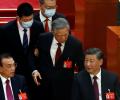
Hu, 79, sitting next to President Xi Jinping in the front row with other top leaders at the ornate Great Hall of People was persuaded to leave the meeting by two men, presumably security guards.
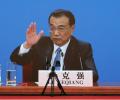
Chinese Premier Li Keqiang, who is at the helm of managing the country's economy for a decade, said that he will be stepping down this year, setting in motion the once-in-a-decade sweeping leadership change in the Communist country.
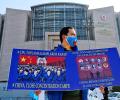
A top leader of the ruling Communist Party has asked China's over 25 million Muslims to "uphold the banner of patriotism" and reorient Islam to adapt to Chinese conditions, amid Beijing's diplomatic offensive to counter a damning UN report accusing it of serious human rights violations against Uygur Muslims.
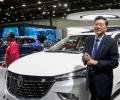
The announcement was a surprise as the new administration to be headed by the new Premier is scheduled to take over during the annual Parliament session slated to be held from March 5 next year.

Chinese President Xi Jinping is all set for an unprecedented third five-year term as he was 'elected' to the powerful Central Committee of the ruling Communist Party on Saturday while several top leaders including Premier Li Keqiang have been left out in the major shake-up at the top.
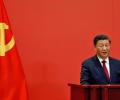
Xi's ascent to power and the quick consolidation of his leadership of the party with a shock anti-graft campaign securing the title of the "core leader" of the party bequeathed only to Mao has indeed forced his rivals in the party to submission and caught the attention of the world.

The China-brokered deal between Iran and Saudi Arabia to revive diplomatic ties should not be a matter of concern for India as the pact would provide regional stability and would be beneficial for New Delhi's interests as well, Iranian ambassador Iraj Elahi said on Friday.
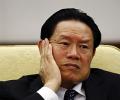
Zhou Yongkang, one of China's top leaders in the previous Hu Jintao's regime, has been charged with trading power for sex, adultery and leaking state secrets.

Recent IMF forecast said China's growth is expected to slow down.

The keynote address will be given by United States President Donald Trump

Modi also said the people of India felt proud that President Xi has twice received him out of the capital.

As India rises, creating niche areas for itself in the Asian landscape, China and India are bound to step on each other's vital areas of importance, says Srikanth Kondapalli.

India and China on Friday agreed to set up a dedicated communication channel to boost security cooperation as Home Minister Rajnath Singh held talks with China's security czar on issues like cross border terrorism from Pakistan and the Afghan situation.
