
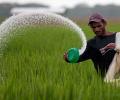
The government on Wednesday raised the minimum support price (MSP) for paddy by 5.35 per cent to Rs 2,300 per quintal for the 2024-25 kharif marketing season. The hike in paddy support price comes despite the government sitting on surplus rice stocks, but it is significant ahead of elections in states like Haryana, Maharashtra, Jharkhand, and Delhi.
The government's main rate setting panel suggested that this be done in two tranches of Rs 2,500 each in the kharif and rabi seasons.

Economist Abhijit Sen, a former Planning Commission member and one of the country's foremost experts on rural economy, died on Monday night. He was 72.

Farmers leaders taking part in the 'Delhi Chalo' agitation on Monday rejected the Centre's proposal of procuring pulses, maize and cotton at MSP by government agencies for five years, saying it was not in farmers' interest and announced that they will march towards the national capital on Wednesday.

'Farmers have been sent notices in which the government is threatening that if you will join the movement, then we will impound your ancestral properties.' 'We will seal your bank accounts.' 'We will revoke the passports of your kids.'

Hazare appreciated farmers' protests at the borders of Delhi saying no violence has taken place in the last 10 days of the agitation.

Data shows that the current system of decentralised marketing and centralised procurement helps Punjab and Haryana farmers the most, while its efficacy in other states has been poor. Experts and farm leaders say success of the laws rests heavily on implementation.

The panel suggests family head must be valued at skilled wage rates.

The minimum support price for the rabi season will not radically alter the falling trajectory of farm incomes

The agriculture sector is likely to grow in the range of 5.2-5.7 per cent in 2013-14, nearly three times more than the last year as good monsoon has raised the prospects of bumper harvest, a CACP discussion paper said.

The provision of consultation with the states has further created confusion on MSP

According to a decision taken by the Cabinet Committee on Economic Affairs, the Commission on Agricultural Costs and Prices will consider the above elements while recommending the MSP. The CACP, an advisory body under the agriculture ministry, recommends MSPs of over 20 crops, including wheat and rice.
Announcing the decision after the meeting of the Cabinet Committee on Economic Affairs, Finance Minister P Chiadambaram said this is an ad-hoc measure and the recommendation of Commission for Agricultural Costs and Prices has been referred to the Prime Minister's Economic Advisory Council. The CACP had recommended the paddy MSP at Rs 1,000 per quintal for 2008-09 Kharif season.
The standing committee on agriculture has criticised the government's criteria of fixing the Minimum Support Price for the farmers
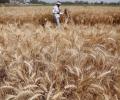
The decision will help farmers earn an additional income of Rs 62,635 crore
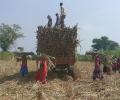
Nitin Tyagi is a young farmer in Budhagaon village of Baghpat district of Uttar Pradesh. A few years ago, Tyagi left his fairly lucrative job in the medical industry and shifted base to his ancestral village to look after his land and property. He opened a small shop selling farm inputs in the village and also started taking a greater interest in agricultural matters which had so far been looked after by his father and uncles. Tyagi and his brothers primarily grow sugarcane, potato and wheat on nearly 10 acres of land with sugarcane taking up most of his time and effort. Being one of the most important and lucrative cash crops of the region, sugarcane is directly linked to the fate of millions of farmers in west UP and with it, the electoral fortunes of political parties seeking their votes in the coming assembly polls.

He said though there was a "ray of hope", certain issues he had flagged remained unresolved.

Food subsidy bill rises 20% in April-January

Hazare, 81, had started his indefinite fast on January 30 over appointment of anti-corruption watchdogs.
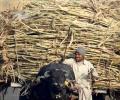
Sugarcane, which is grown by no more than 1.1 million farmers, consumes 70 per cent of water available in Maharashtra for irrigation. In contrast, about 10 million jowar, pulses and oilseeds farmers get only 10 per cent of irrigation water, points out Abhishek Waghmare.
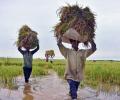
The government has also extended till August 31 the repayment date of short-term crop loan of up to Rs 3 lakh for agriculture and allied activities. The decision, taken by the Cabinet headed by Prime Minister Narendra Modi, will give respite to farmers and also help them take a call on which kharif (summer) crop to grow as sowing picks up with the arrival of southwest monsoon.

The decision, taken by the Cabinet Committee on Economic Affairs headed by Prime Minister Narendra Modi, comes less than a year before next general election.

Critics argue that much more could have been done and that the government was slow to react to many events.

The praise comes a year after Prime Minister Narendra Modi termed it a 'monument of UPA's failures'.
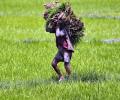
'These three commodities have been chosen very well.' 'It is up to the state governments and central government to see how it is implemented.' 'The government has to do some hand-holding.'

Experts say the Bill should include higher-value food items than just cereals

The Bill at best makes the existing public distribution system a legal right, an aspect that seems of little consequence to the lords of high finance, whose primary anxiety is the FSB-by-numbers.

A provision of Rs 15,000 crore has been made in the budgetary estimate of 2016-17 towards interest subvention.
