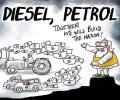
Petrol and diesel prices are unlikely to be increased despite firming raw material costs because of upcoming general elections next year, Moody's Investors Service said. Three state-owned fuel retailers -- Indian Oil Corporation (IOC), Bharat Petroleum Corporation Ltd (BPCL) and Hindustan Petroleum Corporation Ltd (HPCL) -- which control roughly 90 per cent of the market, have kept petrol and diesel prices on freeze for a record 18 months in a row. This is despite the raw material (crude oil) cost surging last year, leading to heavy losses in first half of 2022-23 fiscal year before easing oil prices propelled them to profitability.

State-owned Indian Oil Corp, Bharat Petroleum and Hindustan Petroleum are collectively losing Rs 2.65 billion (Rs 265 crore) per day on selling fuel below cost and may end the fiscal with a Rs 874.4 billion (Rs 87,440 crore) revenue loss.
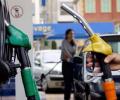
Petrol and diesel prices were cut by Rs 2 per litre each as state-owned oil companies ended a nearly two-year-long hiatus in rate revision, just hours before the general election schedule was announced.

The government is keen on getting global oil majors like Saudi Aramco and National Iranian Oil Corp on board Hindustan Petroleum and Bharat Petroleum through the market route even though privatisation of the state-run oil refining and marketing compa

The operation went on for 66 hours after a giant 120 feet x 120 feet hoarding collapsed on a petrol pump in the Chheda Nagar area during gusty winds on Monday evening, the official said.
State-run Bharat Petroleum Corp Ltd on Wednesday said it has tied up with Hindustan Lever Ltd and three other kitchenware brands for selling grocery items to its LPG customers through its distributor network.\n\n\n\n
IDBI Bank and Bharat Petroleum Corporation Ltd have inked a business-2-business e-commerce tie up aimed at customers of the latter's Rs 8,000 crore (Rs 80 billion) industrial and commercial strategic business unit.
State-run Bharat Petroleum Corporation Ltd on Monday said it is losing Rs 3 per litre on sale of diesel and Rs 2 per litre on petrol
Workers of state-owned Hindustan Petroleum Corporation Ltd and Bharat Petroleum Corporation Ltd returned to work on Friday after a three-day strike to oppose privatisation of the cash-rich oil refiners.\n\n\n\n
Bharat Petroleum Company Ltd has entered into a swap transaction worth Rs 100 crore (Rs 1 billion), making it the first interest rate derivative deal among the public sector entities in India.
Indian Oil Corporation and Bharat Petroleum Corporation have backed out of Gail's Vizag-Secunderabad LPG pipeline.
The process of divestment of HPCL and BPCL, the two public-sector oil companies, would not be set in motion till the Lok Sabha has discussed the issue, Union Petroleum Minister Ram Naik said on Saturday.

Unlike the previous visit, where TDP MPs accompanied Naidu to meetings, sources termed the current visit as "low profile", with one-on-one meetings with key Union ministers.

'Those betting against PSUs will likely be punished in this upswing.'

'They are attacking my wife; they are attacking our 13-month-old daughter. They are saying that I do drugs.' 'I'm giving an open challenge to Mr Nawab Malik and Ms Sana Malik let's go to the labs and let's do the medical test of our family and your family.'
Bharat Petroleum Corporation Ltd, the second largest oil marketing company in India, on Wednesday said it would be pumping in Rs 450 crore (Rs 4.5 billion) for retail expansion during this fiscal.\n\n
Bharat Petroleum Corporation Ltd on Thursday said it lost Rs 1,200 crore (Rs 12 billion) in the first quarter of the current fiscal due to selling petrol, diesel, LPG and kerosene below cost price.
The government has asked Supreme Court not to stay the privatisation of public sector oil majors -- Hindustan Petroleun Corporation and Bharat Petroleum Corporation
Arun Shourie, Union Minister for Divestment, said that the next meeting of the Cabinet Committee on Divestment would discuss the sell-off modalities of HPCL and BPCL.

'The Paris Olympics has once again blessed the Indian sports marketing landscape with fresh faces and promises.' 'Expect at least one biopic.'
Attorney General Soli Sorabjee has said the sale of stakes in two state-run oil refiners does not need parliamentary approval.
Bharat Petroleum Corporation Ltd will invest Rs 631 crore (Rs 6.31 billion) in extending its 609-km Mumbai-Manmad-Indore petroleum product pipeline to Piyala, near Delhi.

'He was the best court craftsman that I have ever seen who could modulate his arguments in accordance with the judge and the mood.'
Petroleum Minister Ram Naik said the terms and conditions of the strategic sale of HPCL and and public offer in BPCL would be worked out by a core group of secretaries on divestment.
Bharat Petroleum Corporation lans to invest around Rs 6,000 crore (Rs 60 billion) in the exploration and production business over the next few years.

The fire was brought under control after three hours, a Mumbai Fire Brigade official said, adding that cooling operations were underway.
Most brokerages are betting that the new government will shift to a policy focussing on boosting rural incomes and consumption since that has clearly been a pain point.
Attorney General Soli Sorabjee is likely to give by Friday his opinion on legal aspects of divestment of oil PSUs HPCL and BPCL, which were nationalised through Acts of Parliament.

The top 100 companies have accounted for 63% of the gains (Rs 51 trillion out of Rs 81 trillion), while firms beyond the top 100 have contributed 37 per cent (Rs 30 trillion).
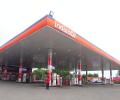
Indian Oil Corporation (IOC) on Tuesday reported halving of its March quarter net profit largely because of losses in the petrochemical business and shrinking margin after it announced a pre-election fuel price cut despite rising input costs. The net profit of Rs 4,837.69 crore in January-March compared to Rs 10,058.69 crore a year back and Rs 8,063.39 crore in the preceding October-December quarter, according to a stock exchange filing by the company.

Capital expenditure (capex) by 54 large central public sector enterprises (CPSEs) and five departmental arms with an annual capex target of Rs 100 crore and above has reached around 42.5 per cent of their annual target of about Rs 7.33 trillion in this financial year so far, a senior official from the Ministry of Finance told Business Standard. "The Centre is pushing the big public undertakings in the infrastructure and refinery sector to achieve 90 per cent of their target by the end of the third quarter," he said. The capex by this group of CPSEs stands at around Rs 3.1 trillion in the April-August period so far.
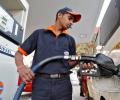
Global oil prices have slumped and India has access to larger amounts of discounted Russian crude oil, yet refiners are not passing on their savings to consumers

Benchmark indices--Sensex and Nifty--were 0.7-0.8 per cent higher from the Saturday closing. Among the widely-tracked Nifty 50 stocks, 39 advanced and the rest 11 declined at the opening bell. Among the individual stocks, Cipla, ICICI Bank, Sun Pharma, Power Grid Corp, and Bharti Airtel were the top five gainers, while Asian Paints, Hindustan Unilever, Britania, HDFC Bank, and BPCL the losers, NSE data showed. On Monday, Indian stock exchanges were closed for trading on the occasion of Pran Pratistha of Ram Temple in Ayodhya.

According to an Andhra government statement, Naidu 'reposed confidence' in the PM's leadership.
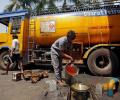
The medium-term scenario for oil marketing companies (OMCs) is high risk due to the surging crude and gas prices. Apart from OPEC-plus cutting production, the Hamas-Israel conflict has caused fears of supply disruption. The July-September quarter of 2023-24 (Q2FY24) saw positive surprises for OMCs. Strong gross refining margins (GRMs) more than offset weak marketing margins.
