
Jio Platforms' quietly sustained investments in building its "non-connectivity" service business - which included a bevy of acquisitions of companies and platforms in media, entertainment, and technology startups - are slowly generating revenues. Non-connectivity revenues of Jio Platforms have now risen 36 per cent year-on-year in the fourth quarter (Q4) of 2024-25 (FY25) to about Rs 3,968 crore, compared with Rs 2,912 crore in the same quarter the previous year.

Reliance Industries has put together an aggressive plan to build its drone business which includes expanding manufacturing capacity five-fold, participating in the new drone production linked incentive scheme, and experimenting with limited logistics payloads to deliver goods. The target is to become a key player in the expected $5 billion market in India by the end of the decade. The drone business is being carried out through a Bangalore-based start up, Asteria Aerospace, in which Reliance has taken a majority stake. Asteria is a subsidiary of Jio Platforms Ltd.

Use cases for drones are, however, immense - industrial inspections, geospatial surveys, agricultural surveys, and general surveillance and security.

An opportunity to enter a burgeoning sector at a low valuation and favourable policies are propelling some of India's largest corporate groups to scoop up drone start-ups. "Indian corporations lost the race in aerospace and space tech. "No one wants to miss the bus this time. "These are seasoned businessmen and they realise that the market cap of tech companies with problem-solving capabilities will exponentially rise in future," says Vipul Singh, CEO of Aarav Unmanned Systems (AUS).

The number of forms to be filled to operate drones in the country have been reduced to six in draft 'Drone Rules, 2021' in comparison to 25 forms mentioned in the Unmanned Aircraft System (UAS) Rules, 2021, it said.
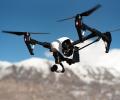
There's a need to train 40,000 pilots over the next year-and-a-half.

It came as a surprise to all stakeholders - competing telecom companies (telcos), most analysts and even the government's internal projections on revenues from the 5G auctions. Reliance Jio disrupted all calculations by paying a stiff Rs 40,000 crore to buy 10 MHz of spectrum in the 700-MHz band, globally considered a key band for efficient 5G service coverage, along with the default 3.5 GHz band and the ultra-high speed and low-latency millimetre band of 26 GHz band. So what made Jio pay almost 45 per cent of its total spend in this auction for the 700 MHz band - much more than what it rustled up even for the 3.5 GHz band?

Drones are being used for carrying out a host of tasks like surveillance to ensure that people are maintaining social distancing, spreading awareness about COVID-19 in densely populated areas, spraying disinfectants and checking people's temperature
