
Banking shares are down up to 11% after the Reserve Bank of India has increased the policy repo rate by 25 basis points from 7.25% to 7.5% with immediate effect.

Wholesale Price Index for the month ended March moderated to 3-year low of 5.96 per cent against Reserve Bank's projection of 6.8 per cent.

Use a mix of instruments that will beat both the wholesale and consumer price indices

'Everyone confuses GDP to be a measure of output, when it is actually a measure of income.'

Asked if the RBI will cut rates in its upcoming policy review, he said the central bank will definitely factor into account various developments and make an assessment of the macro economic conditions.

It can be closer to RBI's perceived comfort level.

According to the Dun and Bradstreet economy forecast while subdued demand is expected to slow down the overall inflation, upside risks to overall inflation persists from depreciation of rupee and increase in global crude oil prices.
Rupee had last ended at 54.81-level a dollar on April 5.

Benchmark shares indices ended marginally higher on Tuesday, amid a volatile trading session, led by oil exploration major ONGC.
The overall inflation in March fell to 5.96 per cent.
RBI faces contradictory signals.
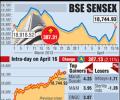
Weakness remains in IT and metal shares; Infosys continues downtrend.
.jpg)
Food prices for consumers also eased to an annual 11.06 percent in August from 11.24 per cent in July.

This increases expectations that RBI may cut rates later this month.
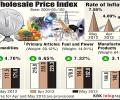
The rise in food inflation was on account of increase in prices of onions, vegetables, cereals and protein-based items.

The market breadth in BSE ended unhealthy with 1,475 shares declining and 649 shares advancing.
Food inflation, as measured by Wholesale Price Index, stood at 10.60 per cent in the previous week.

However, so far only 16 states have amended their Acts based on the model provided by the centre.

In its monetary and macroeconomic development report, RBI has raised hopes of a rate cut but also flagged some challenges.
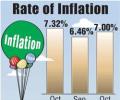
Food prices rose 18.19 per cent year-on-year in October, slower than an annual rise of 18.4 per cent in September.
Fitch Ratings said with GDP growth of 6.5% and WPI-based inflation of 8.8%, India may have entered into a stagflation period in 2011-12.

'If you see the composition of items which are causing this spike in prices, most of them have little to do with the kharif harvest, except for pulses and vegetables to some extent.' 'I don't know on what basis the government is claiming that food prices will moderate in the weeks to come.'

Though it eased slightly, prices of food items like rice, wheat pulses and potato showed a rise.

Declining price of vegetables pulled down inflation to over three-year low of 5.96 per cent in March, core inflation moderated to 3.5 per cent and food price inflation also eased to 8.2 per cent, which is likely to prompt the RBI to consider a rate cut in its annual monetary policy next month.

Inflation based on the Wholesale Price Index (WPI) stood at 6.84 per cent in February. In March, 2012, it was 7.69 per cent.
According to Morgan Stanley, high government deficit and strong growth in rural wages (which is growing at around 20 per cent year-on-year for last three years) are key factors keeping inflation expectations high.

Retail inflation measured by the consumer price index has risen sharply across food and non-food constituents, including services, keeping inflation expectations high, the Reserve Bank of India said in its Second Quarter Review of Monetary Policy 2013-14.
Inflation data for June has not brought any cheer to the markets. From this data, the possibility of a rate cut is negligible. Deficient monsoons and higher food prices would make any rate action difficult.
However, some experts also feel that there is a case for front-loading of interest rate cut to give a push to the economy

The WPI number follows retail inflation (CPI) data, which had slipped to a record low of 3.78 per cent in July.

Rajan has been facing continuous attacks by Bharatiya Janata Party MP Subramanian Swamy and some other sections, who have alleged that he has failed to lower interest rates and boost the economy

The benchmark indices ended higher on Tuesday, amid firm global cues, led by banks as lower inflation in July raised hopes of a rate cut by the central bank. Gains in index heavyweight Reliance Industries also boosted sentiment. The Sensex ended at 17,728, up 95 points and the 50-share Nifty jumped 32 points to close at 5,380.

The NSE Nifty too breached the 11,500-level with a jump of 145.30 points.
The key short-term lending rate (repo rate)has been hiked by 0.25 pc to 7.50 pc.
With the average WPI-based inflation at 7.5% and CPI-based one above 10%, a bit of aggression is required to beat inflation. Four experts give their views.
Inflation moved up to 7.23 per cent in April on account of spurt in prices of vegetables, meat, milk and pulses, although onion and fruits showed a declining trend.

Soft crude prices will cut fuel subsidy bill and help contain fiscal slippage this year.

In the mid-quarter review on December 18, the Reserve Bank left key policy rates unchanged but said it will hike interest rates if inflation does not subside.
The latest numbers are the lowest since December 2009 when headline inflation was at 7.15 per cent.
The common man will get no respite from rising prices for another six months, with the government on Wednesday saying that inflation, currently hovering above 9 per cent, will continue to remain high till December.
