
Global media watchdog Reporters Without Borders (RSF), which publishes a yearly report on press freedom in countries across the world, had last year ranked India at 150 in a survey of 180 countries.
The minister said the government was committed to ensuring the right to freedom of speech and expression enshrined under Article 19 of the Constitution.

Attacks against journalists by supporters of ruling Bharatiya Janata Party increased in the run-up to general elections in the spring of 2019, the analysis alleged.

In the list of 180 countries mapped, India stands at 136, down from last year's 133, colour-coded again in red to show the situation as "difficult".

'Parsis are inclined towards people who work for the welfare of others.'

France-based media rights organisation Reporters Without Borders issued its annual press freedom index for 2010, in which India dropped 17 positions and was ranked at 122 among the 178 ranked countries.

The entire operation was meant to have a chilling effect on independent journalists, those not completely subservient to the regime, the small section still doing what the Fourth Estate should do -- raising questions to those in power.

No lives were lost after cyclone Biparjoy made landfall. Preparations for Biparjoy were not only extensive, they were also telecast far and wide. Ahead of the cyclone's landfall, Shyam G Menon observes there was considerable publicity on how much the government was geared up to face the storm and its aftermath.
The annual Reporters Without Borders analysis attributed the decline in index to "pressure on the media to toe the Hindu nationalist government's line."

The report shows that there has been a deep and disturbing decline in respect for media freedom at both the global and regional levels.
The nation ranked 138 among 180 countries, according to the annual World Press Freedom Index report.

Information technology industry veteran V Balakrishnan on Thursday criticised the new digital rules, alleging that they appear to be unduly compromising the privacy right of citizens. The two key issues with the new IT rules relate to user privacy, which is a fundamental right, and the oversight mechanism lying fully with the executive arm of the government, said the former chief financial officer of Bengaluru-headquartered IT major Infosys Ltd.
'Laws have been used in a way to serve the needs of the current regime and its authoritarian ideology.'
Besides the Ministry of Information and Broadcasting, a bench of Chief Justice S A Bobde and Justices A S Bopanna and V Ramasubramanian also issued notices to the News Broadcasters Association, the News Broadcasting Standards Authority of India and the Press Council of India on the PIL filed by Delhi-based lawyer Reepak Kansal.

The government is attempting everything it can to make sure that this does not happen, observes Aakar Patel.
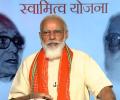
Now we must first compete with Bangladesh. This is not what we had been promised, notes Aakar Patel.
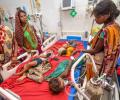
A free press is not necessarily an unbiased press. The media curates what it presents to the public, and that curation is driven by multiple considerations, argues Devangshu Datta.
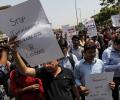
The government of UP has made it a habit of sorts to move against -- or better still, lock up -- mediapersons who give cause for displeasure, says Shuma Raha.

'I criticise the interference of the army in politics.' 'But the people know I am not anti-Pakistan.' 'Public support is my biggest strength.'

The India body said there was a "lack of clarity" on the inputs that weighed in the rankings which were based on "opinion or perception".
 © 2026 Rediff.com - Investor Information - Advertise with us - Disclaimer - Privacy Policy - Sitemap - Feedback - About us - Terms of use - Grievances