
'After the Galwan clash, the rules of engagement changed with the army commanders allowed to use any means at their disposal as they deem fit for tactical operations.'

The IMF on Monday raised India's growth projection to 7.3 per cent for fiscal 2025-26, up 0.7 percentage point from its October forecast, on the back of better-than-expected performance of the economy. The Washington-headquartered multilateral lending agency has also revised India's Gross Domestic Product (GDP) growth forecast to 6.4 per cent for fiscal year 2026-27 beginning April 1, 2026, from its earlier estimate of 6.2 per cent.

India is projected to grow at 6.4 per cent in fiscal year 2025 and 2026, and the country's stable growth is driven by a reform momentum supporting robust consumption growth and a push for public investment, the International Monetary Fund has said. The IMF released its World Economic Outlook (WEO) Update on Tuesday.
NITI Aayog member Arvind Virmani on Monday said India is set to become the fourth largest economy in the world by the end of 2025, an assertion which came days after NITI CEO BVR Subrahmanyam claimed India has already overtaken Japan to reach that spot. The International Monetary Fund (IMF), in its World Economic Outlook (WEO) report released in April had said that India is expected to be the fourth largest economy in the world with a GDP of $4.19 trillion in 2025, ahead of Japan.

The Indian economy is projected to grow at 6.2 per cent in 2025-26, slower than earlier estimated rate of 6.5 per cent, due to escalated trade tensions and global uncertainty, the International Monetary Fund (IMF) said on Tuesday. "For India, the growth outlook is relatively more stable at 6.2 per cent in 2025, supported by private consumption, particularly in rural areas," IMF said in its World Economic Outlook (WEO).

Led by a sharper-than-expected deceleration in industrial activity, economic growth in India slowed more than anticipated and is projected to remain at 6.5 per cent till 2026, the International Monetary Fund said on Friday. "Growth in India slowed more than expected, led by a sharper-than-expected deceleration in industrial activity," the IMF said in its latest update of the World Economic Outlook, according to which the global economy is holding steady. In 2023, India's growth rate was 8.2 per cent, which dropped to 6.5 per cent in 2024.

India's GDP growth is likely to moderate from 8.2 per cent in 2023 to 7 per cent in 2024 and 6.5 per cent in 2025 because the pent-up demand accumulated during Covid has exhausted, as the economy reconnects with its potential, the International Monetary Fund (IMF) said on Tuesday. About the global economy, the IMF said the battle against inflation has largely been won, even though price pressures persist in some countries.
India no longer needs big ticket reforms but small and basic ones to drive the growth forward, Chief Economic Advisor V Anantha Nageswaran said on Monday. Addressing the media after the Economic Survey 2023-24 presented in Parliament, Nageswaran said there is a need to pursue all possible approaches without any ideological orientation. "In terms of the kind of reforms that we need to do, it is no longer big-ticket reforms that dominate your front pages but more about grunt works.

'Whether I am optimistic or pessimistic is not the issue; I am just going by the evidence available.' 'The Indian economy and financial sector are now well-placed and very resilient in dealing with any kind of spillover coming from the external world.'
Citing various macroeconomic parameters that are doing pretty well, India's G20 Sherpa and former CEO of Niti Aayog Amitabh Kant projected that the country is all set to overtake Japan as 4th largest economy in the world by 2025. The size of India's GDP is currently ranked 5th, after the US, China, Germany, and Japan. It overtook the UK in 2022.

The Reserve Bank of India's (RBI's) state of the economy report observed that any durable alignment of headline retail inflation with the target of 4 per cent could recommence in the second half of FY25 and sustain until numbers closer to the target are seen during the course of FY26, dashing hopes of any reduction in the policy repo rate in the current financial year. The report, authored by RBI staffers, including Deputy Governor in charge of monetary policy Michael Patra, said though headline numbers may fall in July and August due to base effect, it is likely to reverse in September.

The IMF on Tuesday projected a growth rate of 6.1 per cent for India in 2023, which is a 0.2 percentage point upward revision compared with the April projection. This is reflective of the "momentum" from stronger-than-expected growth in the fourth quarter of 2022 as a result of stronger domestic investment, the International Monetary Fund (IMF) said. "Growth in India is projected at 6.1 per cent in 2023, a 0.2 percentage point upward revision compared with the April projection," it said in its latest update of the World Economic Outlook.

In FY23, Indian operations accounted for 41.6 per cent of the consolidated revenue of India's top five multinationals, up from 34 per cent in FY18 and 33.2 per cent and 34.2 per cent in FY21.
The International Monetary Fund (IMF) on Tuesday lowered India's economic growth projection for the current fiscal to 5.9 per cent from 6.1 per cent earlier. Yet India will continue to be the fastest-growing economy in the world. In its annual World Economic Outlook, IMF also lowered the forecast for 2024-25 fiscal (April 2024 to March 2025) to 6.3 per cent from the 6.8 per cent it had predicted in January this year. The growth rate of 5.9 per cent in the 2023-24 fiscal compares to an estimated 6.8 per cent in the previous year.

The International Monetary Fund (IMF) on Tuesday said it is expecting some slowdown in the Indian economy next fiscal year and projected the growth to 6.1 per cent from 6.8 per cent during the current fiscal ending March 31. The IMF on Tuesday released the January update of its World Economic Outlook, according to which the global growth is projected to fall from an estimated 3.4 per cent in 2022 to 2.9 per cent in 2023, then rise to 3.1 per cent in 2024. "Our growth projections actually for India are unchanged from our October Outlook.
India decisively withstood global headwinds in 2023 and is likely to remain as the world's fastest-growing major economy on the back of growing demand, moderate inflation, stable interest rate regime and robust foreign exchange reserves. Despite widespread pessimism witnessed among the developed nations and the worsening geopolitical situation, India recorded a gross domestic product (GDP) expansion of 6.1 per cent in the March quarter. The growth moved up to 7.8 per cent in the June quarter and was 7.6 per cent in the September quarter. For the first six months of this fiscal, the growth was 7.7 per cent.

'To the believers of crypto regulations, I have only one question to ask, how will you regulate it?'

A recession is unlikely in the APAC region in the coming year, although the area will face headwinds from higher interest rates and slower global trade growth, Moody's Analytics said on Thursday. In its analysis titled 'APAC Outlook: A Coming Downshift', Moody's said India is headed for slower growth next year more in line with its long-term potential. On the upside, inward investment and productivity gains in technology as well as in agriculture could accelerate growth.

The International Monetary Fund (IMF) on Tuesday slashed India's growth forecast for 2022-23 (FY23) by 80 basis points to 7.4 per cent, citing less favourable external conditions and rapid policy tightening by the central bank. In its update to the April World Economic Outlook, the IMF said that though a global recession in 2022 was ruled out with a growth estimate of 3.2 per cent, the balance of risks was squarely to the downside, driven by a wide range of factors that could adversely affect the global economic performance. "The risk of recession is particularly prominent in 2023, when in several economies growth is expected to bottom out, household savings accumulated during the pandemic will have declined, and even small shocks could cause economies to stall.

The International Monetary Fund (IMF) has said India and China will account for half of the global economic growth in 2023, as the multilateral agency retained its growth forecast for Asia's third-largest economy for 2023-24 (FY24). "India remains a bright spot. Together with China, it will account for half of global growth this year, versus just a tenth for the US and euro area combined," the IMF said in its latest update to the biannual World Economic Outlook. Growth in India is set to decline from 6.8 per cent in 2022 (FY23) to 6.1 per cent in 2023 (FY24) before picking up to 6.8 per cent in 2024 (FY25), the global lender said while citing "resilient domestic demand despite external headwinds".

India's economy continues to be robust, but downside risks such as rising crude oil prices, adverse weather conditions, and the global banking crisis outweigh the upside potential in gross domestic product (GDP) growth in the current financial year (FY24), the finance ministry said on Tuesday in its Monthly Economic Review for March. "We reiterate that downside risks to our official forecast of 6.5 per cent for real GDP growth in FY24 dominate upside risks," the review said. "Opec's surprise production cut has seen oil prices rise in April, off their lows of low-seventies per barrel in March.

Ahead of the 2023-24 Union Budget, the thinking at the top level of the central government is clear: Gross domestic product (GDP) growth of 6-6.5 per cent is a comfortable enough target for FY24 and the focus should be on fiscal consolidation to ensure that the sovereign cost of borrowing does not become prohibitively expensive in a high-interest rate environment, according to people in the know. Those aware of deliberations between the Prime Minister's Office (PMO) and the Ministry of Finance said while the Budget would look to strike a balance between infrastructure investment and welfare schemes, it is unlikely to be populist, though it will be the last full-year Budget before the 2024 Lok Sabha election. Incidentally, 6-6.5 per cent GDP growth is what the upcoming 2022-23 Economic Survey is expected to project for FY24.

The first five months of 2023 have witnessed at least six major events/trends that augur badly for global economic and socio-political prospects, points out Shankar Acharya, former chief economic adviser to the Government of India.

Indian policymakers are almost alone, alongside the United States, in seeking a hard and multi-sectoral global decoupling from China in the expectation that it will boost their economies, observes Mihir S Sharma.
The Economic Survey 2022-23 (FY23), to be presented a day before Union Budget 2023-24 (FY24), is likely to project India's real gross domestic product (GDP) growth between 6 per cent and 7 per cent for FY24, Business Standard has learnt. The broader theme of the Survey could be on how India has dealt with two years of a global pandemic and the ongoing geopolitical disturbance, the strengths and weaknesses that emerged, and what lessons may be learnt. The much-awaited Survey will be the first one by Chief Economic Advisor V Anantha Nageswaran and his team in the finance ministry's economic division.
The International Monetary Fund (IMF) on Tuesday cut its projection of India's economic growth in 2022 to 6.8 per cent, as it joins other global agencies that have trimmed forecasts. The IMF had in July projected a gross domestic product (GDP) growth of 7.4 per cent for India in the fiscal year that started in April 2022. Even that forecast was lower than 8.2 per cent projected in January this year. India had grown at 8.7 per cent in 2021-22 fiscal (April 2021 to March 2022).

'We should look at is full year's growth rather than quarter numbers.'

Ahead of the Union Budget for 2023-24, Budget makers have welcomed the global consensus view that India will remain one of the bright spots in calendar year 2023. But there is some alarm over the grim global situation and how that might impact the Centre's projections and assessments for next financial year. The big global headwinds include a deep and sustained recession in the West, including India's biggest trading partners in North America and Europe, continuing volatility in commodity markets, and renewed Covid-19 fears, as lifting of strict curbs by China could potentially lead to a massive spread again.

India's growth projection released by the latest World Economic Outlook remains unchanged from its previous WEO (World Economic Outlook) update of July this summer but is a three-percentage point in 2021 and 1.6 percentage point drop from its April projections. According to the latest WEO update, released ahead of the annual meeting of the IMF and the World Bank, the world is expected to grow at 5.9 per cent in 2021 and 4.9 per cent in 2022.

The International Monetary Fund (IMF) said on Thursday that a multilateral response is critical to overcome the COVID-19 pandemic in India and globally as it hailed recent announcements by several countries to provide immediate support to India. India is struggling with a second wave of the pandemic with more than 300,000 daily new coronavirus cases being reported in the past few days, and hospitals are reeling under a shortage of medical oxygen and beds.

Eminent economist Arvind Panagariya has said India is on the cusp of returning to a high growth trajectory and voiced confidence that the country will become the world's third-largest economy by 2027-28. Currently, India is the fifth largest economy "so it's another five years.We are already in (the year) 2023. "So 2027-28, India should be the third-largest economy," Panagariya, Columbia University Professor and former Vice Chairman of NITI Aayog, told PTI in an interview in New York.

India has been relatively insulated from the severe headwinds in the West. However, with a third of the global economy expected to slip into recession in calendar year 2023, the impact will strongly be felt on India's exports and trade economy, leading economists said in a panel discussion at the Business Standard BFSI Insight Summit in Mumbai on Wednesday. The panel comprised former Reserve Bank of India executive director and former Monetary Policy Committee member Mridul Saggar, State Bank of India Chief Economic Advisor Soumya Kanti Ghosh, Citibank India Chief Economist Samiran Chakraborty, ICRA Chief Economist Aditi Nayar, and IndusInd Bank Chief Economist Gaurav Kapoor. The topic of the panel discussion was No recession in sight: Is India decoupled from developed economies?

India's growth in the last three financial years has averaged just 1.9%. It is natural to project rapid growth from this low base. Crucial to that would be the assumption that the economy has suffered no lasting damage from the pandemic, observes T N Ninan.

Gandhi took a swipe at the government on Twitter by tagging a chart that showed IMF growth projections for 2020-21 for Bangladesh, Myanmar, Nepal, China, Bhutan, Pakistan, Sri Lanka, Afghanistan and India.

The IMF on Tuesday projected an impressive 12.5 per cent growth rate for India in 2021, stronger than that of China, the only major economy to have a positive growth rate last year during the COVID-19 pandemic. The Washington-based global financial institution, in its annual World Economic Outlook ahead of the annual Spring meeting with the World Bank, said the Indian economy is expected to grow by 6.9 per cent in 2022. Notably in 2020, India's economy contracted by a record eight per cent, the International Monetary Fund (IMF) said as it projected an impressive 12.5 per cent growth rate for the country in 2021.

Pakistan was "drowning" in debt and it was the new government's job to "sail this ship ashore," Prime Minister Shehbaz Sharif said on Wednesday.

Gita Gopinath, the IMF's Indian-American chief economist has been promoted as its First Deputy Managing Director recognising her exceptional intellectual leadership in helping the global economy and the Fund to navigate the "twists and turns" of the "worst economic crisis of our lives". Gopinath would replace Geoffrey Okamoto who plans to leave the International Monetary Fund early next year, Kristalina Georgieva, IMF's managing director announced on Thursday. Gopinath, who was scheduled to return to her academic position at Harvard University in January 2022, has decided to stay, she said. Gopinath, 49, has served as the first female chief economist of the Washington-based global lender for three years.
The International Monetary Fund (IMF), in its latest World Economic Outlook report, has slashed its forecast for India's FY23 gross domestic product growth to 8.2 per cent from 9 per cent, saying that higher commodity prices will weigh on private consumption and investment. This was one of the steepest cuts for emerging economies compared to the IMF's January WEO forecasts. Saying that global economic prospects have worsened significantly due to commodity price volatility and disruption of supply chains caused by the war in Europe, IMF cut its global growth outlook for calendar year 2022 to 3.6 per cent from 4.4 per cent, and said both Russia and Ukraine could experience large GDP contractions.

The International Monetary Fund has reduced India's contribution to world gross domestic product in purchasing power parity terms to 4.6 per cent in 2007 from the earlier estimate of 6.4 per cent.
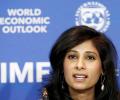
The IMF on Tuesday cut India's economic growth forecast by 0.5 percentage points to 9 per cent for the current fiscal year, with its chief economist Gita Gopinath saying that the slight downgrade is mainly due to the impact of the spread of the Omicron variant. "If you look at the 2021-22 fiscal year, we have a slight downgrade of -0.5 percentage points and for the next fiscal year 2022-23 we have a slight upgrade of 0.5 percentage points. So, growth for the previous fiscal year is now nine per cent and for this year now is at nine per cent. We moved it up slightly," Gopinath told reporters during a news conference in Washington. In its latest update of World Economic Outlook on Tuesday, the International Monetary Fund has cut India's economic growth forecast to 9 per cent for the current fiscal year ending March 31, joining a host of agencies which have downgraded their projections on concerns over the impact of the spread of Omicron on business activity and mobility.
 © 2026 Rediff.com - Investor Information - Advertise with us - Disclaimer - Privacy Policy - Sitemap - Feedback - About us - Terms of use - Grievances