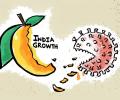
The International Monetary Fund (IMF) on Tuesday cut its economic growth forecast for India to 9.5 per cent for the fiscal year to March 31, 2022 as the onset of a severe second COVID-19 wave cut into recovery momentum. This forecast for 2021-22 is lower than the 12.5 per cent growth in GDP that IMF had projected in April before the second wave took a grip. For 2022-23, IMF expects economic growth of 8.5 per cent, larger than the 6.9 per cent it had projected in April.

However, the World Bank has projected India's GDP growth rate at 7.5 per cent for the next three financial years, including the current one.

The IMF, in its latest World Economic Outlook report, also said India is among the economies that may require more tightening to address inflation pressure.
The IMF, in its latest World Economic Outlook report, also said India is among the economies that may require more tightening to address inflation pressure.

The Indian economy, severely hit by the coronavirus pandemic, is projected to contract by a massive 10.3 per cent this year, the International Monetary Fund said on Tuesday. However, India is likely to bounce back with an impressive 8.8 per cent growth rate in 2021, thus regaining the position of the fastest growing emerging economy, surpassing China's projected growth rate of 8.2 per cent, the IMF said in its latest 'World Economic Outlook' report.
There is a significant risk that advanced economies could experience another downturn, said the World Economic Outlook report released on Thursday.
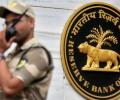
The Reserve Bank of India on Wednesday retained the economic growth projection for the current financial year at 10.5 per cent, while cautioning that the recent surge in COVID-19 infections has created uncertainty over the economic growth recovery. In its last policy review, the RBI had projected a GDP growth rate of 10.5 pc for FY'22. Taking various factors into consideration, it said, "the projection of real GDP growth for 2021-22 is retained at 10.5 per cent consisting of 26.2 per cent in Q1, 8.3 per cent in Q2, 5.4 per cent in Q3 and 6.2 per cent in Q4."

According to the BofA-ML Fund Manager Survey for January, asset allocators assigning more funds to equities than at any time since February 2011, while their confidence in the world's economic outlook has reached its most positive level since April 2010.

Other top losers in the Sensex pack included Bharti Airtel, Asian Paints, TCS, HCL Tech, Tata Steel, SBI, IndusInd Bank and Hero MotoCorp, declining up to 3.28 per cent.

The International Monetary Fund, in its latest World Economic Outlook, projected an average growth rate of about 3.8 percent in market prices for India in fiscal 2013, which is expected to pick up to 5.1 per cent next year.
'Nations like India with high inflation and public debt should be cautious'

"The challenge for many emerging and some developing economies (is) to ensure that present boom-like conditions do not develop into overheating over the coming year," the IMF said in its World economic Outlook report.
The International Monetary Fund expects India's economic growth rate to moderate to 7.5-7.75 per cent this fiscal, from 8.5 per cent in 2010-11, on account slowing investments and sluggish global recovery.
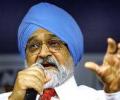
The Planning Commission on Thursday described the International Monetary Fund's growth projection of 8.8 per cent for India as optimistic and said the panel would stick to its outlook.

IMF also asked countries around the world to coordinate policies to achieve a global rebalancing and sustain the recovery.
Advanced economies are projected to grow by just 2.7 per cent in 2010 and 2.2 per cent in 2011, the IMF report said.

India is expected to grow by 8.75 per cent in 2010 and 8.5 per cent in 2011, driven by a strong domestic demand, International Monetary Fund said in its 2010 World Economic Outlook released here on Wednesday.

For the 2009-10 fiscal, Pranab said, he expects the economy to grow by 7.2 per cent.

China's GDP jumped a record 18.3 per cent in the first quarter of 2021, riding on strong domestic and foreign demand and aided by recovery from a low base in early 2020 when Covid-19 stalled the world's second-largest economy, according to statistics released on Friday.

The International Monetary Fund on Thursday retained its projection for Indian economic growth at 5.4 per cent in 2009, implying a slower growth in the second half of this calendar year.
Without accounting for refunds, however, the collection contracted 5.4 per cent, indicating muted economic activity as the Covid-19 pandemic and subsequent curbs paralysed most sectors.
If the projections come true, then India would regain the tag of the fastest growing major economy of the world, crossing China with more than 0.7 percentage point in 2018 and an impressive 1.2 percentage point growth lead in 2019.
Weaker demand for Indian exports and higher financing costs will lead to a deceleration in India's gross domestic product (GDP) growth rate to 7.9 per cent in 2008, the International Monetary Fund has said.The IMF's growth projections for India are in line with other estimates, including that of the Asian Development Bank, which pegged the 2008-09 growth at 8 per cent.
RBI Governor Shaktikanta Das and Finance Secretary Subhash Chandra Garg are also expected to attend the meetings.
The International Monetary Fund on Thursday asked India to "very carefully" look at the much-touted Special Economic Zones, saying the giveaways and tax sops to the zones could divert industrial activity from the rest of the country.
The surge in investment in manufacturing seems to have prompted the International Monetary Fund to increase the gross domestic product growth forecast to 8.4 per cent for 2007.

Investor sentiment got a boost after the IMF said India will see its growth picking up to 7.4 per cent in 2018-19 to regain the status of the world's fastest growing major economy.

'We expect a pick-up in the second half of the current fiscal. But before that, data is likely to show a further slowdown. The second quarter print is likely to be worse than the first quarter,' said a senior official.

Officers across departments and ministries have been asked to speak to people across sectors for 'SWOT' analysis of issues for revival of the economy.

"Now is the time for countries with room in their budgets to deploy -- or get ready to deploy -- fiscal firepower. In fact, low interest rates may give some policymakers additional money to spend," new IMF chief Kristalina Georgieva said.
Fund raises growth forecast to 8.3% in 2006.
There are several companies that are trading at attractive long-term valuations and are likely to provide investors with adequate returns.
The Chinese savings rate is an astounding 50 per cent of the gross domestic product, the IMF said in its latest world economic outlook.
In spite of a recent devastating money/monsoon.htm drought, India's economy has fared well and should enjoy solid growth this year and next, the IMF said.

China's economy, which suffered 6.8 per cent slump in the first quarter due to the coronavirus pandemic -- the worst in 44 years -- bounced back posting 4.9 per cent growth between July and September buoyed by the government's sweeping efforts to stimulate demand and consumption.

'The numbers are null and void now. Look, we can give out projections now, but we know that a week later those numbers will also be irrelevant. So we need to wait,' a top government official said.
International Monetary Fund has cut its 2003 global growth forecast to 3.2 per cent from 3.7 per cent due to the Iraq war and stock market declines, and is particularly worried about weak German growth.
 © 2026 Rediff.com - Investor Information - Advertise with us - Disclaimer - Privacy Policy - Sitemap - Feedback - About us - Terms of use - Grievances