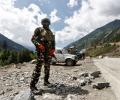
The Indian Army said the soldier, a Corporal in the Chinese People's Liberation Army(PLA), has been identified as Wang Ya Long and he will be returned to the Chinese military at the Chushul-Moldo border point after completion of formalities.

The death toll due to nCoV rose to 1,016 and the confirmed cases have gone up to 42,638, according to the commission.

"All temporary structures and other allied infrastructure created in the area by both sides have been dismantled and mutually verified. The landform in the area has been restored by both sides to the pre-standoff period," the Army said in a statement.

The frontline troops of China and India have "completed" disengagement at most locations of their border, a senior Chinese official said on Tuesday, adding the situation on the ground is easing.
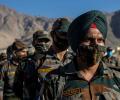
Did Xi deliver a message to Modi at Mamallapuram, which though couched in a velvet glove was time-bound? What was that message? It is clear Indian/Israeli/US spy satellites would not have missed detecting Chinese troop movements towards the Ladakh-Tibet frontier. Then why did some important functionaries in the Government of India choose to only ask the Russians about this in April 2020? Was Russian reassurance of Chinese troop movements being part of a routine exercise the reason that the Leh-based XIV Corps did not mobilise itself for its annual summer exercises near the LAC? A fascinating excerpt from Iqbal Chand Malhotra's new book Red Fear: The China Threat.

The commanders are also expected to specifically deliberate on deployment of first batch of around six Rafale fighter jets which are expected to join the IAF's fighter fleet later this month, they said.

The two sides are also expected to finalise a roadmap for restoration of peace and tranquility in the high-altitude region that witnessed an eight-week bitter standoff between the troops of the two countries.
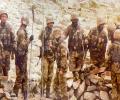
Speaking at a virtual conference of the World Economic Forum, the external affairs minister, at the same time, said the border row happens to be one part of the larger issue of how India and China adjust to each other when both are rising.

"I am very concerned about the recent situation of COVID-19 pandemic in India. On behalf of the Chinese Government and people, as well as in my own name, I would like to express sincere sympathies to the Indian Government and people," according to the message from President Xi to Prime Minister Modi.
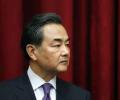
Carrying a message of "peaceful cooperation" from his President for the new Prime Minister, Chinese Foreign Minister Wang Yi on Monday exuded confidence that both the countries have the capabilities to deal properly with the contentious issues such as boundary dispute.
In a written reply to a question in Lok Sabha, Minister of State for External Affairs V Muraleedharan gave a brief account of the four-month-long standoff and said the Chinese side attempted to transgress the Line of Actual in several areas of the western sector since mid-May.

External Affairs Ministry Spokesperson Raveesh Kumar also talked about the China-Pakistan economic corridor in Pakistan-occupied-Kashmir, asserting that India is 'resolutely opposed' to any actions by other countries to change the status quo in the region.

The sources said the soldier was handed back to China at the Chushul-Moldo border point in eastern Ladakh at 10.10 am.

This will be the fourth visit of Modi to China after he came to power in 2014.
Deputy director for the People's Liberation Army Office for International Military Cooperation Major General Huang Xueping held a video conference with his US counterpart Michael Chase last week.

On the first anniversary of the deadly clashes, the army said the supreme sacrifice of the soldiers while fighting the adversary in the "most difficult" high altitude terrain will be "eternally etched" in the memory of the nation.
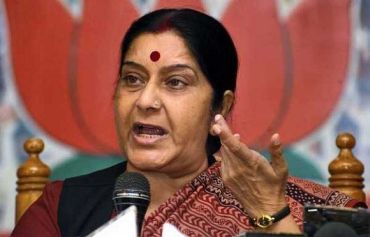
The India-Pakistan ties nose-dived in recent years with no bilateral talks taking place. The ties between the two countries had strained after Pakistan-based terror groups launched attacks in India in 2016.
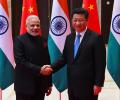
'We hope that both India and Pakistan can exercise restraint and do more to improve their bilateral relations'
China is in no hurry to disengage at the border and the region and international community is moving on. The spectre of a long haul in Ladakh haunts India, points out Ambassador M K Bhadrakumar.

A notice issued to the foreign journalists on Wednesday said they can get the Inactivated SARS-CoV-2 Vaccine, developed by Sinopharm's China National Biotec Group. Sinopharm's COVID-19 vaccine has been granted conditional market approval by China's National Medical Products Administration.
"If I was the foreign minister, I would have had contact with them. I would have gone out of my way and told my intelligence agency to make a contact quietly," former external affairs minister Natwar Singh said.

Beijing will be intently watching Washington's response for any hint of weakness. Xi Jinping, who feels China has a limited window of strategic opportunity, will be emboldened to take additional initiatives in the Indo-Pacific and specifically against India and Taiwan, warns Jayadeva Ranade, the former senior RA&W officer and China expert.
The sources said the ongoing engagement and dialogue at military and diplomatic levels have resulted in complete disengagement of troops at patrolling point 14, 15 and 17 A in eastern Ladakh.

India and China on Friday held 'in-depth' discussions on addressing the remaining issues along the Line of Actual Control (LAC) in eastern Ladakh, holding that disengagement in the North and South banks of Pangong lake provided a good basis to work towards their early resolution.
Wang and Swaraj also discussed issues relating to annual BRICS summit which will be hosted by India in Goa in October.

India on Monday did some plain-speaking with China over its blocking of the Indian bid to get JeM chief Masood Azhar banned by the UN and warned the global community of "serious consequences" if it continues to adopt "double standards" in dealing with terrorism.
The frequency of day and night operations by frontline fighter jets is a signal that India will continue to put pressure on China until the status quo ante is restored in all the areas in eastern Ladakh including Pangong Tso, Gogra and Hot Springs, government sources said.

"The message is clear. We're not going to stand by and let China or anyone else take the reins in terms of being the most powerful, dominant force, whether it's in that region or over here," White House Chief of Staff Mark Meadows told Fox News.

'Why wouldn't so strategically-minded an adversary, such as China, not militarily exploit to the maximum Indian timidity, stupidity, and cupidity all along the LAC and legitimate, as it has done so often in the past, the fait accompli of incremental territorial grabs which, by the way, is its strategy and policy as implemented on the ground?'
During their hour-long in-person meeting on the sidelines of a Shanghai Cooperation Organisation (SCO) conclave in Dushanbe on Wednesday, External Affairs Minister S Jaishankar also told his Chinese counterpart and State Councilor Wang Yi that any unilateral change in the status quo along the Line of Actual Control (LAC) was 'not acceptable' to India and that the overall ties can only develop after full restoration of peace and tranquillity in eastern Ladakh.

A deft hand on India-China relations, Bambawale earlier handled the China desk at the MEA.

However, there is no official word on whether there will be any interaction between Modi and Pakistan President Mamnoon Hussain, who is scheduled to attend the meeting in China.

Sources said Wang is primarily visiting India to hold boundary talks with National Security Advisor Ajit Doval.
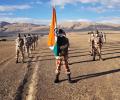
India and China on Friday agreed to hold the next round of military talks at an early date to achieve the objective of complete disengagement in remaining friction points in eastern Ladakh amid fresh sparring between the two sides on the prolonged Line of Actual Control (LAC) standoff.

Confirming the visit, Chinese foreign ministry spokesman Zhao Lijian told a media briefing on Monday that China supported scientists around the world to conduct a global study on the origins and transmission routes of the virus.

'Both sides should, therefore, focus on easing tensions in the friction areas by refraining from any actions that may lead to an escalation in the situation'
"We raced against time and were the first country to report cases to the world," Chinese foreign minister Wang Yi said in interviews to the official media over the weekend.
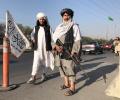
The remarks by China's deputy permanent representative to the UN, Geng Shuang, came during an emergency meeting of the Security Council on the situation in Afghanistan on Monday after the sudden and rapid takeover of the Afghanistan government by the Taliban insurgents.
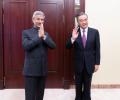
According to Jaishankar, much has changed, mostly to India's disadvantage, since November 1950, when Sardar Patel and Jawaharlal Nehru had a famous exchange of views on how to approach China.
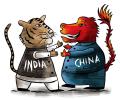
India and China achieved a major milestone this year when their bilateral trade crossed the landmark figure of $100 billion but it did not generate any fanfare in both capitals as the two Asian giants are going through a "particularly bad patch" in their relations due to a set of actions by Beijing in violation of agreements that led to the military standoff in eastern Ladakh. Starting with a modest $1.83 billion in 2001, the bilateral trade crossed $100 billion-mark in the first 11 months this year, a significant milestone for which the two countries carried out campaigns to boost trade and build it as a major stakeholder to improve the relations between two nations, whose ties otherwise remained frosty over the festering boundary dispute and strategic rivalry. According to last month's data from China's General Administration of Customs (GAC), the India-China bilateral trade totalled $114.263 billion, up 46.4 per cent year-on-year from January to November 2021.
 © 2026 Rediff.com - Advertise with us - Disclaimer - Privacy Policy - Sitemap - Feedback - About us - Terms of use - Grievances