
Vodafone-Idea is working on a multi-pronged strategy to begin its long journey to get back in the game but much hinges on how much money it can raise following the government's decision to go for equity conversion last week. Based on discussions with sources aware of the company developments and with vendors, VIL's immediate plan is to invest in increasing 4G coverage to the level of its competitors. Currently, it covers a 1 billion population with 4G while its competitors cover 1.2 billion people.

After Vodafone Idea, Tata Teleservices (Maharashtra) on Tuesday said it will opt for conversion of the interest amount on AGR dues into equity and post conversion, the government's holding in the company is expected to be around 9.5 per cent. The announcement of Tata Teleservices (Maharashtra) came within hours of Voda Idea also deciding to opt for converting the interest amount on AGR dues into government equity. In a filing to the BSE, Tata Teleservices (Maharashtra) said Net Present Value or NPV of interest is expected to be nearly Rs 850 crore as per the company's estimates, subject to confirmation by the Department of Telecom (DoT).

Rs 3,050-crore penalty on Airtel, Voda Idea gets nod. Final decision will be taken by DoT.

On the Sensex chart, Bharti Airtel was the biggest loser with nearly 3 per cent drop in its share price. It was followed by IndusInd Bank, Maruti Suzuki, HeroMoto Corp and Tata Steel.

The Cabinet approved giving Bharti Airtel, Vodafone Idea Ltd and Reliance Jio an option to avail of a two-year moratorium on payments they were supposed to make in yearly installments for the spectrum bought in auctions.
'If you are going to have only a handful of telecom players on whom the entire dream of Digital India rests, it's important they are financially sustainable.'
While in all, 15 entities owe the government Rs 1.47 lakh crore -- Rs 92,642 crore in unpaid licence fee and another Rs 55,054 crore in outstanding spectrum usage charges, it is not immediately clear just how much of that has been sought by the government by midnight.

Conversion of debt of the stressed telecom player Vodafone Idea Ltd (VIL) into equity could be an option to emerge out of the crisis, lenders led by State Bank of India (SBI) have suggested to Department of Telecommunications (DoT). DoT had called senior bank officials on Friday to discuss the stress in the telecom sector arising out of the Supreme Court order last month on the adjusted gross revenue (AGR)-related dues payable by telecom majors, including Vodafone Idea and Bharti Airtel, sources said. The top court has given a time period of 10 years to telecom service providers struggling to pay Rs 93,520 crore of AGR-related dues to clear their outstanding amount to the government.

In percentage terms, IndusInd Bank, SBI, HDFC, ICICI Bank and L&T were among the top losers. On the contrary, Bharti Airtel, Reliance, Sun Pharma, HCL Tech and Maruti Suzuki emerged as major gainers.
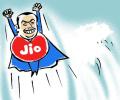
Reliance Jio's aggressive target to reach 100 million households through the launch of the 5G fixed wireless access (FWA) could make it one of the world's largest players in this space. But this also marks a change from its earlier strategy of offering fibre-to-the home (FTTH) broadband to households. Despite its best efforts, in two years Jio has been able to connect only 7 million households with FTTH, as permission for right of way for the last mile became a major impediment and the process of laying ducts for the roll-out was slow and cumbersome.
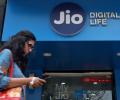
India's first auction of telecom spectrum in five years ended on Tuesday with Rs 77,814.80 crore of airwaves being bought, mostly by billionaire Mukesh Ambani's Reliance Jio. Over 2,250 MHz of spectrum, that carry telecom signals, in seven bands worth nearly Rs 4 lakh crore at the reserve or start price, was offered for bidding in the auction that began on Monday. Telecom secretary Anshu Prakash said 855.60 MHz of spectrum was bought for Rs 77,814.80 crore in the two-day auction.

Telecom operator Bharti Airtel on Monday announced 20-25 per cent tariff hikes for various prepaid offerings, including tariffed voice plans, unlimited voice bundles and data top-ups, and said the new rates will come into effect from November 26. The entry-level tariffed voice plan has been raised by about 25 per cent, while for unlimited voice bundles, the increase in most cases is about 20 per cent. Sunil Mittal led telco -- whose India mobile customer base stood at about 323 million at the last count -- has also increased the tariffs for data top-up plans by about 20-21 per cent

Commercial 5G services will be rolled out in 13 cities in India, including the metropolises, in 2022, the Department of Telecommunications (DoT) said in a statement on Monday. These cities are Delhi, Gurugram, Mumbai, Pune, Chennai, Kolkata, Bengaluru, Hyderabad, Chandigarh, Lucknow, Ahmedabad, Gandhinagar, and Jamnagar. "These metros and big cities would be the first places for the launch of 5G services in the country next year," the DoT said.

Mobile operators with the exception of Reliance Jio are in a much worse financial condition than expected earlier. The combined borrowing of the four incumbent operators - Bharti Airtel, Vodafone Idea, Bharat Sanchar Nigam (BSNL), and Mahanagar Telephone Nigam (MTNL) - reached an all-time high of Rs 3.85 trillion at the end of March this year. The companies' combined debt was up 22.4 per cent year-on-year last financial year against 8.3 per cent growth in their borrowing in the previous year. As a result, the incumbent operators' debt-equity ratio shot up to an unsustainably high level of 6.83X at the end of March this year from 2.3X at the end of March 2020. This was largely due to big losses reported by all these companies last financial year. The four incumbent operators racked up combined net losses of Rs 70,000 crore in FY21.
Supreme Court had on October 24 upheld government contention that non-core revenue in telecoms groups should be included in adjusted gross revenue. According to DoT's calculations, Bharti Airtel faces a liability of around Rs 42,000 crore after including licence fees and spectrum usage charges while Vodafone-Idea may have to pay about Rs 40,000 crore.

The brand integration not only marks the completion of the largest telecom merger in the world, but will also set the company on its future journey to offer strong digital experiences to 1 billion Indians on its 4G network.

Over the past one-and-half years, the number of stocks trading below their respective face value has increased 29 per cent after a sharp correction in stocks of small-cap companies.
With the Adanis submitting an earnest money deposit (EMD) of just Rs 100 crore on Monday for the upcoming 5G spectrum auction, the apprehension among the rivals that the group is nursing ambitions of being an all-India mobile player has been allayed at least for now. Based on its EMD, analysts say it can buy spectrum worth just Rs 900 crore, whose use will be limited to enterprises and captive networks -- that too is likely only in a few circles where it has its infrastructure like ports, airports, and power stations. While getting all-India millimetre band spectrum of 400 MHz (which costs Rs 2,800 crore) is ruled out, it might choose circles like Gujarat and Mumbai to start with.

Telecom gear makers, who are in talks with telcos, say that if all goes well, they are ready to roll out the first phase of 5G services from October this year and cover the country's top 30-50 cities (in limited areas) by March 2023. The gear makers expect the telecom companies to give them a heads-up about their plans as well as the equipment required by July, and have promised deployment in three to four months after that. India's main telecom gear suppliers are Nokia, Ericsson and Samsung.

India's second-largest telecom operator Bharti Airtel on Tuesday posted more than twofold year-on-year jump in its consolidated net profit for the March quarter to Rs 2,008 crore, buoyed by a lift in average revenue per user and an exceptional gain. The telco said its Q4 scorecard was backed by strong performance delivery across the portfolio and its CEO Gopal Vittal, in a statement, exuded optimism about opportunities in the coming years and Airtel being "well-poised" as a company. Airtel, which competes in the market with Reliance Jio and Vodafone Idea, as well as state-owned BSNL/MTNL, promised to maintain razor sharp focus on financial flexibility, optimising the capital structure and finance cost.

The merged entity would be known as 'Vodafone Idea Ltd'.

Prime Minister Narendra Modi will launch the much-awaited 5G services in India on October 1, 2022, an official release said on Friday. According to the release, 5G to be launched by the Prime Minister in select cities, will progressively cover the entire country over the next couple of years. The cumulative economic impact of 5G on India is estimated to reach $450 billion by 2035. Capable of supporting ultra-high-speed internet services, the fifth generation or 5G is expected to unleash new economic opportunities and societal benefits, serving as a transformational force for Indian society.

India's telecom sector has been through dizzying peaks, troughs, policy U-turns, court battles, brutal competition, and daily controversies. India could go back to a private sector duopoly with just Reliance Jio and Bharti Airtel surviving the mayhem. The third player, Vodafone Idea, could be history.
The government has given an option to telcos to pay back interest on dues through equity and also conveyed that it has no interest in acquiring any telecom company, a top official of debt-ridden Vodafone Idea has said. Vodafone Idea Ltd (VIL) managing director and CEO Ravinder Takkar in an interview to PTI said it is clear that the government wants the company to compete in the market and there should be at least three private service providers in the telecom sector. "I have had many many interactions across various parts of the government leading up to this announcement (telecom reforms).
The Supreme Court on Friday dismissed the applications filed by telecom majors, including Vodafone Idea and Bharti Airtel, seeking rectification of the alleged errors in calculation of Adjusted Gross Revenue (AGR) related dues payable by them. "All the miscellaneous applications are dismissed," a bench headed by Justice L Nageswara Rao said while pronouncing the order. The telecom companies had submitted before the apex court that arithmetical errors in the calculation be rectified and there are cases of duplication of entries.

Top companies have grabbed a bigger pie of their sectors in the pandemic period, leading to a further rise in market concentration in many industries as measured by the Herfindahl-Hirschman Index (HHI). The HHI score, which indicates competitive intensity in an industry (or a lack of it), reached a new high in FY21 as bigger firms raised their revenue market shares either organically or through mergers and acquisitions. A higher HHI score indicates a rise in market concentration in favour of a few firms while a lower score means that the industry's revenue is more evenly divided among many companies

Billionaire Gautam Adani's group is said to be planning a surprise entry into the race to acquire telecom spectrum, which will pitch it directly against Mukesh Ambani's Reliance Jio and telecom czar Sunil Bharti Mittal's Airtel, sources said. Applications for participating in the July 26 auction of airwaves, including those capable of providing fifth-generation or 5G telecom services such as ultra-high-speed internet connectivity, closed on Friday with at least four applications. Jio, Airtel and Vodafone Idea -- the three private players in the telecom sector -- applied, three sources with knowledge of the matter said.
Total wireless subscribers increased from 1.1 billion, in January to 1.2 billion in February, thereby registering a monthly growth rate of 0.72 per cent.

Reliance Jio has accused old operators, including Bharti Airtel and Vodafone Idea, of "illegally" masquerading wire-line numbers as mobile numbers for "undue enrichment".

Based on industry estimates, telecom companies, including Bharti Airtel, Reliance Jio, Vodafone Idea and BSNL, are expected to invest over $10 billion on buying 5G telecom equipment in the next five years as they transition from non-standalone networks to standalone 5G networks.

Companies have activated a comprehensive pandemic response plan with requisite risk mitigation protocols for keeping networks working as telecom is an essential service.

Attempts are being made to balance the need for health of the sector, consumer interest while complying with the Supreme Court order on statutory dues.

Analysts have pointed out that with the dues arising out of the SC judgment there could soon be only two private telcos in the country, and not three - Reliance Jio, Bharti Airtel and Vodafone Idea - as now.
Airtel, Vodafone-Idea and other telecom operators may have to pay the government a whopping Rs 1.42 lakh crore following the Supreme Court order last week that sent shock waves through an industry already grappling with billions of dollars in debt and an intense tariff war to retain customers.

Jio's adjusted gross revenue share went up by 7 percentage points in Q2FY18-19 over the previous quarter in the circles of the C category.

With India rolling out 5G services, can telcos get the sizeable 350-400 million 2G customers to upgrade to 4G, or even better -- but very improbably -- straight to 5G?
It reported adding 698,3146 subscribers in September, the lowest since it added 6.1 million in November 2017.

The job market saw an uptrend in the March quarter (Q1), with job interviews increasing 13.71 per cent quarter-on-quarter (QoQ) to over 30 million, according to Apna.co, India's largest jobs and professional networking platform. It recorded a 42 per cent QoQ growth in its employer base. As a result of the second wave of Covid-19 last year, sectors such as healthcare, delivery, and e-commerce were booming while others had fairly low employment.

Bidding for the sixth round of spectrum auction for radiowaves worth Rs 3.92 lakh crore will start from March 1, according to a notice issued by the Department of Telecom on Wednesday. The long-awaited spectrum auction is being held after a gap of four years and over two years after the Telecom Regulatory Authority of India (Trai) calculated and recommended base price for the radiowaves. The DoT has fixed January 12 for the pre-bid conference and January 28 as the last date for seeking clarification to the notice.

Reliance Jio's decision to acquire 700 MHz in combination with the possible use of an advanced standalone (SA) 5G network could give it an edge over its rivals, according to most analysts. The dissenters argue that the stiff price tag touching Rs 40,000 crore to grab 10 MHz of spectrum in 700 to provide coverage for its SA 5G network which offers ultra-low latency (unlike non-standalone or NSA), has a long way to go in India in terms of finding use cases that can be monetised. Globally, 700 MHz is a pivotal band which provides huge coverage, indoor penetration (especially useful in India where walls are thick) and is already considered by the European Union to be the 'pioneer band' for 5G, with 3.5 GHz and 26 GHz, both of which were auctioned in India recently.
 © 2026 Rediff.com - Advertise with us - Disclaimer - Privacy Policy - Sitemap - Feedback - About us - Terms of use - Grievances