
The Nifty IT has been one of the worst-performing indices on the bourses this calendar year. Rising concerns of a potential global recession, which investors fear can dampen demand for export-facing domestic information technology (IT) giants, have sent the index down over 30 per cent on a year-to-date basis. By comparison, the Nifty50 Index has shed 2.8 per cent during the period, reveals data by ACE Equity.

Retail investment demand for gold bars and coins as well as central bank purchases pushed the global gold demand by 28 per cent to 1,181.5 tonnes in the September quarter, according to the World Gold Council report. The total global demand stood at 921.9 tonnes during the July-September quarter of 2021, the World Gold Council's 'Gold Demand Trends Q3 2022' showed on Tuesday. Investment was down 47 per cent year-on-year as gold backed Exchange Traded Fund (ETF) investors responded to a challenging combination of higher interest rates and a strong US dollar with significant outflows of 227 tonnes.

The rupee extended its losses and slumped 60 paise to close at a record low of 77.50 (provisional) against the US dollar on Monday, pressured by the strength of the American currency overseas and unabated foreign fund outflows. Forex traders said risk appetite has weakened amid mounting concerns about inflation that may trigger more aggressive rate hikes by global central banks. At the interbank foreign exchange market, the rupee opened lower at 77.17 against the greenback, and finally settled for the day at 77.50, down 60 paise over its previous close.

BSE benchmark Sensex nursed losses on Friday as investors pocketed gains after a five-session winning streak amid a bearish trend overseas. A depreciating rupee and foreign fund outflows further soured risk sentiment, traders said. The 30-share gauge, which had started the trade on a firm note, soon gave up all the gains and finally ended 651.85 points or 1.08 per cent lower at 59,646.15. The broader NSE Nifty snapped its eight-day rally to close at 17,758.45, down 198.05 points or 1.10 per cent.

The ever-astute Ravi Matthai, Director of Indian Institute of Management, Ahmedabad in 1971, offered me a basic salary of Rs 1,000 per month on my return from the United States. I doubt if IIMA could hire a faculty member at Rs 55,000 per month today! points out Dr Shreekant Sambrani.

Billionaire Mukesh Ambani's Reliance Industries on Saturday said it will raise as much as $5 billion in foreign currency-denominated bonds and use the proceeds to retire existing borrowings. In a stock exchange filing, the company said the Finance Committee of the company board at its meeting on Saturday approved a "proposal for issuance of senior unsecured US Dollar-denominated fixed-rate notes from time to time, for an aggregate amount up to $5 billion, in one or more tranches".

The Reserve Bank's rate-setting panel will start its 3-day deliberations on Wednesday amid expectations of yet another rate hike of 50 basis points to check high inflation, in line with similar actions taken by other major central banks, including the US Fed. Based on the recommendations of the Monetary Policy Committee (MPC), the RBI had effected 50 basis points increase in repo rate each in June and August after raising the short-term lending rate by 40 basis points in an off-cycle decision in May. The MPC, headed by RBI Governor Shaktikanta Das, is scheduled to meet during September 28-30.

Jet fuel prices on Thursday were hiked by the steepest ever 16 per cent to catapult rates to an all-time high in step with hardening international oil rates.
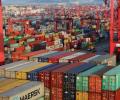
Exporters on Thursday demanded fiscal incentives, tweaking in customs duties on certain products and credit at affordable rates in the forthcoming Budget to boost exports and create jobs. In a pre-budget virtual meeting with Finance Minister Nirmala Sitharaman, the Federation of Indian Export Organisations (FIEO) said the depreciation of the rupee against the US dollar is affecting exports' competitiveness and the sector requires more support. "Creation of employment is the biggest challenge faced by the country...We would urge the government to provide fiscal support to units which provide additional employment in the export sector," the exporter's body said.

Among the many exits from the billionaire's club in 2022 are D Uday Kumar Reddy of Tanla Solutions (net worth down 66 per cent), Sushil Kanubhai Shah of Metropolis Healthcare (down 65.7 per cent), Vijay Shekhar Sharma of One97 Communications (down 66 per cent), and C K Birla (down 43.4 per cent).

A sharp rally in domestic stocks from June lows has once again rendered Indian markets expensive to their emerging-market (EM) peers. The 12-month forward price-to-earnings (P/E) multiple for the Nifty50 Index is around 20.6x - 82 per cent higher than 11.3 per cent for the MSCI EM Index. India's valuation premium has hit a five-month high. This is on the back of sharp outperformance to EM and global peers from June lows and also due to earnings downgrades, following the April-June quarter of 2022-23 earnings.

When the Tatas re-boarded Air India on January 27 last year, the price of aviation turbine fuel was at over Rs 80,000 per kilolitre. Rupee was trading at around Rs 74 to a US dollar. The Omicron variant of Covid-19 was in prevalence - barely a week earlier, India had reported over 340,000 cases on a single day. Seven-day home quarantine of international travellers was the norm.

Sliding for the fifth straight session, the rupee fell 3 paise to close at a fresh lifetime low of 79.06 against the US dollar on Thursday amid a strong greenback overseas and unrelenting foreign fund outflows. At the interbank forex market, the local unit opened at 78.92 against the greenback and witnessed an intra-day high of 78.90 and a low of 79.07. It finally settled at 79.06, down 3 paise over its previous close of 79.03.

Equity indices overcame a wobbly start to clock gains for the third session on the trot on Tuesday, propped up by banking, metal and energy stocks amid a mixed trend in global markets. A recovery in the rupee also bolstered sentiment, traders said. The 30-share BSE Sensex advanced 246.47 points or 0.45 per cent to settle at 54,767.62 after starting the trade on a weak note. In a volatile session, the benchmark hit a high of 54,817.52 and a low of 54,232.82 during the day.

It has mostly been a one-way street for markets that have moved up sharply since July. The front-line indices - the S&P BSE Sensex and the Nifty50 - have gained 6.7 per cent and 7.3 per cent, respectively, in the past three months. The rally in mid- and small-caps has been sharper, with both indices surging 14 per cent and 9 per cent, respectively, during this period. This sharp run has made analysts at Jefferies cautious.

'This resilience should be viewed as reflecting the strength of the structural story.'

Delhi Chief Minister Arvind Kejriwal on Wednesday appealed to Prime Minister Narendra Modi to have photos of Lord Ganesh and Goddess Lakshmi on currency notes.

Based on the current momentum, the funds likely to be raised through the RBI's relaxed window would be $3.5 billion-$4 billion.

It's the first time in my memory that I have seen a negative expected return for equities, notes Akash Prakash. Hopefully, this implies the consensus is being too negative, and markets, as usual, will surprise everyone and deliver the least likely outcome.
In August, domestic equity markets garnered one of the highest foreign portfolio investor (FPI) flows since the outbreak of the pandemic in 2020, despite the US Federal Reserve standing firm on unwinding its stimulus measures to control inflation. FPIs pumped in over Rs 51,000 crore ($6.4 billion) in August, the most since December 2020 and the third-highest tally since March 2020-the month the Covid-19 pandemic roiled global markets. This was the second consecutive month of positive foreign flows. In the preceding nine months, FPIs had yanked out over $32 billion or Rs 2.2 trillion.

With economic activity still to reach pre-pandemic levels, the RBI may slow down the pace of rate hikes until next year to quell soaring inflation while supporting growth, the Asian Development Bank (ADB) says in its latest report. The Manila-based multilateral funding agency has raised the inflation forecast for the current fiscal year ending in March 2023 to 6.7 per cent from its earlier projection of 5.8 per cent. For the next fiscal year too, the forecast has been revised upwards to 5.8 per cent from 5 per cent earlier.
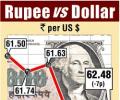
The rupee was also pressured as the euro fell for a second day on Friday, hurt by the European Central Bank's surprise interest rate cut and a downgrade to France's credit rating, while the dollar inched up before a key US jobs report.
.jpg)
In the global market, the dollar was quoted lower in the early trade with investors looking ahead to the following day's European Central Bank policy decision.
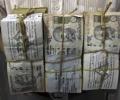
The rupee which has been relatively stable over the last couple of months after having seen as much as 20 percent fall to a record low in late August has been boosted mainly by robust foreign fund inflows into the stock market.

The rupee on Tuesday recovered from its all-time intra day low of 77.79 to close higher by 7 paise on a stellar rally in domestic stock markets. After opening lower at 77.67, the local unit plunged further to its all-time intra-day low of 77.79 due to a spike in crude oil prices and disappointing macroeconomic data. However, a strong rally in domestic equities helped the rupee rebound and close at 77.48 (provisional), showing net gains of 7 paise over the last close of 77.55. The forex market was closed on Monday on account of Buddha Purnima.

'When the gold price rises rapidly, India's physical gold market remains on standby.'

India's exports may have touched an all-time high of $422 billion in 2021-22 but recession in key western markets and geo-political crisis due to the Russia-Ukraine war are expected to impact the growth of the country's outbound shipments in 2023. All the global trade promoting factors like political stability, movement of goods, adequate availability of containers and shipping lines, demand, stable currency and smooth banking systems are in disarray. Adding to the woes, COVID cases have again started rising in countries like China, Japan, South Korea and the US.

The rupee breached the 80-mark against the dollar on Tuesday. The steady depreciation in the value of the rupee against the US dollar is likely to prove expensive for corporate India. The listed companies' revenue expenses in foreign currency or imports exceed their export revenues or revenue earnings in forex. In their latest financial year, BSE500 companies, excluding banks and non-banking finance companies and insurance (BFSI), reported combined forex expenses of Rs 12.31 trillion against forex earnings of around Rs 10 trillion.

ITC was the top loser in the Sensex pack, slipping over 3 per cent, followed by Maruti, Infosys, NTPC, HCL Tech and Tata Steel. NSE Nifty shed 63.20 points to close at 18,114.90.
Equity indices frittered away a good start to close with modest losses on Monday, pressured by heavy selling in metal stocks after the government imposed export duties on steel-making raw materials to curb soaring prices. The 30-share BSE Sensex opened strong and gained momentum as the session progressed, but came under severe selling pressure in afternoon trade to close 37.78 points or 0.07 per cent lower at 54,288.61. On similar lines, the broader NSE Nifty slipped 51.45 points or 0.32 per cent to end at 16,214.70.

KCR said despite 'bhaashanbaazi', industries are closing down, the nation's GDP is crashing and the rupee is falling drastically compared to the US dollar.

Bharti Airtel was the top loser in the Sensex pack, slipping around 1 per cent, followed by Tata Steel, HDFC Bank, Infosys, HDFC, Bajaj Auto and PowerGrid.

'India seems to be on a relatively better wicket compared to other emerging markets.'
The currency market won't care for our moans, groans, cries and sighs. The rupee will find its own level, explains Tamal Bandyopadhyay.

Chief Economic Advisor (CEA) V Anantha Nageswaran on Tuesday said India is not defending the rupee and the Reserve Bank of India is taking necessary steps to ensure that the movement of the rupee is gradual and in line with market trends. Nageswaran further said that the rupee is being managed in a manner that reflects the fundamentals of the economy. "India is not defending the rupee... I don't think Indian fundamentals are such that we need to defend the rupee. "The rupee can take care of itself," he said at an event in New Delhi.

The recent currency volatility - rupee's depreciation against international currencies - may have given heartburns to automakers that rely on imports or pay royalty to parent companies abroad. But for Maruti Suzuki India, favourable movement of the yen - the currency that matters the most - against the Indian rupee, has given it reasons to cheer. The yen's sharp fall against the rupee and the rupee's depreciation against the US dollar, which in turn will bump up export realisations, are set to give a margin boost to the maker of Baleno and Brezza, said analysts. The softening of commodity prices and slew of new SUV launches in the coming months will also aid margins, they said.

The depreciation in rupee may pose a problem for students who have taken loans from Indian lenders.

The country's foreign exchange reserves surged by $58.38 billion in April-September 2021 to $635.36 billion, says an RBI report released on Wednesday. The forex reserves were at $576.98 billion at end-March 2021. The Reserve Bank of India (RBI) publishes half-yearly reports on management of foreign exchange reserves.

Jet fuel prices on Wednesday were cut by 1.3 per cent -- the first reduction after 10 rounds of price hikes -- on softening international crude oil rates. Simultaneously, prices of commercial LPG - used by business establishments such as hotels and restaurants - were reduced by Rs 135 per 19-kg cylinder. The price of aviation turbine fuel (ATF) -- the fuel that helps aeroplanes fly -- has been reduced by Rs 1,563.97 per kilolitre, or 1.27 per cent, to Rs 1,21,475.74 per kl (Rs 121 per litre) in the national capital, according to a price notification of state-owned fuel retailers.

'This is a good time to restructure your portfolio because the sectors and stocks that performed in the last bull market may not perform as much now.'
 © 2026 Rediff.com - Investor Information - Advertise with us - Disclaimer - Privacy Policy - Sitemap - Feedback - About us - Terms of use - Grievances