
ITC was the top laggard in the Sensex pack, tanking 6.97 per cent, followed by L&T, HDFC, SBI, ONGC, ICICI Bank and IndusInd Bank.

Modi launched the membership drive of the ruling Bharatiya Janata Party from his Lok Sabha constituency of Varanasi on Saturday, noting that it will further connect people from all walks of life with the saffron party.

On the Sensex chart, Axis Bank, Titan, IndusInd Bank, HDFC Bank, Dr Reddy's, HDFC and Asian Paint were major losers.

'Even before the outbreak of the flu, it had become clear that the tax revenue numbers for 2019-2020 were overestimated,' observes A K Bhattacharya.

Whatever your queries, tax expert Mahesh Padmanabhan will answer them and give you tips on tax planning on Friday, February 2, between 4 pm and 5 pm IST. Join us then
Overall sentiment was cautious as investors were on a wait-and-watch mode ahead of the Union Budget

Tuesday's meeting at the PM's residence, attended by all the five secretaries in the finance ministry besides top officials of other economic ministries and NITI Aayog, cleared a five-year vision plan for the government to make India a $5-trillion economy by 2024.

The government may introduce some important bill, sources said.

The collection from borrowings and other liabilities will be 20 paise, while income tax will yield 17 paise to every rupee collection.

The numbers become all the more important because actual tax collections fell short by Rs 1.91 trillion compared to what was projected in 2018-19. Besides, the Budget for FY20 did not give actual figures for 2018-19, but the revised numbers given in the interim Budget.
The regulator typically meets overseas investors in the US and UK in the first half of a financial year, and had opted for a virtual meet last year too.
The market capitalisation of BSE-listed companies on Thursday crossed the historic Rs 200 lakh crore mark for the first time, driven by a continuous rally in the broader market. Riding high on the bullish investor sentiment, the market capitalisation of BSE-listed companies reached a record Rs 2,00,47,191.31 crore at close of trade. The 30-share BSE index closed the day with a gain of 358.54 points or 0.71 per cent at its lifetime peak of 50,614.29. This is the fourth consecutive day of gains for the markets.

The global COVID-19 situation, rollout of vaccines, geopolitical trends, Union Budget and economic recovery would be the major factors driving investor sentiments in 2021 after a tumultuous year which saw both 'the worst of times and the best of times' for the stock market, said analysts. What a year 2020 turned out to be! From witnessing gigantic losses to record-shattering gains, investors went on a roller-coaster ride amid the coronavirus pandemic and massive stimulus measures. Markets closed 2020 with remarkable gains of around 16 per cent, but will the winning ways continue in 2021 as well?

Referring to visible indicators of green shoots, the finance minister said the forex reserve is at an all time high and the stock market is upbeat.

'Hope they don't tinker around with capital gains tax in any way.'

Vaccinating all citizens above the age of 18 years against COVID-19 will cost Rs 67,193 crore, of which states together will incur Rs 46,323 crore, India Ratings and Research (Ind-Ra) said on Thursday. As the second wave of COVID-19 sweeps the country with alarming speed and severity, the government has announced a liberalised and accelerated Phase 3 strategy of COVID-19 vaccination. Under this scheme, all persons above 18 years of age will be eligible to get COVID-19 vaccine doses from May 1.

The government has limited room to reduce expenditure without further weakening growth, it noted.

AI, IoT, 3D printing, drones, data storage, quantum computing etc are all re-writing world economic order, the FM said.

ONGC was the top laggard in the Sensex pack, dropping 5.80 per cent, followed by PowerGrid, HCL Tech, TCS, Tata Steel and Reliance Industries.

Companies providing portfolio management services (PMS) had a tough time beating the benchmark index in January, with more than half of the schemes invested in large companies underperforming in the run-up to the Union Budget. The Nifty 50 index was down 2.5 per cent during the month. Only around 44 per cent of PMS schemes did better, among the schemes investing in large-cap companies. The analysis is based on data from industry tracker PMS Bazaar. Half the mid-cap schemes outperformed, while the rest underperformed.

The Union Budget 2021-22 has made it easier for sovereign wealth funds and pension funds to invest in Indian infrastructure projects, but some of the new rules may need more clarity, experts said. The proposed regime requiring investments through holding companies may have adverse tax implications for such funds and may create an arbitrage between the new and old projects, they said. Besides, the ownership structure of holding companies through which investments are to be made requires further clarification, they added.

They are now scaling or shutting down their businesses because they can't compete with untaxed grey market gold. India's gold smuggling has increased significantly since the import duty was increased in the Union Budget 2019 in contravention with the broader market expectations of a cut.
This could impact non-resident Indians staying in countries such as UAE which does not impose income tax on individuals under local tax laws.
The Reserve Bank of India on Wednesday retained the economic growth projection for the current financial year at 10.5 per cent, while cautioning that the recent surge in COVID-19 infections has created uncertainty over the economic growth recovery. In its last policy review, the RBI had projected a GDP growth rate of 10.5 pc for FY'22. Taking various factors into consideration, it said, "the projection of real GDP growth for 2021-22 is retained at 10.5 per cent consisting of 26.2 per cent in Q1, 8.3 per cent in Q2, 5.4 per cent in Q3 and 6.2 per cent in Q4."

'As valuations of large-caps appeared to be out of whack, investors started lapping up quality mid-caps and small-caps, which were available at relatively comfortable valuations.'

Five to six issues may hit the market if Chalet Hotels's IPO is successful and if there are no negative surprises in the Union Budget on February 1.

The department of investment and public asset management (Dipam) can also seek in-principle approval from the Cabinet Committee on Economic Affairs (CCEA) for strategic divestment of PSUs on a case-to-case basis considering investor appetite and sectoral trends.
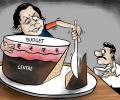
Niti Aayog will prepare the next list of central public sector companies for disinvestment in the next few weeks, its vice chairman Rajiv Kumar said on Thursday and expressed hope that the proposed asset reconstruction and management companies to address banks' bad loan woes will do a good job like the UTI. Days after Finance Minister Nirmala Sitharaman announced the Union Budget for 2021-22 laying out various measures (including disinvestment proposals) to bolster the pandemic-hit economy, Kumar also emphasised that the Modi government has shown consistent commitment for the welfare of farmers and for the improvement of the agriculture sector. "Now the process has begun... We will complete preparation of the next list in the next few weeks, we have got the marching order," Kumar said about the list of public sector companies for the next round of stake sales.

While it took UPI three years to reach a billion transactions in a month, the next billion came in just a year. Digital payments, especially UPI, saw increased adoption in 2020 due to the Covid-19 pandemic.

Equity markets braved all odds this fiscal and rewarded investors with high returns as the benchmark Sensex surged more than 66 per cent despite COVID-led disruptions and concerns over its impact on the economy. Market analysts termed FY 2020-21 as a roller coaster ride for not only Indian markets but also for equity indices globally due to the pandemic. In an unprecedented come back, the 30-share BSE Sensex has jumped 19,540.01 points or 66.30 per cent so far this fiscal. This extraordinary rally holds significance as markets faced volatile trends this fiscal.

The government on Monday clarified that transactions involving royalty/ technical services fee would be taxable under income-tax and not be liable for equalisation levy that is paid by foreign companies for conducting business with Indian parties, while explaining what would construe online sale of goods or services.

They have been on an unbroken selling streak since the Union Budget, spooked by increase in income-tax surcharge, taxes on buybacks, and lack of stimulus to prop up the economy.

This was the one Budget that required radical departures on all these fronts, when it had none, asserts, Shreekant Sambrani.

IMF's Chief Economist Gita Gopinath on Thursday said it would be damaging for India to start tightening policy support in the midst of the COVID-19 pandemic and also stressed on reducing wasteful expenditures in the upcoming Budget. Delivering NCAER's '9th C D Deshmukh Lecture' virtually, Gopinath said there is scope for the Indian government to provide more direct support to people.

The Budget Session will be held from January 29 to April 6.
It had earlier proposed cutting it down to Rs 250 crore due to slow progress in enrollment of new employees.

Finance Minister Arun Jaitley did a balancing act in the Union Budget 2015.

Slammimg the erstwhile UPA government, Sitharaman said between 2012 and 2013, foreign investment recorded a negative 36 per cent growth.

Azad said electoral laws make it clear that the ruling party should have no advantage during elections and both the Opposition and the ruling side should be on an equal footing.

Sitharaman is presenting the full Budget for 2019-20. She is carrying the Budget documents in a red silk bag with national emblem.
 © 2026 Rediff.com - Advertise with us - Disclaimer - Privacy Policy - Sitemap - Feedback - About us - Terms of use - Grievances