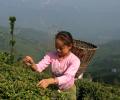
The famed Darjeeling tea may have slip to a new production low in 2025, as changing weather patterns, a shortage of pluckers and mounting economic stress weigh on the region's gardens.

As India's tea exports reach their highest in years, a sharp rise in imports is raising concerns among producers. In 2024, India took the third spot in tea exports, pipping Sri Lanka after exporting 254.67 million kg (mkg) of tea, up from 231.69 mkg in 2023.

The Tea Board has proposed a Rs 20-crore advertisement campaign for generic promotion of tea. It will project tea as a health drink.
Chai Sahay, an artificial intelligence-based mobile app, will be primarily used to issue advisory, disseminate information related to various schemes of the board for the sector as well as provide real-time weather updates, says Avishek Rakshit.

The tea industry's cup of woes brimmeth - scanty rainfall and pest attacks have dragged down production in May, prices are lower than last year, and demand from some export markets is muted. Production in North Bengal - comprising the Dooars, Terai, and Darjeeling - is majorly affected; parts of Assam are also hit. Arijit Raha, secretary general, Indian Tea Association (ITA), said that the Tea Board numbers for April show a crop loss of about 9 per cent for North Bengal, compared to last year.

Out of the 745 gardens in Assam, which accounts for over 55 per cent of total tea production, an alert has been sounded for 88 gardens, while for West Bengal, out of the 377 gardens, 65 have been cautioned.
India is looking to develop alternative export markets for tea such as Iraq, Saudi Arabia, the US, Japan and Tunisia in view of the Russian invasion of Ukraine, people aware of the matter said. Meetings are being held with buyers in some of these countries in virtual mode, with the help of diplomatic missions located there. Similar meetings for the remaining countries have also been planned.

As the economic crisis in Sri Lanka - the world's largest exporter of orthodox tea - continues to rage across the island nation, tea producers in India look to cash in on the opportunity to seize the market. The country's largest tea growing company, McLeod Russel India, expects orders to come in from July. "A huge opportunity is coming up for everyone in India. "McLeod Russel is well placed because we have the capacity for orthodox tea," said Azam Monem, director, McLeod Russel. About 10 per cent of McLeod's production is orthodox tea.
Under the trade agreement between India and Iran, the West Asian country can pay India in rupees for its imports against oil exports to India, which New Delhi pays for in Iranian rial.

Over the years, India has also lost its CTC market heavily to Kenya. And, Sri Lanka, which markets the Ceylon tea brand, has also been able to aggressively tap these markets.
The Tea Board has sought the help of Indian Space Research Organization to track the progress of replantation of tea bushes with the help of remote-sensing satellite.

Planters from Assam said despite the Covid-19 pandemic, trade enquiries from China had been rising. However, owing to the growing conflict, enquiries may dry up. 'We have seen how the trade dried up in case of the Pakistan conflict and fear the same,' a planter from Assam said.
The quality of Indian tea had lately come under scrutiny in major export markets, due to the presence of pesticides and chemicals beyond permissible limits.
The first meeting with the owners and bankers was held in Kolkata on Saturday for the closed gardens in West Bengal and Assam. The rehabilitation package was approved by the commerce ministry recently.
Your morning cup of tea might become clean, soon. The Tea Board has asked tea packeters and blenders to stop adding hazardous colours to tea.
In an effort to boost India's tea export, a delegation from the Tea Board is on a tour to Cairo for finalising the opening of a Tea Marketing Centre in the Egyptian capital.
India's organic farming efforts will see a sea change in the tea sector following the launch of the project to develop organic black tea with funding from the Amsterdam-based Common Fund for Commodities, a UN body.
Greenpeace says samples of leading brands tested contain unacceptable levels of dangerous chemicals.
Indian tea exporters on Thursday took their first step to enter the huge Chinese market by offering the world famous Darjeeling tea and other high-quality varieties for which they hope to secure a 'niche' market in the world's most populous nation.
Scanty rainfall, last year's lockdown, growing competition from Nepal and the disaster of the 2017 Gorkhaland agitation are steadily weakening exports and sales of Darjeeling tea.
Rough estimates from plantation companies have pegged production loss in excess of 100 million kg (mkg) across India which is valued at around Rs 2000 crore. Usually, plantation companies in Assam and West Bengal produce around 15 per cent of the total tea during March-April.
Tea estates across Assam and West Bengal, which were hitherto closed owing to the lockdown, opened in April.

The industry began to upgrade its practices even before the NGO alleged Indian tea contained harmful pesticides.

The world-famous Darjeeling tea is losing its flavour even as it struggles with falling production, says Avishek Rakshit.

Sale of India's specialty tea varieties from exclusive estates in Assam and Arunachal Pradesh are on the rise in the domestic market, and sought after in overseas markets too.

The unrest in the hills has led to the tea sector losing its entire second flush, and Rs 200 crore of its annual earnings.
According to Darjeeling Tea Association, in 1986 the Darjeeling logo was created and registered in the UK, the US, Japan, Canada and Egypt, and under the Madrid Agreement also covering Germany, Austria, Spain, France, Portugal, Italy, Switzerland and former Yugoslavia.
Tea growers and traders in India can heave a sigh of relief now with the country's tea export to Pakistan showing tremendous improvement.
Intends to acquire control of owner of 'Himalayan' water brand.
Efforts to revive tea gardens in India have received a boost following the launch of the first round of special purpose tea fund loans to Assam on Monday.
Move over diplomacy. It looks the tea-relations between India and Pakistan is going to excel in the days to come, better than their diplomatic relations.
In an effort to give a fillip to the ever-growing wine sector, the Central government has proposed to form a National Grape and Wine Board (NGWB) on the lines of other commodity boards like the Tea Board.
The tea industry, hit by rising costs, falling prices and political unrest in the North Bengal plantations, is especially vulnerable to the COVID-19 lockdown.
India's tea exports are set to be on target in the year to March 2003 while coffee shipments would surpass the projection and hold steady at the previous year's level, officials said on Friday.
Indian exports are set to reach the targeted $80 billion mark by the close of 2007, thus raising the country's share in global exports to one per cent, the Union Minister of State for Commerce and Industry, Rajiv Pratap Rudy
India's exports of tea to Pakistan jumped nearly 73 per cent to 6.4 million kg in 2003 from 3.7 million kg in 2002, even as the country's total exports during the first 11 months of last year came down 22.18 per cent
 © 2026 Rediff.com - Investor Information - Advertise with us - Disclaimer - Privacy Policy - Sitemap - Feedback - About us - Terms of use - Grievances