
Witnesses said the police in riot gear turned tough as the protestors tried to break through security barricades in front of Jamuna from a nearby sit-in demonstration, defying the earlier announced ban on rallies adjacent to Jamuna.

A rally in Dhaka, Bangladesh, organized by the Inqilab Moncho party, demanded justice for slain student leader Sharif Osman Hadi and called for the cancellation of work permits for all Indians residing in Bangladesh. The protest also sought the repatriation of alleged killers believed to be in India, further straining relations between the two countries.
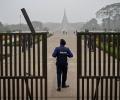
Bangladesh Nationalist Party (BNP) acting chairman Tarique Rahman visited Dhaka University and offered prayers at the grave of slain student leader Sharif Osman Hadi amid heavy security. He also offered prayers at the grave of Bangladesh's national poet Kazi Nazrul Islam.

Sharif Osman Hadi, a leader of the July Uprising in Bangladesh, died after being shot, sparking protests and political unrest. The interim government has promised action, while demonstrators have targeted media outlets and blamed India.

Two primary suspects in the murder of Inquilab Moncho leader Sharif Osman Hadi have fled Bangladesh and are believed to be in India, according to Dhaka Metropolitan Police. The suspects allegedly crossed into Meghalaya with assistance. Bangladesh is working with Indian authorities for their arrest and extradition.

'The strain you are witnessing is entirely of Yunus's making. His government issues hostile statements against India, fails to protect religious minorities, and allows extremists to dictate foreign policy, then expresses surprise when tensions rise'

The partition of Bengal in 1905 split more than a province, it touched people's hearts and awakened India's fight for freedom.
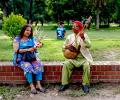
One year after Sheikh Hasina's 15-year rule ended in Bangladesh, hopes for real democracy are fading.
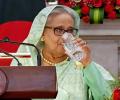
Sheikh Hasina's son Sajeeb Wazed Joy spoke over phone to his mother. After that Sheikh Hasina agreed to resign.

Members of minority communities in Bangladesh -- mostly Hindus -- faced at least 205 incidents of attacks in 52 districts since the fall of the Sheikh Hasina government on August 5, according to two Hindu organisations in the violence-hit nation.

Ahead of the upcoming Durga Puja festival, Bangladesh authorities have assured of increased security measures that have been put in place amid concerns of violence targeting minority Hindu communities.

The White House on Monday strongly refuted allegations that the United States interfered in the internal affairs of Bangladesh, leading to the resignation and fleeing of the country's former prime minister Sheikh Hasina.

A lawyer was killed on Tuesday during clashes between the security personnel and followers of a Hindu community leader, who was denied bail and sent to jail by a court in the port city of Chattogram in Bangladesh, police said.

A Bangladeshi court on Tuesday denied bail to prominent Hindu leader Chinmoy Krishna Das Brahmachari, arrested on alleged 'sedition' charges, and sent him to prison, amid protests by community members in the capital Dhaka and the port city of Chattogram.

He also said that there is improvement in the law and order situation in the country.

The clashes broke out this morning when protesters attending a non-cooperation programme to demand the government's resignation faced opposition from the supporters of the Awami League, Chhatra League, and Jubo League activists.

Pakistan wanted to be constitutionally communal, India wanted to be secular but is communalising itself. All three nations share a penal code, but they have amended their laws to enable the State to specifically target minorities, points out Aakar Patel.

As thousands of youth continued their movement at Shahbagh in Dhaka to press for death penalty for war criminals, President Pranab Mukherjee on Saturday said he believed Bangladeshi youths would determine the country's future.
Ahmed Rajib Haider, a prominent blogger attached to the Shahbagh protests raging on in Bangladesh, was killed on February 15. His murder has led to a renewed wave of protests to demand capital punishment for all war criminals involved in crimes against humanity during Bangladesh's liberation war in 1971.
President Pranab Mukherjee will be honoured by Bangladesh government on Monday in recognition of his contribution to the struggle that led to the birth of this nation 42 years ago.
At least three persons were killed in sporadic clashes in Bangladesh on Monday during a nationwide general strike called by fundamentalist Jamaat-e-Islami to protest their leaders' ongoing trial for 1971 war crimes.
The Bangladesh parliament on Sunday amended the war crimes law to allow the prosecution to try and punish any organisations, including the Jamaat-e-Islami, a significant move that could pave the way for banning the country's largest Islamic party.
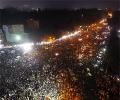
Bangladesh's Supreme Court on Tuesday handed down the death penalty for fundamentalist Jamaat-e-Islami leader Abdul Quader Mollah for his involvement in the 1971 war crimes, revising a special tribunal verdict which had sentenced him to life imprisonment.

Special Trial Tribunal-3 Judge Sayeed Ahmed pronounced the verdict in presence of seven of the accused. One of the death row convict is on the run.
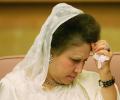
Bangladesh's Supreme Court on Wednesday upheld the death penalty for an influential opposition BNP leader Khaleda Zia for committing crimes against humanity.

A special Bangladeshi tribunal on Wednesday sentenced opposition Bangladesh Nationalist Party's 83-year-old leader Abdul Alim to jail until death for committing large-scale killings and other war crimes during the 1971 Liberation War against Pakistan.

A prominent lawmaker of the opposition Bangladesh National Party was on Tuesday sentenced to death by a special Bangladeshi tribunal for genocide during the country's 1971 liberation war against Pakistan, becoming the first Member of Parliament and seventh person to be convicted of crimes against humanity.
'Pakistan is paying the price for ignoring secularism. In seeking to be ever more Muslim to define its nationhood, it has become a terrorist haven.'

73-year-old leader of the Bangladesh's largest Islamist party had refused to seek presidential clemency.
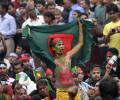
Three bloggers have been murdered in Bangladesh in the last three months, and yet, the international community does not seem to be sufficiently incensed.
The four-member Appellate Division bench headed by Chief Justice Surendra Kumar Sinha pronounced the single-word judgement at the tense courtroom.
 © 2026 Rediff.com - Investor Information - Advertise with us - Disclaimer - Privacy Policy - Sitemap - Feedback - About us - Terms of use - Grievances