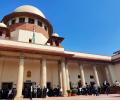
The Supreme Court on Monday agreed to consider listing for urgent hearing the petitions challenging the constitutional validity of the Waqf (Amendment) Act, 2025.

Several petitions were filed in the apex court challenging the Act, contending that it was discriminatory towards the Muslim community and violated their fundamental rights.

A fresh plea has been filed in the Supreme Court challenging the constitutional validity of the Waqf (Amendment) Act, 2025, claiming it was a "blatant intrusion" into the rights of a religious denomination to manage its own affairs in the matter of religion. The plea, filed by Samastha Kerala Jamiathul Ulema, argues that the amendments would distort the religious character of Waqfs and irreversibly damage the democratic process in their administration. Several other petitions have been filed in the apex court challenging the validity of the bill, including those by Congress MP Mohammad Jawed, AIMIM president Asaduddin Owaisi, and AAP MLA Amanatullah Khan.

A three-judge Supreme Court bench will hear petitions challenging the constitutional validity of the Waqf (Amendment) Act, 2025, on April 16. The petitions, including those by politicians and the All India Muslim Personal Law Board (AIMPLB) and Jamiat Ulama-i-Hind, were filed in the top court challenging the validity of the newly-enacted law. The Centre has filed a caveat in the apex court, seeking a hearing before any order is passed.

Instant 'triple talaq', also known as 'talaq-e-biddat', is an instant divorce whereby a Muslim man can legally divorce his wife by pronouncing 'talaq' three times in one go.

The current situation in Kerala politics is perhaps best described as a case of the state's traditional two front politics now seeing a third front (the BJP) muscling in with the potential outcome being either a messy three front affair or a renewed endorsement of the two front pattern but with one of the old fronts compromised or quashed, observes Shyam G Menon.
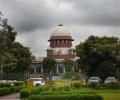
The Supreme Court of India will likely hear a batch of petitions challenging the constitutional validity of the Waqf (Amendment) Act, 2025 on April 15. The Act, which came into force on April 8, has been met with widespread criticism from various stakeholders, including politicians, the All India Muslim Personal Law Board (AIMPLB), and Jamiat Ulama-i-Hind. They argue that the law is discriminatory and violates the fundamental rights guaranteed under Articles 25 and 26 of the Constitution. The petitions allege that the amendments give the government more control over the administration of Waqf, effectively sidelining the Muslim minority from managing their own religious endowments.

The DYFI has been organising numerous challenges and festivals across the state as part of its various fund-raising events to help the rehabilitation efforts for the survivors of the devastating landslides in Wayanad district on July 30.

In an affidavit filed in the court in response to petitions challenging the law, the Union of India said that despite the top court setting aside the practice in 2017, it has "not worked as a sufficient deterrent in bringing down the number of divorces by this practice" among the members of the Muslim community.

The specter of how the Munambam issue was exploited during the November by-elections is proof of the price Kerala is paying for its emergent politics. Controversies become the stuff of slow-burn and brinkmanship. The former promises mileage; the latter searches for an advantage, notes Shyam G Menon.

The overtures by CPI-M state secretary MV Govindan had upset the Congress that had, subsequently, accused the Left party of turning the UCC into a Hindu versus Muslim issue for gaining political mileage.

Huge cutouts of football stars including Messi, Neymar Jr and Ronaldo can be seen across the state.
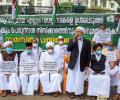
The apex court pulled up the state government for giving in to traders' pressure by granting relaxations ahead of Bakrid and said it disclosed a 'sorry state of affairs'.

The incident occurred during the inauguration of a 'madrassa' building in the district, where students were felicitated recently.

It claimed that the Act is violative of Articles 14, 15 and 21 of the Constitution and thus, is liable to be struck down.

Holding that fixing marriageable age for Muslims was an encroachment into their religious rights, a newly constituted umbrella body of the community in Kozhikode has decided to move the Supreme Court seeking exemption from the minimum age limit of 18 years.
 © 2026 Rediff.com - Investor Information - Advertise with us - Disclaimer - Privacy Policy - Sitemap - Feedback - About us - Terms of use - Grievances