

The current situation in Kerala politics is perhaps best described as a case of the state's traditional two front politics now seeing a third front (the BJP) muscling in with the potential outcome being either a messy three front affair or a renewed endorsement of the two front pattern but with one of the old fronts compromised or quashed, observes Shyam G Menon.
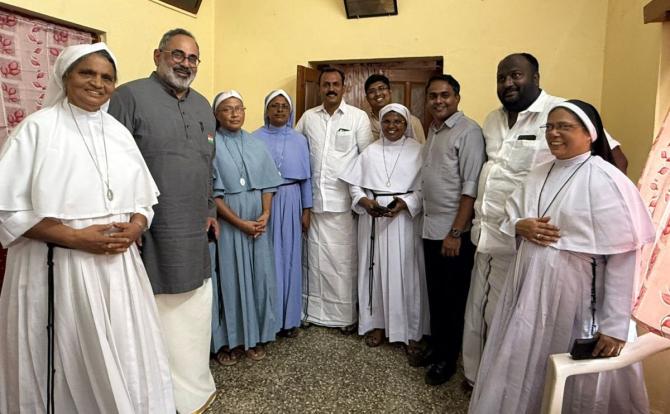
How much of a lasting lesson to Kerala politics can the recent arrest and subsequent release of two Christian nuns in Chhattisgarh, be?
On July 25, Sisters Preethi Mary and Vandana Francis were arrested in Chhattisgarh in a case of alleged human trafficking and forced religious conversion.
The complaint was filed by a local functionary of the Bajrang Dal, an organisation associated with extreme right-wing Hindu sentiments and generally considered to be a part of the pantheon of outfits forming the face of Hindutva, of which the most prominent political manifestation is the Bharatiya Janata Party.
A BJP-led central government has been ruling India for the past over a decade.
The arrest of the nuns created a flutter in Kerala because it followed months of cozying up between the BJP and sections of the state's Christian church, not to mention the ascent of the religiously conservative right-wing outfit, Christian Association & Alliance for Social Action (CASA), within the Christian community in Kerala.
The emergent equation had contributed to the BJP winning its first parliament seat from the state, when actor turned politician Suresh Gopi won from Thrissur.
The Thrissur victory had been despite attacks on the Christian minority reported elsewhere in India.
Same time as the BJP triumphed in Thrissur in the 2024 polls to Parliament, the Christian electorate along Thiruvananthapuram's coastal belt behaved differently, voting in favour of the Congress' Shashi Tharoor.
The impression observers have is that the BJP has made inroads into the Christian electorate in central and northern Kerala by exploiting the insecurities of the church as it struggles to keep its flock together amidst a general fraying of social and religious bonds caused by education and human mobility, and strains within the economic/business verticals relevant to the Christian community.
The nuns' arrest was thus after the gains the BJP had come to register in Kerala via its newfound friendship with sections of the Christian church.
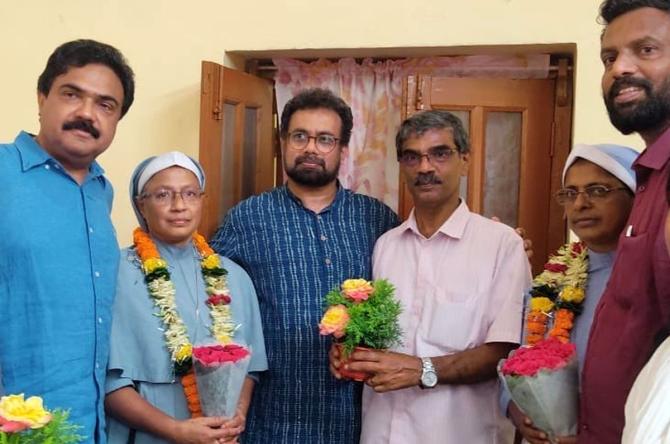
The backlash to the arrest was quick and the embarrassment to the BJP, sizeable.
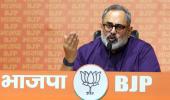
The BJP's state unit headed by Rajeev Chandrasekhar (he lost to Tharoor from Thiruvananthapuram in the Lok Sabha polls of 2024) dismissed the allegations against the nuns in Chhattisgarh and seemingly distanced itself from the views of the party up north.
It would seem an intelligent move as it also dilutes the northerner-stamp the BJP endures in South India.
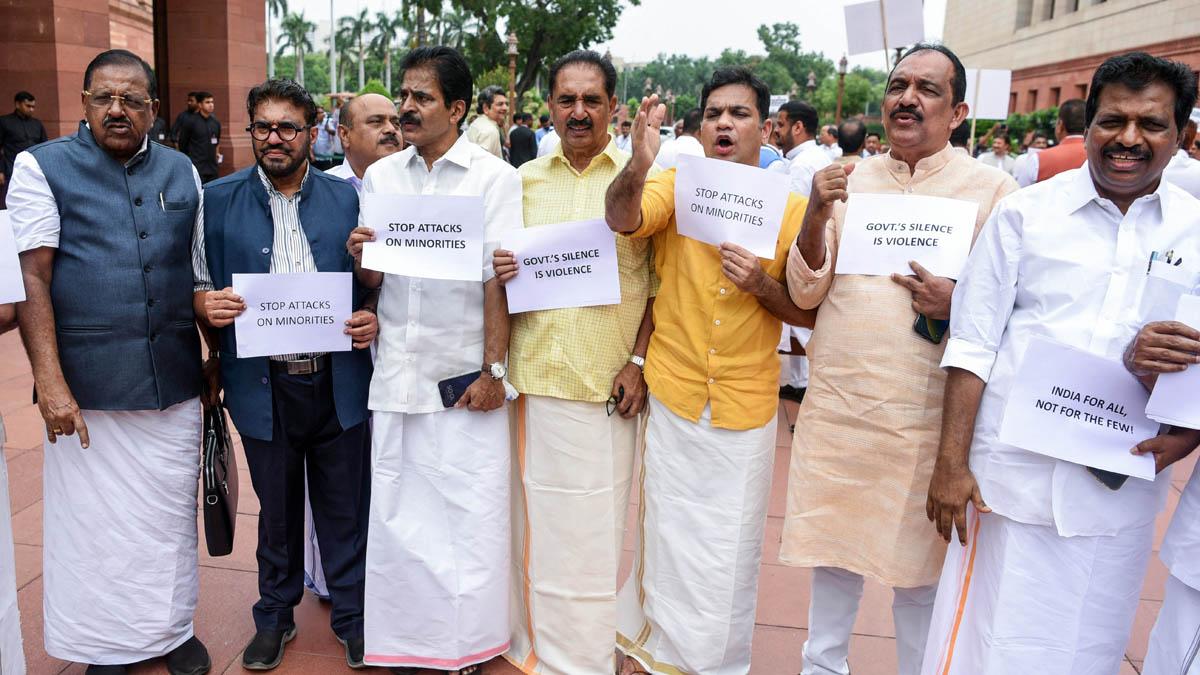
During the period of incarceration of the nuns, rallies and street side protest meetings were dime a dozen in Kerala.
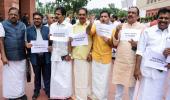
The state's two main political fronts -- the Left Democratic Front (LDF) and the United Democratic Front (UDF) -- dispatched senior politicians to Chhattisgarh to meet the nuns and state authorities.
As did the BJP, which couldn't be seen to trail behind.
Discussions happened with the Union home minister and senior BJP functionaries in Delhi.
Reported less prominently but known well by the Kerala electorate nonetheless were the scenes of right-wing jubilation staged outside the venue of the proceedings in Chhattisgarh.
It pointed to the nature of the ecosystem that sections of the church had opted to cavort with.
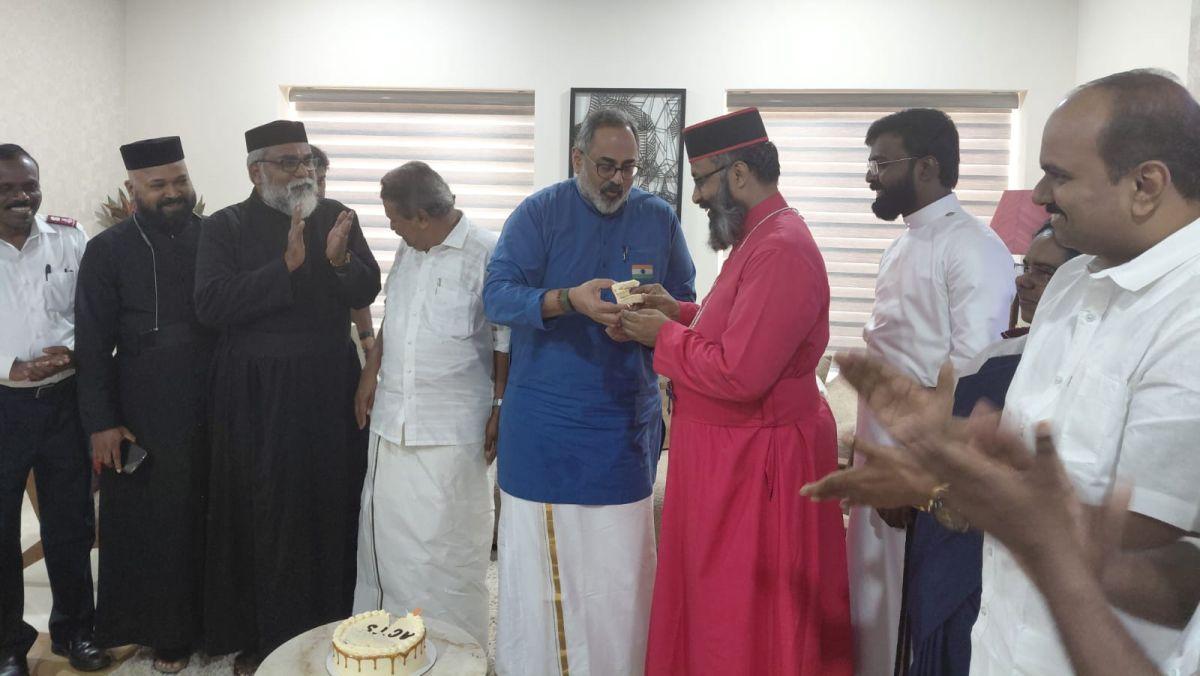
On August 2, the nuns were released on bail.
But as Kerala-based news television channels reported, despite even the BJP's state unit shying off the charges alleged, the charges were not entirely dropped and the release featured restrictions on the nuns' freedom like surrendering their passports, furnishing bonds and regularly informing authorities of their whereabouts.
The question many in Kerala now ask is whether the case of the two nuns will have a substantial impact on how sections of the Christian community see their emergent proximity to Hindutva.
Will they re-evaluate it?
Or, will political adjustments by the BJP, like accommodating more from the Christian community in key positions in the party, revert the situation to business as usual?
It is a question with no clear answer for there are multiple variables although none of them genuinely weaken the BJP even as they make the forces opposed to Hindutva seem yet to grasp the true nature of the beast and still lacing their responses with political opportunism.
Take the case of the Communist Party of India-Marxist -- CPI-M, which anchors the LDF.
At the height of the nuns' arrest and debates around whether the Christian community had erred cozying up to the BJP, there were those recalling the CPI-M's ability to coexist with the polarising statements of another community leader.
Vellapally Natesan is the longstanding general secretary of the SNDP Yogam, an organisation representing the interests of the Ezhava community, the largest community within the Hindu fold in Kerala.
On July 20, about a week before the nuns' arrest in Chhattisgarh, Natesan was in the news in Kerala for his observations on the state's Muslim population.
Natesan, as reported in The New Indian Express of July 20, 2025, said that both the LDF and the UDF were 'primarily catering to the interests of the Muslim community' and he 'warned that the Muslim population would soon become the majority in the state and said the current situation is such that the state government should just listen to Kanthapuram and govern'.
Kanthapuram A P Aboobacker Musliyar is the tenth and current grand mufti of India and general secretary of the All-India Sunni Jamiyyathul Ulama as well as the Samastha Kerala Jamiyyathul Ulama of AP Sunnis.
Natesan, as per The New Indian Express report, claimed that the Indian Union Muslim Leage (IUML -- it is powerful in north Kerala politics) was seeking influence beyond Malabar and was now looking at Thiruvananthapuram and Kochi with a view to securing the chief minister's post.

In the last several years, Natesan has been an unpredictable figure in Kerala politics and it has much to do with how the emergent balance of power in the state can be played.
The current situation in Kerala politics is perhaps best described as a case of the state's traditional two front politics now seeing a third front (the BJP) muscling in with the potential outcome being either a messy three front affair or a renewed endorsement of the two front pattern but with one of the old fronts compromised or quashed.
The general perception is that the LDF and the BJP are ideologically opposite and similar in cadre-based architecture, replete with propaganda and publicity wings.
The UDF lacks the architectural discipline and cohesiveness of its rivals but somewhere in its looseness, appeals to the humanist side of existence.
Further, Kerala's three main communities -- Hindus, Muslims and Christians -- have, broadly speaking, distinct behavioural patterns at the community level.
Although there are community organisations specific to caste within the Hindu vertical, they have usually pulled on each one's terms.
Aiding this has been the absence of a church (in the generic sense) within Hinduism.
Nudging the religion closer to a church-directed architecture with offices and office-bearers that matter has been among the perceived agendas of Hindutva.
Muslims have been known to be religiously and politically bonded and in the case of Christians, the general imagery has been one of the bonding being business-driven as well.
The above is a street-level picture.
Confronted with academic research and precision, it won't hold.
But it won't be wrong to say that the above imagery is the rough backdrop against which, Kerala's contemporary politics is popularly beheld.
The religious composition of Kerala, wherein the three main religions are near evenly matched and all have their share of Communist-supporters, means that unlike elsewhere in India, the BJP will require to get communities other than the Hindus also on board to dominate state level politics.
The BJP, as the biggest, wealthiest and politically most powerful party in India at present, has plenty to offer those aligning with it.
BJP politicians have in the past hinted at being able to do much in Kerala with an increase in assembly seats (they have none currently), even if said increase is short of sizable numbers.
They are likely not incorrect in their assessment.
Kerala politics, steeped in community and religion-based verticals, still falls short of unitedly opposing the BJP, except in the case of the Muslims who have at national level borne the brunt of the Indian right-wing's attacks.
Journalists and researcher all talk of how clued into contemporary politics, Kerala's Muslims are.
Reason -- as a frequently targeted community at the national level, they have to stay abreast of what's going on; there is no other option.
However, there is a trend to note here.
When it comes to elections to Parliament, Muslims typically go with the UDF because at a national level, the UDF's constituents -- mainly the Congress -- are politically significant.
Parties like the CPI-M and CPI are marginal players nationally.
In state elections, the Muslim vote has sometimes stood with the LDF, sometimes with the UDF and overall, generally shunned the BJP.
This reflects issue and context-based choice of candidate and party.
The flip side of the trend is that both the UDF and the LDF, one could argue, don't have an all-weather incentive to keep on indulging the Muslim vote.

Amidst this, for many years, Kerala's Ezhava community had stood firmly with the Left parties.
It showed indications of change some years ago, when Natesan betrayed signs of warming up to the BJP.
The signs were alarming enough for the parties concerned to take note.
Today, the CPI-M is perceived as trying to regain the trust of the Ezhava vote bank and not so much, that of the Muslims.
One proof, critics cite for this is the lack of any major criticism of Natesan by the CPI-M despite his recent remarks.
On the other hand, Natesan's remarks had drawn strong protest from the IUML and the Congress.
As LDF politicians turned up alongside the UDF and the BJP, to press for the release of the arrested nuns in Chhattisgarh, the CPI-M's relative quietness on Natesan's remarks was remembered by discerning critics.
It made the LDF's protest at the nuns' arrest look like opportunism.
Worse, it underscored the bleakness at the heart of Kerala politics wherein concerns rarely exceed the self-interest within religious and communal silos and due to which, a firm solidarity designed to keep the BJP at bay has eluded the LDF and the UDF.
A day after the nuns' release, social media was alive with displays of firm resolve to check the BJP.
But in a season of drift as outlined above, what lasting lesson can the nuns' arrest teach the LDF, the UDF or the electorate?
A prominent political commentator I spoke to pointed out that the nuns belonged to the Roman Catholic church, the most powerful faction within India's Christian community.
To him, that explained the scale of protest and access to senior politicians, to find a solution.
Smaller factions remain easy prey and it is unlikely they would earn similar support.
Further, its wealth and assets make the Christian church vulnerable.
He saw the arrest and release sending a message to the Christian church to fall in line and his gut feeling was, the church will.
" I believe, they will comply," he said.
Thanks to such angles, observers keep their fingers crossed on whether the nuns' arrest works as a lasting lesson for the state about the BJP's nature.
Properly analySed and articulated, there is enough in the episode for the UDF and the LDF to tuck into, during a future election campaign (the state has local body elections later this year and assembly polls in 2026).
But will they?
There are other factors too, as to why such doubts persist.
For some months now there has been an ongoing discussion in Kerala about how its political imagination and political concerns may have changed in line with the onset of economic prosperity.
We are not talking of a prosperous government (the state has a financially weak government); we are talking of a people who have become prosperous thanks to their earnings and the remittance economy and enjoy a generally high standard of living.
The question doing the rounds is what would the priorities of such an electorate be and can a modern politics founded on secularism, social justice and diminishing economic inequality be deemed the main aspiration of such an electorate?
The answer to it is as yet unclear but some feel that a combination of economic well-being, the need of the successful to establish their choices in life as the best ideal, residents deeply partial to a well-settled life and a growing component of older people in the population mix, have Malayalis leaning towards a revival of conservatism and continued social domination by community and religious silos.
If so, it is advantage BJP in the long run because it unhesitatingly endorses these values and practices.
In contrast, both the UDF and the LDF would seem rolling on short term objectives, constant recalibration of political loyalties to suit political aims and a general lack of clearly stated long term goals.
To be fair, the sense of humanism receding in the rear-view mirror is an Indian problem. It is not Kerala's alone.
Around the time the nuns' arrest was inspiring protests in Kerala, there was a major news reported at the national and international levels.
The story of how India deported alleged illegal Bangladeshi migrants -- basically how it treated them during the deportation process -- was reported in depth by The Washington Post in the US.
Subsequently, The Indian Express, carried a report on the same subject on August 2.
Why don't these reports concern us as much as, say, 25 per cent import tariff on Indian goods imposed by the US?
The deportation story may also seem very different from the nuns' arrest.
But I suspect, in the low attention span and concern we reserve for such matters, there is a larger change in character to swathes of us that must be noticed.
On July 31, 2025, a special National Investigation Agency court in Mumbai delivered its verdict on the 2008 Malegaon bomb blast case.
All the seven accused persons were acquitted.
Same day, The Indian Express reported a conversation with former special public prosecutor Rohini Salian, wherein she pointed out that the electorate must shoulder its share of blame for the prevailing state of affairs.
'I am not even disappointed with the verdict because this has become routine for me. We lose our sensitivity when this keeps happening.
'Nobody wants the truth to come out. We work very hard, but someone doesn't want us to. Whose failure is this finally? Our own -- the people's.
'Not the government because this is the government that the people have elected, and they will govern the way they need to.
'You cannot blame the government -- you must blame your own selves,' Salian was quoted as saying.
Although from a totally different topic, Salian's observation should sum up what at least some in Kerala must be feeling after the nuns' arrest and release.
More than the state's political parties, its electorate needs to introspect.
Shyam G Menon is a freelance journalist based in Mumbai.
Feature Presentation: Aslam Hunani/Rediff








 © 2026