
Season 3 belongs to Jaideep Ahlawat who, despite the not so well-etched character, owns Rukma and gives the confrontation with Srikant Tiwari the missing edge of the earlier two seasons, observes Saisuresh Sivaswamy.

The expansion in equity market volumes is driven by retail speculators indulging in heavy trading of complex derivatives that are economically unproductive, say Praveen Chakravarthy and T V Somanathan.

For the first time in his political career, he failed to carry his party to even a working majority -- and again, for the first time in his career, he finds himself in a situation where he cannot rule by dictatorial fiat, points out Prem Panicker.
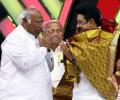
For now, the DMK can be expected to sound the bugle for Opposition unity at the national level, predicts N Sathiya Moorthy.
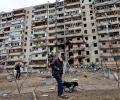
Now, as before, India's vote at the UN was dictated by paramount national interests. Though the Indian vote was 'neutral', its explanation was explicit in its criticism of the Russian actions. India took back with the left hand what it had given with the right, explains Ambassador T P Sreenivasan.
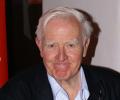
'Le Carré's spies were nothing like the exotic Kim of Kipling or the caricature that is James Bond.' 'Driven by a simple patriotism, held back by incompetence and politics, his characters use deceit and treachery to win their morally Pyrrhic victories,' notes P Rajendran.

Industry was the most obvious casualty of the Left's excesses. Now what lies ahead for the state?

Though a pyrrhic victory for the BJP, the party he chose to align himself against his former mentor Banerjee, it nevertheless is being seen as a morale booster for the saffron party as his former party, the Trinamool Congress under Banerjee's leadership, has garnered an overwhelming 213 seats out of 292 seats which went to polls.

Prime Minister Modi has certainly pulled back, and his political capital -- dependent as it is on an image that he knows best and never retreats -- may have taken a bit of a beating. But, equally, it is hard to say that the protesters have 'won', argues Mihir S Sharma.
Rajeev Srinivasan considers the lessons from Tata Steel's acquisition of Corus.

'No, the liberals haven't lost because there weren't any liberals in the fray to begin with.' 'What has happened is that left-wing orthodoxy has lost to right-wing orthodoxy.' 'That is at best a Pyrrhic victory for India,' argue Sonali Ranade and Sheilja Sharma.
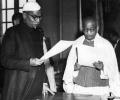
Vallabhbhai Patel's great claim to fame originated from his steely leadership of a struggle against a repressive regime, a good three decades before the achievement of states unification, points out Shreekant Sambrani.
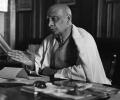
Generations of Indians don't quite grasp that there would barely be an India had it not been for the Sardar whose steadfastness and guile stitched together that which had been united only in philosophy and spirituality and sometimes not even then -- for thousands of years. A fascinating excerpt from Hindol Sengupta's The Man Who Saved India, Sardar Patel and His Idea of India.

Greeks greeted news of a deal with creditors on Monday with a measure of relief mixed with much anger.
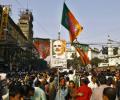
It has been said that by 2025, India could become among the top five economies in the world. If India does become a $5 trillion economy but gets all its rivers polluted, food chain poisoned and genetic pool depleted and biometric database of Indians sold or stolen at the behest of commercial czars, will it not be a pyrrhic economic victory, asks Gopal Krishna.
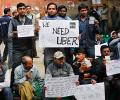
The whole point about this is not who eventually wins or loses but how, in just a few years, technology has so changed our lives, says Subir Roy.
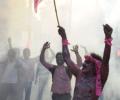
Sheela Bhatt lists ten quick takeaways from the passage of the Telangana bill in the Lok Sabha.
'The BJP currently occupies the centre stage of Indian politics, much the way the Congress did in the 1970s. That may be comforting to the party, but it could also be the road to perdition of easy self-congratulation and sycophancy.'
The spectre of Singur and now its verdict is looming large on the future of many of Bengal's projects, especially the state government's industrial parks that are vacant. As many more episodes await, the question uppermost on everyone's minds is, how long will Singur haunt Bengal?

Performance counts more than populist slogans when you are in power, says N Sathiya Moorthy.

Before considering reducing the freedom of private investors in the derivatives market, we need to check if the maladies in markets elsewhere exist in India, says Susan Thomas.

'When the Brexit bomb goes off, the shrapnel will wound us.' 'We will in the time-honoured tradition apply band-aids all over.' 'Those who shout the loudest will get economic relief like interest rate reduction and debt restructuring.' 'Others will go on living lives of quiet despair,' says S Muralidharan.
'The BJP can kill two birds with one stone by wresting back control of the message; and the steps are fairly obvious. Once the media is neutral, there is a level playing field,' argues Rajeev Srinivasan.
Maharashtra politics is at crossroads. Anything can happen in this dynamic situation. Uddhav will have to prove he is a worthy inheritor of his father's legacy and keep his cadre and leaders in the party stable. Fadnavis will have to prove that manoeuvrings on floor of the house was an inevitable political necessity to change the destiny of Maharashtra eventually. Modi and Shah will have to show that they can and will are resist use of 'the system' in the pursuit of power. Sheela Bhatt/Rediff.com analyses the situation.
Gujarat Lokayukta Justice R A Mehta's resignation letter is a stinging indictment of the Narendra Modi government's obstructionist attitude towards a constitutional watchdog.
 © 2026 Rediff.com - Investor Information - Advertise with us - Disclaimer - Privacy Policy - Sitemap - Feedback - About us - Terms of use - Grievances