
Axis Bank and ICICI Bank consumed 37-59 per cent of their operating profit for COVID-19 provisioning, while the figure is 24 per cent in case of Kotak Mahindra Bank and 10-12 per cent for IndusInd Bank and HDFC Bank.

PSBs have been requested to reach out to MSMEs to provide bill discounting to them against their dues since they suffer the most from shortage of cash.

Finance Minister P Chidambaram on Monday favoured mergers in the banking industry so that India can have two-three global sized banks.

If the banks throw caution to the winds for building loan books, the hydra-headed bad loans may resurface and spoil the party, warns Tamal Bandyopadhyay.

Despite unprecedented levels of uncertainty in Samvat 2077, investors have little to complain about on the returns front. The BSE Sensex delivered returns of 38 per cent in this period, while the Nifty registered a return of over 40 per cent. As is the case in bull markets, companies in the small- and mid-capitalisation basket outperformed the benchmarks, with returns almost twice those of frontliners.
The government is likely to infuse additional capital of Rs 20,000 crore in the public sector banks next financial year to meet Basel III global capital risk norms.

Dissatisfied with the wage hike offer made by Indian Banks' Association (IBA), public sector lenders' employee unions on Monday threatened to go on a two-day strike from February 10.

As industrialist Vijay Mallya fights his wilful defaulter tag, former CAG Vinod Rai has said Kingfisher Airlines' loan default is just a "trickle" and the overall problem of huge bad loans at public sector banks can be blamed on 'cronies' using connections to borrow money.
Pranab Mukherjee proposed a separate entity for bank recapitalization.

'The Insolvency and Bankruptcy Code is neither beneficial to banks nor helpful for the borrower.' 'Genuine people who are caught in economic stagnation will lose everything and thousands will lose jobs.'

Non-performing assets of banks have increased from Rs 2.75 lakh crore in March 2015 to Rs 7.33 lakh crore as on June 2017.
As many as seven firms, including JM Financial, Ernst and Young and Deloitte, have bid for managing the strategic sale of IDBI Bank. These firms would make a virtual presentation before the Department of Investment and Public Asset Management, which is handling the sale process, on August 10, according to a notice by DIPAM. The firms that have bid for acting as transaction advisor are Deloitte Touche Tohmatsu India LLP, Ernst and Young LLP, ICICI Securities, JM Financial Ltd, KPMG, RBSA Capital Advisors LLP and SBI Capital Markets.

With a view to protect prudent commercial decision of bankers, the government has taken a slew of decisions, including doing away with personal responsibilities of MD and CEO of PSBs for compliance in dealing with large value frauds committed by bank officials.

Most of the lenders had informed their customers in advance about the strike call given by All India Bank Employees Association (AIBEA), All India Bank Officers' Association (AIBOA), BEFI, INBEF, INBOC and Bank Karmachari Sena Mahasangh (BKSM), and its impact on banking services.
It's going to be another predictable quarter for banks. Slower credit growth, high interest rates and deteriorating asset quality will continue to haunt the sector, especially public sector banks.

Banks need to raise capital to comply with Basel III norms. This mode of raising money gives all shareholders equal investment opportunity.

Amid strong opposition from CIL workers union to the proposed stake sale in the company, Finance Minister P Chidambaram has said the disinvestment proceeds of about Rs 20,000 crore (Rs 200 billion) from the coal behemoth will be invested in public sector banks.

The government on Thursday approved a proposal to inject Rs 12,517 crore in public sector banks to help them enhance the lending activity and meet the capital adequacy norms.
What's worrying for the public sector banks is the rise in delinquency in the housing portfolio, which does not include real estate. But a bank chief said that with low exposure to the real estate sector, the state-run banks have fewer worries. The other area of concern is credit cards but the operations of public sector banks in this segment are small compared with the likes of ICICI Bank, HDFC Bank and Citibank, the largest players in the business.

Some of the services like cash deposit and withdrawal at the counter and cheque clearances have been impacted due to the strike by banking staff.

The biggest challenge with public sector banks is the processing time, which is why starting early helps.

As many as 8.5 lakh bank employees are set to benefit from the wage hike, which will be effective from November 2017.

The Indian economy requires a Rs 3 lakh crore fiscal stimulus, including cash transfer to households through Jan Dhan accounts to spur economic growth amid the pandemic, industry chamber CII said on Thursday and pitched for appointment of a 'Vaccine Czar' for speedy vaccination coverage. CII president T V Narendran also said the chamber expects GDP to grow at 9.5 per cent in 2021-22 as the strong growth in the second half of the fiscal year will be supported by robust external demand and large-scale coverage of vaccination, allowing resumption of economic activity. He also advocated for appointment of a "Vaccine Czar" for speedy vaccination coverage.

Further, Finance Minister Nirmala Sitharaman said the banks have sufficient liquidity, and efforts are being made to ensure that due payments are released to the micro, small and medium enterprises (MSME) sector by large corporates.
Corruption cases in public sector banks have reduced by half in the past one year, chairman of the Parliamentary Standing Committee on Personnel, Public Grievances, Law and Justice, E M Sudarsana Natchiappan, said on Wednesday.

One thing is for sure: It smacks of the regulator's lack of confidence in the bank's board, points out Tamal Bandyopadhyay.

'The PSBs ended up recording Rs 7,709 crore losses in the March quarter compared to the Rs 11,688 crore profits of their private peers,' reveals Tamal Bandyopadhyay.
State-run banks accounted for nearly two-third of the customer complaints received during the last financial year, the Reserve Bank of India (RBI) on Thursday said in its report on trend and progress of banking in the country.
Also, there were not many clients in the market as they had already made alternate arrangements due to the strike.

This is following revival of demand from the corporate sector and small and medium enterprises (SMEs), even as a nascent economic recovery is taking shape. Credit growth of scheduled commercial banks had accelerated to 9.2 per cent year-on-year (YoY) by the end of December 2021 after breaching the 7 per cent-mark in November, for the first time since April 2020.
Some banks have seen gross non-performing assets as high as 15 per cent in their education loan portfolios.

India's equity markets are on a roller-coaster ride, after delivering spectacular returns for two consecutive years - in 2020 and 2021. The benchmark National Stock Exchange's (NSE's) Nifty50 is down 1.5 per cent in the first nine months of the current calendar year 2022 (CY22) as foreign portfolio investors sold Indian stocks due to rising bond yields in the US and across global markets, including India. The sell-off in the Indian equity markets has, however, not been broad-based and largely limited to sectors facing earnings headwinds from rising interest rates, lower commodity and energy prices, and likely economic recession in advanced economies.

The NITI Aayog has recommended privatisation of state-owned insurer United India Insurance Company as the government aims to move ahead with its new public sector enterprise (PSE) policy for Atmanirbhar Bharat. The policy think tank has suggested that the public sector insurer be considered for privatisation in the banking, insurance and financial services sector, which has been classified as 'strategic' in the PSE policy, said an official. The policy proposes the "bare minimum" presence of government-owned companies in strategic sectors, and privatisation, merger or closure of remaining public sector undertakings (PSUs).

The overall debt servicing metrics of Indian corporates are weak.

The government may delay Rs 14,000 crore (Rs 140 billion) fund infusion in the public sector banks in view of volatile market conditions.

While Chanda Kochhar got a pay of Rs 2.66 crore, Arundhati Bhattacharya took home only Rs 28.96 lakh

Bankers seem to be pleased with the government for keeping its promise of not interfering in operational matters, but are apprehensive about the intense scrutiny of their functioning.

The current process for selecting auditors could compromise their "independence".
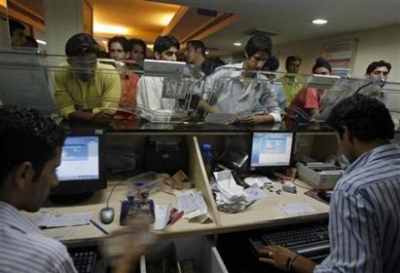
Bringing down government stakes would augment their capital.
"The life of a Finance Minister is not easy. Various players, including policy makers, politicians, agriculturists and business houses, participate in the making of the economy."
 © 2026 Rediff.com - Investor Information - Advertise with us - Disclaimer - Privacy Policy - Sitemap - Feedback - About us - Terms of use - Grievances