
Banks do extensive investigation before declaring an account fraud; they owe it to us as they deal with our money. Why would they try to fix an innocent borrower? asks Tamal Bandyopadhyay.

This shortfall could continue to hurt loan growth in 2016-17.

The effect of the HDFC-HDFC?Bank merger will be for the bigger space of the Indian financial sector and not just limited to the banking sector. The large finance companies have practically no benefit of regulatory arbitrage. Earlier, such arbitrage between banks and NBFCs was normal. The logic of the merger is very clear - the cost of borrowing of banks is lower.

The Centre is looking to continue maintaining an arms length in financial sector appointments.

Reversing the burden of evidence means that the principle of innocent until proven guilty does not apply. It is exactly the opposite: Guilty as charged, until you can convince the judges of the contrary, points out Shekhar Gupta.

Nationalisation has served its purpose. It's time to move ahead, keeping majority ownership of the government in a few banks to serve the people, argues Tamal Bandyopadhyay.

Under the Indradhanush roadmap announced in 2015, the government will infuse Rs 70,000 crore in state banks over four years while they will have to raise a further Rs 1.1 trillion from the markets to meet their capital requirement in line with global risk norms, known as Basel III.

Between April and August, it issued request seeking LoC against 147 individuals to prevent them from leaving the country, the bank said in response to a Right to Information query filed by Pune-based activist Vihar Durve.

The government has recapitalised public sector banks (PSBs) by infusing over Rs 3.10 lakh crore in the last five fiscals, a majority of which was through issuance of recapitalisation bonds, Parliament was informed on Monday. "Government has infused Rs 3,10,997 crore to recapitalise banks during the last five financial years i.e., from 2016-17 to 2020-21, out of which Rs 34,997 crore were sourced through budgetary allocation and Rs 2,76,000 crore through issuance of recapitalisation bonds to these banks," Minister of State for Finance Bhagwat Karad said in a written reply in the Lok Sabha. He was responding to a host of questions asked by Congress party's Member of Parliament Manish Tewari.

The meeting will review annual financial performance of public sector banks, credit offtake in the economy, priority sector lending and progress made under various social sector schemes, including Atal Pension Yojana (APY) and Pradhan Mantri Jan Dhan Yojana.
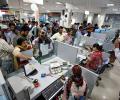
Amid slowdown blues, the government has unveiled a raft of measures over the past few months aimed at improving liquidity in the system, moderating interest rates as well as credit growth apart from addressing stress in the NBFC sector.

The government has invited applications for the post of chief economic adviser (CEA) to replace K V Subramanian, who will complete his three-year tenure next month. Subramanian was appointed as CEA on December 7, 2018, while he assumed charge on December 24 in the same year. As per the public notice dated October 24, 2021 issued by Department of Economic Affairs, the Ministry of Finance, officer of central, state governments, RBI and public sector banks holding analogous post on regular basis in parent cadres or department are eligible to apply for the post.

Rajiv Kumar is a retired IAS officer of 1984 batch of Jharkhand cadre.

Could it have been more reformist? Of course, but this is an election year Budget, observes Akash Prakash.

The Indian economy has recovered 'handsomely' from the pandemic-induced disruptions, former Niti Aayog vice chairman Arvind Panagariya said on Tuesday, while expressing hope that the recovery will be sustained and the growth rate of 7 to 8 per cent will be restored. Panagariya suggested that the government must now signal its intention to wind down fiscal deficit by cutting it by half-to-one percentage point in 2022-23. "The Indian economy has recovered handsomely, returning to its pre-COVID GDP... "Only private consumption is still below its pre-COVID-19 level," the eminent economist told PTI in an interview.

The Cabinet on Wednesday gave in-principle approval for strategic disinvestment along with transfer of management control in IDBI Bank in line with the Budget announcement earlier this year. The central government and LIC together own more than 94 per cent equity of IDBI Bank. LIC, currently the promoter of IDBI Bank with management control, has a 49.21 per cent stake. The Cabinet Committee on Economic Affairs chaired by Prime Minister Narendra Modi approved the strategic sale of IDBI Bank, an official statement said on Wednesday.

The branch managers have come out of their glass cabins and the sellers' market has transformed into a buyers' market, but there is no end to the harassment of customers, asserts Tamal Bandyopadhyay.

'It's a clear case of political patronage helping an individual grow.'

Modi government's story of five years with regard to equity allocation for PSUs shows that it may have allowed a large part of its resources to be wasted. This is also a worrying reflection of the government's inability to take hard decisions - whether they pertain to privatisation or forcing weak public-sector banks to wind down their operations, says A K Bhattacharya.

Banks looking to raise capital via bond sales to fund decade-high credit growth were compelled to put some of these debt issuances on hold amid a sharp rise in yields since late September, sources told Business Standard. A major private lender, Axis Bank, has not yet followed through with a planned issuance of infrastructure bonds worth around Rs 3,000 crore. This is because volatility in the bond market in late September led to investors seeking higher yields, sources said.

The finance minister has emphasised on the quick disbursal of additional loans to MSMEs, to simplify process, formats and documentation.

Finance Minister Nirmala Sitharaman on Tuesday said the interest of all employees of state-owned banks which are likely to be privatised will be protected, even as bank unions observed a two-day strike against the government's privatisation decision. Replying to a query during a press conference, she clarified that public sector presence will continue in the banking space. "...we have announced public enterprise policy based on which we have identified those four areas in which we said government presence, public sector presence will be there, and bare minimum presence is what we have said, in that financial institutions are also there. "Meaning, even in financial sector we will still have the presence of public sector enterprise...not all of them are going to be privatised," she said.

All transfers and promotions for next financial year will be decided by respective banks, not by the merged entity.

A paper authored by Rajan said, state-linked banks can be a first step in altering the ownership structure of some PSBs, where the government brings down its stakes to below 50 per cent, creating distance from operations of banks, and improving governance along the way.

The Supreme Court (SC) on Monday slapped a fine of Rs 2000 ($25) and a four-month jail sentence on fugitive businessman Vijay Mallya. In addition, the former liquor baron has been asked to deposit $40 million with 8 per cent interest within a month, failing which his properties would be attached to recover the amount. The court held Mallya guilty of contempt after it was brought to its notice that he had transferred $40 million to his children in the US.
'The worst is over, but it may take a couple more years for the banking system to re-establish the growth process.' 'Banks are the major pillars in an economy's revival.' 'Without banking operations and lending, revival will not happen.'

Coming Wednesday, Finance Minister (FM) Nirmala Sitharaman will present the 2023 Union Budget - the last full Budget ahead of the 2024 Lok Sabha elections. While India exited 2022 as a relatively bright spot in the global economy, the FM will endeavour to present a Budget that insulates India's economy against global headwinds and recession in advanced economies, while sticking to the path of fiscal consolidation. In this, she is being helped by her core team of trusted advisors.
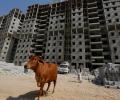
Property buyers fund the project cost and the entire debt and entire equity servicing, and yet, have no locus standi in the IBC process, points out Debashis Basu.

'Every few days, I wake up with a sense of restlessness that time is running out'... 'We have created a due process for stressed assets to resolve, but there is no concrete plan in place for public sector bank balance sheets,' says RBI Deputy Governor Viral Acharya.

Moody's Investors Service on Thursday said second wave of Covid infections has increased asset risks for Indian banks, but a severe deterioration is unlikely. It said that the second wave of coronavirus infections in India has exacerbated stress among individuals and small businesses that were hit the hardest by the initial outbreak. Still, a number of factors will prevent sharp increases in problem loans, and banks have sufficient buffers to absorb anticipated loan losses.

The government has amended rules of the Foreign Exchange Management Act (FEMA), paving the way for up to 20 per cent foreign direct investment in the insurance behemoth LIC. The government is planning to dilute its stake in LIC through the the Initial Public Offering (IPO). LIC in February had filed the Draft Red Herring Prospectus (DRHP) before the markets regulator Sebi for the IPO.

During the first half of the financial year 2021-22, the reported number of fraud cases in various banking operations increased to 4,071 as against 3,499 in the year-ago period, the RBI's Report on Trend and Progress of Banking in India 2020-21 showed. However, the amount involved in frauds in various banking operations based on the date of reporting declined to Rs 36,342 crore during April-September 2021 from Rs 64,261 crore in the corresponding period of the previous financial year, the report said on Tuesday. In H1 2021-22, banks saw 1,802 reported cases of frauds amounting to Rs 35,060 crore which were related to advances.

Here's how the move will affect the banks' customers.

Addressing the 74th Annual General Meeting of the Indian Banks' Association (IBA), she said the industry needs to imagine how Indian banking has to be in the immediate and long-term future. As far as the long-term future is concerned, she said it is going to be largely driven by digitised processes and there is a need for seamless and interconnected digital systems for a sustainable future for the Indian banking industry.

Rising non-performing assets are a biggest concern for India's PSU banks.

The most important positive of India's stealth bull market is earnings growth across different sectors, explains Debashis Basu.

No government can 'ignore inclusiveness in a democracy', Montek Singh Ahluwalia tells Anjuli Bhargava.

'This plan is basically to allow some of the government assets for rent, and surely not for sale.' 'There is a difference between selling a house and renting out a house.'

12 out of 21 public sector banks reported declines in their loan books in the last financial year against seven such banks in 2015-16 and none in 2013-14.
Private sector lender ICICI Bank has revised its external benchmark lending rate (EBLR) to 8.10 per cent, and state-owned Bank of Baroda has raised the rate to 6.90 per cent with immediate effect after the RBI hiked the key repo rate. Likewise, two other public sector banks -- Bank of India and Central Bank of India -- have also raised the repo linked lending rate. In an out of turn Monetary Committee Meeting (MPC), the Reserve Bank on Wednesday announced to hike the benchmark repo rate -- the short term lending rate it charges to banks -- by 0.40 per cent to 4.40 per cent with immediate effect, aimed at taming the rising inflation caused by the global geopolitical situation.
 © 2026 Rediff.com - Investor Information - Advertise with us - Disclaimer - Privacy Policy - Sitemap - Feedback - About us - Terms of use - Grievances