
Digital Personal Data Protection (DPDP) law aims to protect the privacy of Indian citizens while proposing a penalty of up to Rs 250 crore on entities for misusing or failing to protect digital data of individuals.

Information and Broadcasting Minister Prakash Javadekar said the Bill will be introduced in Parliament during the current Winter Session.

The new rules allow for a staggered implementation road map, giving companies, data fiduciaries, data principals, and other stakeholders up to 18 months to comply with the administrative guidelines under the DPDP Act.

The biggest fear many of the e-commerce firms have is the possible requirement to change business models overnight, which would drastically increase costs as well as disrupt businesses.

The US on Thursday raised concerns over India's Personal Data Protection (PDP) Bill and draft non-personal data governance framework, claiming these could potentially threaten innovation and economic growth. In its latest 'Special 301' Report, the US Trade Representative (USTR) kept India on the priority watch list, maintaining the country remains one of the world's most challenging major economies with respect to protection and enforcement of intellectual property (IP). In December 2021, a joint parliamentary committee released a report recommending changes to the PDP Bill, 2019, that could undermine important IP protections in India.

Parliamentary Affairs Minister Prahlad Joshi has said that 31 bills will be taken up in the monsoon session. Among these include the Digital Personal Data Protection Bill, 2023.
The government has raised the penalty amount to up to Rs 500 crore for violating the provisions proposed under the draft Digital Personal Data Protection Bill 2022 issued on Friday. The draft personal data protection bill in 2019 proposed a penalty of Rs 15 crore or 4 per cent of the global turnover of an entity. The draft proposes to set up a Data Protection Board of India, which will carry on functions as per the provisions of the bill.

The JCP was constituted in the Lok Sabha in December 2019 and was expected to submit its report in the Budget Session.

The government will investigate a claim that WhatsApp accessed the microphone of smartphone users while the phone was not in use, Minister of State for Electronics and Information Technology Rajeev Chandrasekhar said on Wednesday.

The government on Wednesday withdrew the Personal Data Protection Bill from Lok Sabha and said it will come out with a 'set of fresh legislations' that will fit into the comprehensive legal framework.

The government on Thursday tabled the Digital Personal Data Protection Bill 2023 in the Lok Sabha with an aim to protect the privacy of Indian citizens, while proposing a penalty of up to Rs 250 crore on entities for misusing or failing to protect digital data of individuals.

The data protection bill introduced in Parliament on Thursday enables the government "to call for information" from data protection board, data collecting entities or intermediary, and safeguards the Centre from legal proceedings for "action taken in good faith" under the provisions of the legislation.

The digital platforms are responsible and accountable for ensuring the safety of 'digital nagriks', the minister said, adding that the government will respond to every instance of alleged misuse or alleged breach of users' privacy.

Significant controls and exemptions to the government under the proposed Digital Personal Data Protection bill 2022 are likely to make it harder for companies to invest in data centres and data processing activities in India, according to global technology industry body ITI. The ministry of electronics and IT has floated draft Digital Personal Data Protection (DPDP) Bill 2022 and has invited comments on the same till January 2. "The Bill grants significant controls to the executive arm of GOI (Government of India) and delegates much of the detailed rulemaking authority to separate, as yet undefined processes.

After withdrawing the personal data protection bill, the government is hopeful of getting a new legislation passed by the next Budget session of Parliament, Union minister Ashwini Vaishnaw has said. The government on Wednesday withdrew the Personal Data Protection Bill from the Lok Sabha. The Joint Committee on Personal Data Protection Bill, 2019, headed by BJP member P P Chaudhary, had tabled its report in Lok Sabha on December 16, 2021.
After withdrawing the personal data protection bill, the government is hopeful of getting a new legislation passed by the next Budget session of Parliament, Union Minister Ashwini Vaishnaw has said.

At the outset, all eyes will be on the Lok Sabha Secretariat on Monday when it is expected to review the stay granted by the Supreme Court on the conviction of Rahul Gandhi in the 'Modi surname' case and decide on the revocation of his Parliament membership.

Hours after Congress leader Manish Tewari on Thursday said the government might get the Digital Data Protection Bill classified as a money bill, Union IT Minister Ashwini Vaishnaw refuted the charge and termed it a "normal bill".
The government will "notify such countries or territories outside India to which a data fiduciary may transfer personal data", according to the draft unveiled on Friday for public feedback.
During an open house discussion with stakeholders on the draft Digital Personal Data Protection (DPDP) bill 2022, Chandrasekhar said that the right to privacy is a fundamental right while the right to information is not. "Right to privacy is a fundamental right and right to information is not.
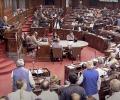
Opposition alliance INDIA on Thursday boycotted a meeting of the Business Advisory Committee (BAC) of the Rajya Sabha to protest Prime Minister Narendra Modi not making a statement on Manipur violence in Parliament, a senior leader said.

The panel will likely play an important role as the Personal Data Protection Bill gets tabled in Parliament.

The productivity of the Budget session was abysmal. The Lok Sabha functioned for 33% of its scheduled time (46 hours); the Rajya Sabha 24% (32 hours).

If the Personal Data Protection Bill gets passed in its present form, a new class of companies and entities could emerge. The sole job of these new entities would be to manage the consent for data usage of a user.Banks, healthcare firms and fintech companies, among others, fear that sharing non-personal data with the government may hurt business interests. Banks also fear the threat of data misuse.
The Rajya Sabha on Wednesday passed the Digital Personal Data Protection Bill 2023 by voice vote following a walkout by opposition members over the Manipur issue.

The Centre's claim has been made in an additional affidavit filed in response to several pleas challenging the new privacy policy of WhatsApp.

MeitY had stated there was a need to set up GACs as grievance officers hired by the platforms often did not address issues satisfactorily.

Both Lok Sabha and Rajya Sabha did not see a debate on the Manipur violence, but Prime Minister Narendra Modi and Home Minister Amit Shah spoke on it during their addresses on the no-confidence motion.

One fallout of Rahul Gandhi's disqualification will be reflected in the Opposition's role in Parliament and related institutions.

Women are a minuscule minority of those arrested under the IT Act.

The 54-year-old Lekhi, who took oath as a Union Minister of State on Wednesday on her second term as the MP from the prestigious New Delhi constituency, has been at the forefront of struggles on a host of issues ranging from those pertaining to women and environment to law and development.
'There were two options before the government -- create a complex, cumbersome law, which will cause a tremendous amount of compliance challenges for startups or say let's go back and do a clean slate, where we do a framework of laws and policies'

The action was taken under Section 69A of the Act that empowers the government to block any information generated, transmitted, received, stored or hosted in any computer resource in the interest of sovereignty and integrity of India, defence of India, security of the state, friendly relations with foreign states or public order or for preventing incitement to the commission of any cognisable offence.

Tharoor argued that the proposed bill represents a "grave chapter in the history of the Indian republic, seeking to ratify an ordinance that in many ways is an assault on our democratic heritage and the spirit of federalism."

In a first of its kind move, the Indian Railways Catering and Tourism Corporation (IRCTC), the ticket booking arm of the Indian Railways, is looking to monetise its bank of passenger data while conducting business with private and government companies. IRCTC has a large bank of data related to every online railway ticket ever generated as it is the country's only railway ticketing platform, an IRCTC official told Business Standard. The public sector undertaking, which has sought the services of a consultant to assist with the monetisation process, plans to raise Rs 1,000 crore through this exercise.

It is sad that the legislative pre-consultation on such an important bill is being done in a very biased manner, notes Shailesh Gandhi, former Central Information Commissioner, recounting his experience with Minister Rajeev Chandrashekhar.
After the first draft of the Bill was submitted under a committee chaired by Justice B N Srikrishna in 2018, there were objections raised by businesses, especially on the broad restrictions on cross-border data flow.

Representatives of Facebook India have been asked to appear on Friday before the Joint Committee on the Personal Data Protection Bill, 2019, chaired by Bharatiya Janata Party MP Meenakshi Lekhi, while Twitter officials are required to appear before the panel on October 28, as per the notice issued by the Lok Sabha Secretariat.

Ashok Kumar Gupta, chairman of the Competition Commission of India (CCI), has never minced words while talking about the giant technology companies, referring to them on multiple occasions as "centres for entrenched and unchecked dominance". The anti-trust regulator has, in fact, been cracking down on big technology companies such as Google, Apple, Facebook, and others, after they were hauled up by regulators and lawmakers in Europe and Australia. However, in several instances, existing regulations have prevented the CCI from going all out against these companies for anti-competitive activities.
 © 2026 Rediff.com - Investor Information - Advertise with us - Disclaimer - Privacy Policy - Sitemap - Feedback - About us - Terms of use - Grievances