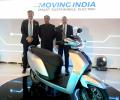
With its new premium Primus and Ampere NXG, it is targeting buyers seeking a faster and more stylish ride

The EV industry is at an inflection point and batteries will play a critical role ahead -- batteries and related components typically constitute 35-45 per cent of an EV's costs.

In a boost to the electric vehicle boom in India, Taiwanese major Hon Hai Technology Group (aka Foxconn) is likely to set up an EV manufacturing unit in India through its subsidiary Foxtron. Amid speculation that the company may look at Tamil Nadu and probably the Ford India unit near Chennai for its new facility, sources indicate that the group was already betting big in the electric vehicle component space in India through Bharat FIH, which is already having a tie up with companies like Ola Electric and Ather. Bharat FIH currently has two manufacturing units in Tamil Nadu's Sriperumbudur that manufactures phones like Apple iPhones and Xiaomi phones.

Electric vehicle retail sales in the country witnessed over three-fold jump last fiscal with two-wheeler offtake leading the segment, according to data compiled by automobile dealers' body FADA. Total electric vehicle (EV) retails reached 4,29,217 units in 2021-22, a rise of three-fold from 1,34,821 units in the financial year 2020-21, the industry body said. Total EV sales had stood at 1,68,300 units in the 2019-20 fiscal, it noted.

China's covid crisis could provoke a raw material crunch for India's EV industry later this year.

To ramp up domestic battery manufacturing capacity and reduce the dependence on imports, the government has initiated talks with a few lithium-rich countries to supply the mineral to Indian companies, industry sources informed Business Standard. The Ministry of External Affairs (MEA) held a meeting with the ambassadors of countries, including Argentina, Chile, and Bolivia, among others, to put forth its request.

A team of more than 60 people under Neeraj Mittal, an IAS officer, was instrumental in getting up the New Industrial Policy 2021 targeting investments of around Rs 10 trillion by 2025.
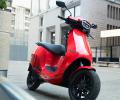
The government-appointed expert committee, which probes incidents of Ola Electric's S1 Pro and Okinawa vehicles catching fires, has added the latest case of fire involving PureEV electric scooter to its investigation, a senior government official told Business Standard. "A team comprising experts from Indian Institute of Science (IISC) and Centre for Fire, Explosive and Environment Safety (CFEES) are investigating the cases. "As soon as the report is submitted, we shall take appropriate action," said Giridhar Aramane, secretary at the ministry of road transport and highways.
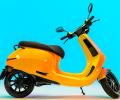
The entry of SoftBank-backed Ola into the electric scooter (e-scooter) segment is set to power up the overall market and perhaps fast-track the adoption of battery-operated vehicles. But for manufacturers of internal combustion engine (ICE)-powered two-wheelers, such as Bajaj Auto, Hero MotoCorp, and TVS Motor, it will be a double whammy. Not only will they have to contend with the aggressive pricing of Ola's scooter and incur a loss at each unit of the e-scooter sold, the volumes of their regular (ICE) models, too, could feel the squeeze, observed analysts. Ola is expected to price its e-scooter in the range of Rs 85,000-1.1 lakh.

US hedge fund Tiger Global and Japanese investment giant SoftBank have trimmed their investments in Indian start-ups by over a third - from $3.8 billion in the second half of 2021 to a mere $1.08 billion in H1 2022, according to data from Venture Intelligence. While SoftBank's investments in India dropped from $1.9 billion in H2 2021 by more than a fifth to only $0.33 billion in H1 2022, that of Tiger Global fell from $1.92 to $0.74 billion in the same period. Private equity (PE) fund trackers point out that this year most of the deals that Tiger Global has invested in are in the early stage (up to series D), and only a few are in the series E and above.
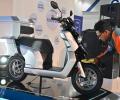
as the FAME II deadline of March 31, 2024, nears, EV manufacturers are worried about their investments and future plans.

Recently, TPEM's first born electric concept, Avinya broke cover. The model promises a minimum range of 500 kilometres and advanced technology features, aimed at buyers in India and outside. TPEM, the newly formed entity may also consider a separate dedicated sales channel for the EVs with a distinctive corporate identity once the volumes reach a critical mass and throughput is large enough for the dealers to be profitable, said Chandra. Elaborating further on the hiring strategy he said, "We will hire from everywhere-wherever the talent of the required competency is available."

Ford, which had announced to quit the Indian market last year, said it was exploring the possibility of using one of its plants in India to produce electric cars for exports.

For every one experienced candidate being recruited by e-two wheeler companies, 10 have no prior experience; recruitments are for skilled, low-end jobs, not for managerial or supervisory roles.
Ride-hailing major Ola on Wednesday said it will launch its electric two-wheeler range in New Zealand. This will help support the New Zealand government's goal of bringing on road 64,000 new electric vehicles by the end of 2021, while also helping the public sector become carbon neutral by 2025, Ola said in a statement. According to the industry sources, the company plans to launch the range in New Zealand over the next 6-9 months.

After a recent fall in profit, Masayoshi Son of SoftBank announced that the Japanese tech investor will look at dramatic cost-cutting. Before he does that, investments in India for calendar year 2022 (CY22) will fall radically, observed sources in the know. Last year, the company had invested around $3.2-3.5 billion in the Indian start-up ecosystem - almost 10 per cent of the total investment the sector received. For CY22, the investments may not even touch $1 billion.

Ola's factory will create 10,000 jobs and serve as the company's global manufacturing hub for India and international markets.

The aim is to replace nearly 40 per cent of its existing last mile fleet of delivery vans with EVs by March 2020. o start with, the company is looking at deploying nearly 160 e-vans by the end of 2019.

The car was expected to have a price tag of Rs 10 lakh and launch was slated for this June.

Palo Alto-based electric carmaker Tesla has initiated talks with the government on the modalities of setting up fully-owned retail outlets. The company needs to comply with the foreign direct investment (FDI) guidelines related to single-brand retail, including local sourcing norms, to sell directly in India. At least two other foreign majors - Apple and Ikea - were engaged in talks with the government long before the sourcing norms were eased under the single-brand retail route.

These start-ups include high-growth companies such as Ola, Paytm, Lenskart, UrbanClap and Urban Ladder. Nearly half of these have gone on to raise follow-on funding, a key measure of success for start-ups. A few have become unicorns, the term for start-ups valued at $1 billion or more.

Of the 1,145 offers made this year, consulting firms made up 34 per cent, followed by banking, financial services and insurance, pharma/healthcare, IT/ITeS and FMCG/retail.

The $306-million investment in Ola Electric Mobility by SoftBank Corp, Arun Sarin Family, Ratan Tata and Matrix has been the biggest funding in this space in value terms this year.

With the 21 unicorns collectively valued at $73.2 billion, India is the fourth biggest in terms of unicorns, behind the US, China and the UK, as per the Hurun Global Unicorn List.

The company, which rents cars by the hour, day, week and month, has Mahindra E2O Plus and Tata E Tigor available on the platform for which it charges a subscription fee of Rs 15,000-20,000 per month.

The promoter-brothers, distant cousins to IndiGo's Rahul Bhatia, are eyeing Air India's ground handling subsidiary to augment their aviation services business even as they make a big play in EVs.

What will it take for Tesla to plug and play in India? Sector pundits say it's a mix of strategy, getting the price right, timing, the right talent, and above all, patience.

Ola was supposed to expand to the Netherlands, Kenya, Dubai, Israel, and Brazil.
Even at early stage, start-ups are raising more money faster owing to the rise of a lot of specialised early-stage VCs and emergence of seed-stage programmes.
 © 2026 Rediff.com - Investor Information - Advertise with us - Disclaimer - Privacy Policy - Sitemap - Feedback - About us - Terms of use - Grievances