
This comes a day after President Droupadi Murmu gave her assent to the Viksit Bharat Guarantee for Rozgar and Ajeevika Mission (Gramin) (VB-G RAM G) Bill, which replaces the MGNREGA and has a provision for 125 days of wage employment for rural workers.
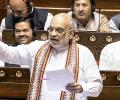
In his notice to the chairman of the Rajya Sabha, the Congress leader alleged that the home minister had made unfounded allegations against chairperson of Congress parliamentary party with "a premeditated motive to malign her reputation."
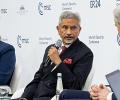
India's External Affairs Minister S Jaishankar countered a US senator's claim that democracy does not put food on the table, citing India's PMGKAY program which provides food to 800 million people. Jaishankar argued that different parts of the world have different experiences with democracy and that the model of globalization has contributed to issues with democracy in some regions. He emphasized that India's democratic system effectively delivers food security, highlighting the PMGKAY program as an example.
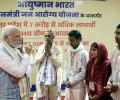
According to a parliamentary response by the Union health ministry in 2023, around 654,000 families in Delhi are eligible to enrol under the scheme.

The Supreme Court of India expressed concerns about the long-term sustainability of providing free rations to migrant workers, emphasizing the need for job creation and capacity building instead. The court's remarks came during a hearing on the ongoing issue of providing relief to migrant workers, a matter that gained prominence during the COVID-19 pandemic. The court questioned the government's reliance on freebies and stressed the importance of creating opportunities for migrant workers to become self-sufficient. The debate highlighted the challenges of balancing immediate relief with long-term economic solutions for vulnerable populations.

The government has extended the PMGKAY scheme to provide 5 kg free foodgrains per month to around 80 crore poor people for another five years. A decision in this regard was taken in the meeting of the Cabinet, chaired by Prime Minister Narendra Modi, on Tuesday. Giving details on Wednesday, Information and Broadcasting Minister Anurag Thakur said the Pradhan Mantri Garib Kalyan Anna Yojana (PMGKAY) has been extended for another five years from January 1, 2024.

The government has extended the Pradhan Mantri Garib Kalyan Anna Yojana (PMGKAY) scheme to provide 5 kilogrammes of free foodgrains per month to around 80 crore poor people for another five years.

The order said 865 villages from 12 tehsils in Belagavi, Karvar, Kalburgi and Bidar have been included under the Mahatma Jyotirao Phule Jan Arogya Yojana.
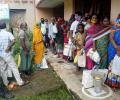
A bench of Justices MR Shah and Hima Kohli directed the Centre to submit a fresh chart with the number of migrant and unorganised sector workers registered on eShram portal.
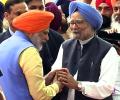
Whether it was the MGNREGS or the NFSA or the Aadhaar-based DBT scheme for cash transfer, the Modi government has built on the basic architecture created by the Singh government. Policy makers in the Modi government, instead of discarding them as products of the previous political regime, worked on them, expanded their scope and reach, and used new tools to improve their performance, explains A K Bhattacharya.

Is it a case of poor targeting of a welfare scheme, or is it a reflection of the government's desire to expand the scope of this benefit to secure greater electoral dividends? asks A K Bhattacharya.

The Union Cabinet on Wednesday approved a proposal to extend distribution of 5 kg foodgrains per month for free under the Pradhan Mantri Garib Anna Yojana (PMGKAY) to over 80 crore ration card holders for four months till March 2022, a decision that will cost an additional Rs 53,344 crore to the exchequer.
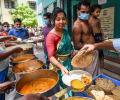
The government on Wednesday extended by three months its programme to provide free rations to the poor at a cost of Rs 44,762 crore as it looked to ease pain from high inflation and make political gains in the upcoming Gujarat elections.
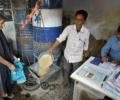
The Pradhan Mantri Garib Kalyan Anna Yojana (PMGKAY) was launched in March 2020 to provide free 5 kg foodgrains per person per month to about 80 crore beneficiaries covered under the National Food Security Act (NFSA) to reduce their hardship during the lockdown period. This was over and above the general allocation under the NFSA.

Both prime ministers believed in crafting schemes to help the common man. Modi used quite effectively the instruments Dr Singh introduced. In assessing Modi's success with many schemes, Dr Singh's fundamental work should not be ignored, points out A K Bhattacharya.
5-kg free food grains per person per month would be given to around 80 crore people for the two months.
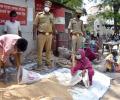
In the three months leading up to the Assembly elections, Chief Minister Yogi Adityanath's government distributed over 1.4 million tonnes (MT) of wheat, 0.95 MT of rice, 0.10 MT of chana (gram), 101.9 million litres of soybean oil and 100,000 tonnes of salt as free ration. This was part of the Covid relief package, officials said.
The government's subsidies on food, fertilisers and petroleum are estimated to decline by 39 per cent to Rs 4,33,108 crore this fiscal and fall further by 27 per cent to nearly Rs 3.18 lakh crore in 2022-23. In its revised Budget (RE) estimate for the 2021-22 fiscal, the government has pegged total subsidies to be at Rs 4,33,108 crore against the actual Budget estimate of Rs 7,07,707 crore in the previous financial year. Out of which, the food subsidy is estimated to decline to Rs 2,86,469 crore in the current fiscal from Rs 5,41,330 crore in 2020-21, while petroleum subsidy is estimated to fall to Rs 6,517 crore from Rs 38,455 crore in the said period.

The Congress on Sunday gave a call to party leaders in poll-bound states to work with unity to ensure victory that will 'set the tone' for 2024 Lok Sabha polls even as it showed willingness to forge an alliance of 'like-minded' parties.

'The decision to supply free food grains is not an economically sound decision because the government will find it very difficult in future to charge anything for food grains.'
Initially, the additional free benefit under the PMGKAY was provided for a period of three months (April-June 2020) to ameliorate distress caused by the COVID-19 pandemic. However, with the crisis continuing, the programme was extended for another five months (July-November 2020).

Elections may be a few months away, but the government may get into election mode much earlier than that, predicts A K Bhattacharya.

Why did Karnataka's economic prosperity fail to influence the nature of electoral promises made by political parties in the run-up to the assembly elections? asks A K Bhattacharya.
Gandhi was unusually more proactive and practically led the Opposition protest against the rise in the prices of petrol, diesel and LPG cylinders during the Question Hour.

Economist Abhijit Sen, a former Planning Commission member and one of the country's foremost experts on rural economy, died on Monday night. He was 72.

"The Right to Life as guaranteed by Article 21...gives the right to every human being to live a life of dignity with access to at-least bare necessities of life. To provide food security to impoverished persons is the bounden duty of all States and Governments," the top court observed while issuing a slew of directions on a plea of three activists.

The Delhi high court on Thursday set aside the AAP government's doorstep ration delivery scheme -- Mukhymantri Ghar Ghar Ration Yojna.

'It has been an ongoing process, talking to the relevant ministries about eliminating leakages and curbing non-core expenditure in various schemes.'

The Food and Security Bill will be implemented after few months.

Although the Disaster Management Act for Covid containment measures, considered a hindrance in conducting the census, was withdrawn in March this year the Centre has not taken any further action on conducting the much-delayed population enumeration.
The free food scheme is driven by electoral considerations, but its long-term fiscal risks outweigh the short-term gains, cautions A K Bhattacharya.

Assam Chief Minister Himanta Biswa on Tuesday said that the Centre is likely to sign a peace accord with militant organisations from the state's Adivasi communities within September.
A decision in this regard was taken in the Cabinet meeting chaired by Prime Minister Narendra Modi.

'A delay of two years has happened, but stretching it to 2024 is a bit too far.' 'And we do not know about 2024 also.'
A 6-7 million tonnes shortfall in rice production due to a fall in paddy sowing area is likely to keep rice prices at elevated levels, adding to the inflationary pressure that the slowing economy is already grappling with. Elevated food prices, including that of cereals, had led to retail inflation reversing a three-month declining trend, to touch 7 per cent in August. Similarly, the wholesale price inflation, which declined to 11-month low, also showed price pressures from cereals resulting from wheat output being impacted by severe heat waves in some parts of the country.
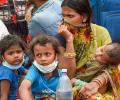
Only two in every five migrants said they received ration or cooked food from the administration either daily or at times.
The government's food subsidy in the ongoing fiscal year is expected to be a little less than Rs 4 trillion.

Finance Minister Nirmala Sitharaman has brought down the budgetary allocation for the fertiliser subsidy for FY21 to Rs 71,309 crore, from the RE of Rs 79,998 crore for FY20, while increasing food subsidy to FCI through "ways and means advance" to Rs 50,000 crore for FY21, from Rs 36,000 crore in RE for FY20, and under the National Food Security Act (NFSA) to Rs 77,982 crore, from Rs 75,000 crore.
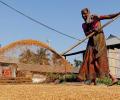
Stating that the food subsidy bill is becoming "unmanageably large", the Economic Survey 2021 on Friday suggested the government to increase the selling price of foodgrains provided through ration shops to over 80 crore beneficiaries. Foodgrains via ration shops are supplied at highly subsidised rates of Rs 3 per kg for rice, Rs 2 per kg for wheat and Rs 1 per kg for coarse grains through Public Distribution System (PDS) as per the National Food Security Act (NFSA). "While it is difficult to reduce the economic cost of food management in view of rising commitment towards food security, there is a need to consider the revision of central issue price (CIP) to reduce the bulging food subsidy bill," the survey said.
A study by eminent economists, by Jean Drze, Reetika Khera and Meghana Mungikar released few days back shows that more than 100 million people are excluded from the PDS because the central government insists on using 2011 population figures to calculate state-wise coverage under the National Food Security Act.
 © 2026 Rediff.com - Investor Information - Advertise with us - Disclaimer - Privacy Policy - Sitemap - Feedback - About us - Terms of use - Grievances