
Expenditure on new projects slowed down for the second quarter in a row amid an uncertain global environment and higher borrowing costs. There were new projects worth a cumulative Rs 3.26 trillion in the July-September period, according to data provided by project tracker Centre for Monitoring Indian Economy (CMIE). This figure is much less than Rs 4.39 trillion in the June quarter (Q1FY23) and Rs 8.46 trillion in the March quarter (Q4FY22).

About 56 million Indians may have plunged into extreme poverty in 2020 as a result of the pandemic, increasing the global tally by 71 million and making it the worst year for poverty reduction since World War II, according to fresh estimates by the World Bank. "The global goal of ending extreme poverty by 2030 is likely to be missed: By then, about 600 million people will remain in abject poverty. A major course correction is needed," Indermit Gill, chief economist at the World Bank, tweeted. The World Bank in its latest "Poverty and Shared Prosperity" made fresh estimates of poverty using a new extreme poverty line based on the purchasing power parity (PPP) of $2.15, the earlier one being at $1.9.

The country's unemployment rate in July fell to 6.80 per cent, the lowest level in the last six months, amid rising agriculture activities during monsoon, according to Centre for Monitoring Indian Economy (CMIE) data. The unemployment rate dropped to 6.80 per cent in July from 7.80 per cent in June, the CMIE data said. Rural unemployment declined 6.14 per cent to 272.1 million last month from 265.2 million or 8.03 per cent in June, it said.

Congress spokesperson Abhishek Manu Singhvi cited a viral video on social media platforms, claiming that in it Modi's voice is heard in a call with BJP rebel Kripal Parmar.

While there were Rs 7.01 trillion worth of new assets in December 2019, this fell 88.6 per cent to Rs 80,000 crore for the three months ending December 2020, shows data from project tracker Centre for Monitoring Indian Economy (CMIE), reports Sachin P Mampatta.

The development of private data sources is a hugely positive development. It should serve as a challenge to the government to improve its own record on producing timely and reliable statistics, points out T N Ninan.

Nearly 3.64 lakh educated and "semi-educated" youngsters had registered with employment exchanges across Gujarat till December 2021, according to state government data.

The only real solution to the jobs crisis, whether in India or abroad, is to direct tech innovation towards job enhancing sectors, and disincentivising job-replacing ones, observes R Jagannathan.

The second wave of COVID-19 and the resultant localised lockdowns have impacted over 75 lakh jobs, taking the unemployment rate to a four-month high of 8 per cent, the Centre for Monitoring Indian Economy (CMIE) said on Monday. The situation on the employment front is expected to continue to remain challenging going forward as well, CMIE's managing director and chief executive Mahesh Vyas said.

When it comes to losing a job permanently, the youngest and the oldest segments in the workforce have reported an increase in setbacks in the second wave of the pandemic, a survey of by a Fortune500 company has said. The survey, conducted in April this year, covered 2,000 persons in India. Six per cent of those over 55 years of age reported having permanently lost their job, as against 4 per cent last year. In those aged under 24, the proportion reporting a permanent job loss has increased to 11 per cent from 10 per cent in the year-ago period, the survey done by financial technology company FIS said.

Indian economy is expected to grow by 10 per cent or more in the current fiscal, and 8 per cent plus in the next fiscal year, Niti Aayog Vice-Chairman Rajiv Kumar said on Tuesday. Addressing a book launch event, Kumar further said that seven years of the Modi government has laid a strong economic foundation for businesses to thrive in India. "There was a hiccup (in economic growth) for two years due to COVID-19 pandemic.

Urban men lost more jobs than women during the second wave of COVID-19, implying a complete loss of livelihood for millions of households, according to the Centre for Monitoring Indian Economy (CMIE). The most disproportionate loss of jobs because of the first wave of COVID-19 was among urban women, CMIE's MD and CEO Mahesh Vyas said in his analysis. He said urban women account for about three per cent of total employment, but they accounted for 39 per cent of total job losses in the first wave of the pandemic.

Emerging technologies like cybersecurity and the Internet of Things have the potential to add 1.4 million new IT jobs in India by 2027.

New projects fell 6.3 per cent in the December quarter compared with the September quarter. The value of new projects in the just-concluded quarter was Rs 2.1 trillion, according to the data from Centre for Monitoring Indian Economy (CMIE), which was lower than the Rs 2.2 trillion seen in the September quarter. It is, however, higher than Rs 1.5 trillion recorded for the quarter ended December 2020, the first year of the Covid-19 pandemic. This data ties in with the November data for core sector growth, an index of eight core industries, which grew at its slowest pace since early 2021.

In his address after more than 75,000 people were given appointment letters for various government jobs in the first tranche, Modi acknowledged the challenges facing the economy the world over with many countries hit by a record inflation and unemployment and said India is making every effort to come out of the situation unscathed.

These could include strengthening the public-private partnership (PPP) dispute resolution mechanism, uniform PPP institutional framework, easier terms for infrastructure companies accessing bond markets, and tax sops, Business Standard has learnt. Investment in infrastructure projects with high multiplier effect has been the Centre's main plank to revive the economy, create employment and boost consumption.

Over 10 million Indians have lost their jobs because of the second wave of COVID-19, and around 97 per cent of households' incomes have declined since the beginning of the pandemic last year, Centre for Monitoring Indian Economy (CMIE) chief executive Mahesh Vyas said on Monday. The unemployment rate measured by the think-tank is expected to come at 12 per cent at the end of May as against 8 per cent in April, Vyas told PTI, adding this signifies that about 10 million or 1 crore Indians have lost jobs in this period. Stating that the main reason for the job losses is "mainly the second wave" of COVID-19 infections, Vyas said, "As the economy opens up, part of the problem will be solved but not entirely."

'The China opportunity, the digital opportunity and the end of geography opportunity are the three pieces of luck India got due to Covid.'

'Nobody is talking about the inequality that is going to come.'

To help the country emerge as a true welfare State, political parties must put the country's interests first before strategising to win elections and short-term goals, argues Ramesh Menon.

The Centre for Monitoring Indian Economy has revised its GDP growth forecast for the current fiscal to 6.7 per cent from 6.2 per cent announced last month.

The Centre for Monitoring Indian Economy said sectors like machinery (with a weight of 18 per cent in the index for industrial production), chemicals (14.5 per cent), basic metal (12.4 per cent), rubber, plastic and petroleum products (11.8 per cent) and transport equipment (11 per cent) would be the growth engine for this year. The projection is based on analysis of projected capacity and expected capacity utilisation of major industries.

'Some people even boldly ask for a 100% increase in the salary.'


It was women who unambiguously bore the brunt of the lockdown joblessness, says Kanika Datta.

While the lockdown hit employment in all age groups, it hit the employment of youngsters who are less than 29 years of age much more. The lockdown also hit women more than it has affected men, reveals Mahesh Vyas.

'Unemployment barely figures in the Budget except as a derived demand from the industry and infrastructure.' 'There is no effort at direct attack on unemployment.'

'The term 'pro-growth' must be qualified somewhat because, while a rising tide will lift all boats, it will not necessarily do so equally.'

Completed projects saw an improvement of 29.2 per cent over the June quarter, which is valued at Rs 0.31 trillion.
The outlook cut is based on a weak premise since the economy is expected to rebound this fiscal but a wake-up call was needed.

Unemployment was worse only in the pre-demonetisation period, according to the data, at 9.6 per cent in August 2016.

E-learning and work from home have forced a section of feature phones users to shift to smartphones.
The rate of unemployment was the highest in the urban areas, which constitute the most number of red zones due to the COVID-19 cases, at 29.22 per cent, as against 26.69 per cent for the rural areas.
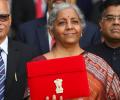
Had Finance Minister Sitharaman thought a little more about the middle class, disadvantaged sections, and the poor who are struggling, it would have been an inclusive Budget that would have made history, notes Ramesh Menon.
The recent government decision to restrict supply of subsidised cooking gas cylinders to six per year to each household will see consumption for fuel decline to 4.1 per cent in second half of the fiscal, a report by think-tank CMIE said.

The Centre for Monitoring Indian Economy (CMIE) has lowered its growth forecast to 6 per cent, from 6.2 per cent projected earlier, for this fiscal, owing to the delay in recovery in industrial sector and the fall in mining, manufacturing and construction segments.

The Centre for Monitoring Indian Economy (CMIE) has lowered its automobile production forecast by a percentage point to 9.6 per cent for this fiscal on account of a persistent higher interest rate regime, hike in taxes and the resultant increase in vehicle prices.

Even after the government data showed a sharp fall in FY12 growth numbers and the April factory output data at a poor 0.1 per cent, a leading economic think tank on Thursday said it expects a revival in fortune and pegged GDP growth for the current fiscal at 7.3 per cent.

This will cost the government Rs 3.1 trillion, about 10 per cent of its annual expenditure, and higher than any other spending item in its Budget.

Niti Aayog vice-chairman Rajiv Kumar debunked claims of jobless growth, saying how can a country grow at an average of 7 per cent without employment.
 © 2026 Rediff.com - Investor Information - Advertise with us - Disclaimer - Privacy Policy - Sitemap - Feedback - About us - Terms of use - Grievances