
Despite the relaxation of the one-child policy in 2016, the number of live births per 1,000 people fell to a record low of 10.48 in 2019, down from 10.94 in 2018.

Although there is headroom for further monetary policy action, at this juncture it is important to keep our arsenal dry and use it judiciously: RBI's Das.
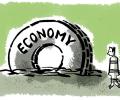
As he projected a grim outlook for the economy, RBI Governor said that amidst this encircling gloom, agriculture and allied activities have provided a beacon of hope on the back of an increase of 3.7 per cent in foodgrains production to a new record.

SBI was the biggest loser in the Sensex pack, shedding 2.40 per cent, followed by Yes Bank, Bharti Airtel, L&T, Sun Pharma, M&M, ICICI Bank, ONGC, RIL, Asian Paints, Vedanta and HUL, which lost up to 2.37 per cent.

The government hopes the latest action will lead to banks also lowering the cost of borrowing for corporate and individual borrowers.

The monetary authority said it was worried on three fronts with regard to inflation as well as the economy.
However, RBI would continue to nudge banks to cut lending rates
The 50-stock NSE barometer Nifty finished 14.75 points, or 0.14 per cent, down at 10,382.70 after shuttling between 10,340.65 and 10,393.15.
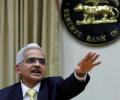
Chances of a rate cut in April improve if core inflation continues to ease, growth falling below the projected 7.2% for FY19 and if the global trade slowdown exacerbates.
The statement, issued after the 2-day meeting of the 6-member Monetary Policy Committee of the Reserve Bank of India, also said that recapitalisation of public sector banks along with resolution of stressed assets under the Insolvency and Bankruptcy Code (IBC) will create demand for fresh investments.

For the first time, the value of card and mobile payments of Rs 10.57 trillion was more than ATM withdrawals of Rs 9.12 trillion in Q4 of fiscal 2019-20. In the months of lockdown, the gap may have widened further, but cash could be back in vogue when the situation normalises.

S&P expects India to grow at 7.4 per cent in 2015, similar to the central bank's forecast for the fiscal year ending in March.

Both the indices closed at five-month highs, led by financial services, IT and metal stocks, amid persistent foreign fund inflows.

Potato, a daily consumable vegetable, witnessed maximum inflationary pressure at 60.58 per cent

Industry players said they were indeed seeing a serious fall in capacity usage, though some sectors were seeming to prevent further fall in the overall capacity utilisation.
Inflation in the 'fuel and power' basket in December slumped to 8.38 per cent, nearly half of 16.28 per cent.

The trade gap was $11.66 billion in December 2015 while in September 2015 it stood at $10.16 billion
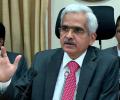
Das favoured shifting the stance of monetary policy from neutral to accommodative to send a clear signal, indicating that more measures could be taken in the near future to boost growth.

After unseasonal rains, supply disruptions and pandemic-induced woes pushed retail inflation well over the Reserve Bank's comfort zone in 2020, the scenario is likely to stay that way at least in the short term as economic recovery slowly gains foothold. For most part of this year, pricier food items pushed the retail inflation, based on Consumer Price Index (CPI), higher in the range of 6.58-7.61 per cent, except for March when the reading was 5.91 per cent. Experts believe retail inflation is likely to average around 6.3 per cent this fiscal and mostly will remain sticky going forward owing to pick-up in demand across sectors.

The economic growth is likely to moderate to 6.1 per cent, slowest in over seven quarters, from 6.6 per cent last year same period.

The government had amended the RBI Act through Finance Act 2016.

This is contrary to the expectations of a majority of analysts predicting for another hike given the rise in inflation lately, including domestic ratings agency Icra

'We are very watchful about inflation and growth. But the main challenge is economic revival and growth.'

The report, however, said it remains watchful of the upside risks to inflation emanating from pass-through of minimum support prices (MSPs), adverse movement in crude oil prices, volatility in global financial markets, lagged impact of the rupee weakness on input prices, adverse implications from fiscal slippage and staggered impact of HRA increases by states and its second-round impact.

Jaitley said if interest rates were lowered, the economy could grow faster than 7-7.5 per cent.

This is the fifth straight cut in rates by the Reserve Bank of India in as much policy reviews in 2019, and takes the total quantum of reductions to 1.35 per cent.

Reserve Bank of India Governor Urjit Patel on Saturday exhorted banks to reduce their lending rates to push credit demand in laggard segments, saying banks have benefited from influx of low-cost deposits and its previous repo rate cuts.

Analysts at Bank of America Merill Lynch said that fears of inflation getting "generalised" are overdone, as only two sub-categories of fuel and light and housing (accounting for 22 per cent of the basket) have seen a price-rise above the headline 5.2 per cent.

For protein rich items such as meat and fish, eggs as well as milk and products, the inflation in May slowed compared to last month
All-out efforts are needed to mitigate the adverse impact of the Covid-19 pandemic, and the RBI will use any instrument necessary to revive growth and preserve financial stability, according to the minutes of the central bank's policy meeting.

Currently, banks follow system of internal benchmarks, including Prime Lending Rate, Benchmark Prime Lending Rate, Base rate and Marginal Cost of Funds based Lending Rate.

The minutes of the December MPC meet reveal members felt the current spike in the headline inflation rate was due to a temporary supply shock on the food front, expected to moderate by the second quarter of 2020-21.

The Nikkei Markit India Manufacturing Purchasing Managers' Index (PMI) -- a gauge of manufacturing performance -- fell to 52.3, down from October's 22-month high of 54.4.

The policy review observed that the moderation in inflation, excluding food and fuel, that was witnessed in the first quarter of 2017-18 has "by and large, reversed".
Given the various risks to growth, one could argue for rate cuts to be deeper than the 5 per cent terminal repo rate that we are projecting at this stage, says Kaushik Das.
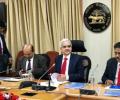
The fourth consecutive rate cut is expected to lower equated monthly instalments (EMIs) for home and auto buyers, and borrowing cost for corporate.
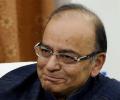
Priorities include the amendments of the Companies Act and the Motor Vehicle Act
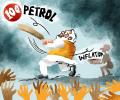
'People know if inflation is not within the tolerance band, then action will be taken so they do not expect inflation to rise above that.'
RBI said at the current juncture, the all-out effort is to maintain and sustain, with the hope that when life is secure, resources, energy and time can be marshalled to rebuild and revive.
High frequency indicators suggest that a growth recovery is underway, but very tentatively and with weak legs, says Saugata Bhattacharya.
 © 2026 Rediff.com - Advertise with us - Disclaimer - Privacy Policy - Sitemap - Feedback - About us - Terms of use - Grievances