
India has refused to budge from its stated position at the trade talks and asserted that rich nations would have to move first on reducing farm subsidies to break the deadlock at the World Trade Organisation in Geneva.
The government said in Friday it was negotiating aggressively at the World Trade Organisation to facilitate easy movement of professionals across borders to deliver services.
On the eve of the WTO Ministerial Conference in Hong Kong, India on Monday asserted it will not be rushed into a global trade deal that displaces millions of its poor farmers.
The Association of Southeast Asian Nations is expected to sign a free trade agreement with India next week, Malaysian International Trade and Industry Minister Rafidah Aziz has said.
India has decided to unilaterally reduce tariffs for African least developed countries in a bid to provide market access to products of their interests.
Zia, elected for a second term in 2001, was making her first bilateral visit to India eight months before her tenure ends.
India will press for greater market access for developing countries in the services sector besides highlighting concerns in agriculture and industrial goods negotiations at the World Trade Organisation mini-ministerial on Saturday at Davos.
Notwithstanding the growing political ties, China has accused India, its biggest trade partner in South Asia, of carrying out restrictive trade practices, including technical barriers, opaque and complicated regulations
The government is all set to liberalise the promotional Market Access Initiative scheme to enable exporters penetrate new markets, as it targets to achieve $120 billion in exports this fiscal.

India had proposed amending the formula to calculate the food subsidy cap of 10 per cent.
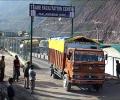
Pakistan on Friday pitched for liberalising visa regime with India and expressed willingness to accord non-discriminatory market access (NDMA) to New Delhi soon to boost bilateral trade.
The G-20, a group of developing countries including India, on Friday dismissed as "unacceptable" a 'blended formula' of tariff reduction in agriculture, proposed by the United States and the European Commission.
India has set an ambitious target to quadruple annual information technology exports to $50 billion by 2010 from $12.5 billion at present.

"We have many relationships...they have a history. We will do what is in our national interest and part of that strategic partnership is the ability of each country to comprehend and appreciate the national interest of the other," Jaishankar said.
The proposal, which comes in response to the EU-US formula made on the sidelines of the OECD meeting in Paris recently, emphasises on differentiated tariff cuts for developing countries.
India's efforts to include services in the proposed Framework on Agriculture and Non-agriculture Market Access have received a shot in the arm with the European Union showing willingness to extend its support.
The contentious issue of market access, in World Trade Organisation negotiations, will figure prominently in the discussions between Commerce and Industry Minister Arun Jaitley and visiting European Union Trade Commissioner Pascal Lamy.

The agreement on services, if ratified by all member countries, could prove to be a game changer for Indian professionals in education, healthcare & IT.

So, how does Pompeo's check list look like? In a broad sense, he is coming here 'to make sure that we have economic openness'; to ensure that 'we have to deliver'; to understand that 'we have to execute' what we promised to do; and, to 'broach some tough topics', points out Ambassador M K Bhadrakumar.

Expressing deep concerns over India's policy of preferring domestically manufactured information and communication technology goods, the apex body of US telecom industry has told lawmakers that this will have negative impact on exports and economic competitiveness.
Commerce Minister Arun Jaitley will lead a high-power delegation to the WTO ministerial beginning at Cancun in Mexico on September 10 in which India and other developing countries are expected to lock horns with the US and EU on several issues.

Indian talent may soon be allowed to work in France without a degree from a French institute.
Enthused by 174 per cent growth in services trade this year, India is readying to make an aggressive offer in the WTO negotiations on services.
In a major blow to China's exports, the European Union has announced that it is cancelling some of the advantages enjoyed by Chinese commodities under the generalised system of preferences (GSP) so that other developing countries can also benefit.
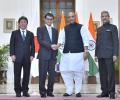
The India-Japan 2+2 dialogue added strategic heft to the special relationship in the wake of growing Chinese assertiveness on regional affairs, points out Dr Rajaram Panda.
The Indian banks are not prepared to implement the stringent Basel-II norms including that of capital adequacy and non-performing assets in toto by 2006, according to the Federation of Indian Chambers of Commerce and Industry survey.
The textiles ministry is in favour of a reduction in textiles tariffs under ongoing World Trade Organisation negotiations on market access, but said overall reduction in the case of developing countries should be lower than developed countries.
The United States is optimistic India will support Washington's plan to eliminate global tariffs on manufactured goods despite New Delhi's opposition to the proposal, a senior US official said on Wednesday.
 © 2026 Rediff.com - Investor Information - Advertise with us - Disclaimer - Privacy Policy - Sitemap - Feedback - About us - Terms of use - Grievances