
During the 30-minute meeting between Samaraweera and Rice, the peace process in Sri Lanka and the current security situation came up for discussion.
India and Sri Lanka consider an open sky policy within the framework of the air traffic agreement of the SAARC nations.
Japan's special envoy Yasushi Akashi is likely to meet LTTE leaders to kickstart the stalled peace process.

US Secretary of State John Kerry on Saturday warned Sri Lanka that "true reconciliation" with Tamils will take time, even as he praised the "openness" of the new government in efforts to boost democracy, human rights and reaching out to the minority community.

External Affairs Minister Sushma Swaraj arrived in Colombo on Friday on a two-day trip to set the stage for Prime Minister Narendra Modi's visit to Sri Lanka next week, the first bilateral visit to the country by an Indian premier in over 25 years.

The PM said the government knew that Sri Lankan nationals who joined the Islamic State had returned, but they could not be arrested as joining a foreign terrorist organisation is not against the law in the island nation.

The visit and the agenda is mainly to re-emphasise the traditional connect between India and Sri Lanka, particularly in the context of Buddhism, which is a shared heritage.

India has dismissed reports that the Colombo station chief of the Research and Analysis Wing had been expelled in the run up to this month's Sri Lankan presidential election and maintained that he has moved out after completion of his three-year tenure.

External Affairs Minister Sushma Swaraj on a two-day visit during which she is expected to discuss the fishermen's issue and rights of minority Tamils with the Lankan leadership.

Political analysts said Sirisena's move to install Rajapaksa as the prime minister could lead to a constitutional crisis as the 19th amendment to the Constitution would not allow the sacking of Wickremesinghe as the premier without a majority.
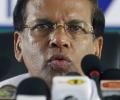
Sri Lanka's new President Maithripala Sirisena on Monday unveiled his cabinet that included members from a cross-section of parties and announced fresh parliamentary polls in 100 days, two years ahead of schedule.

Maithripala Sirisena is expected to meet his Indian counterpart Pranab Mukherjee besides holding talks with Prime Minister Narendra Modi
'Our policy is pro-Sri Lanka.' 'Burma is not the only girl on the beach in South Asia.''
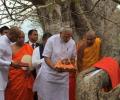
"Looking forward to a wonderful day," Prime Minister Narendra Modi tweets before he leaves Colombo. G Sudhakar Nair/PTI reports from Anuradhapura

China for the first time has divulged the deployment of a nuclear submarine for anti-piracy operations in the Gulf of Aden, a move defence experts say could cause unease among neighbours, including India.

From Sri Lanka's most popular political family to its most despised -- going by the voices on the streets calling for the Rajapaksas' ouster -- what went wrong for the clan? Veteran Sri Lanka watcher N Sathiya Moorthy offers an insight.

Sri Lanka's new government on Sunday said it will probe whether longtime president Mahinda Rajapaksa sought military help to cling to power after he realised that he had lost the closely contested election.
President Maithripala Sirisena's government in Colombo has clearly decided to restore some balance in its diplomatic outreach, which presents a great opportunity for India.

The results of the recent presidential elections in Sri Lanka are likely to have stunned groups in Tamil Nadu that have been giving moral and material support to Tamils in the north and east of the island for decades. Tamil Nadu-based groups had asked Sri Lanka Tamils to protest against the election and boycott voting.

Rajapaksa has blamed India, the United States and European countries for his humiliating defeat.
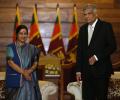
The two countries also signed memoranda of understanding in education and health sectors after visiting External Affairs Minister Sushma Swaraj and her Lankan counterpart Mangala Samaraweera co-chaired the 9th Indo-Lanka Joint Commission meeting in Colombo.
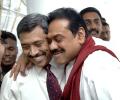
Gotabaya Rajapaksa
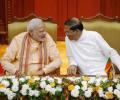
'What we have heard from the Sri Lankans is their desire to have a foreign policy that allows Sri Lanka to best advance its own interests rather than a foreign policy that relied solely on one relationship.' 'We think this is an attitude that makes a lot of sense. India and Sri Lanka have many areas of shared interests, and it's certainly welcomed by us to see that deepening of those ties.'
 © 2026 Rediff.com - Investor Information - Advertise with us - Disclaimer - Privacy Policy - Sitemap - Feedback - About us - Terms of use - Grievances