
Since items in the 12% category account for only about 5% of total GST, the additional boost to consumption may not be significant, points out M Govinda Rao.

Brave statements such as we will continue to be the fastest growing large country are of no consolation, because the direction of trade also determines the flow of investment, points out M Govinda Rao.
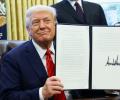
The Trump trade shock is a chance to push long-overdue reforms, rather than tinker with tariffs to appease the US, suggests M Govinda Rao.

'The finance minister missed yet another opportunity to simplify the income tax structure in the Budget.' 'This was an opportune moment to get rid of the old tax system entirely and move fully to the new system,' asserts M Govinda Rao, member of the 14th Finance Commission.

At nearly 82 per cent of GDP, India's public debt is very high, but the country doesn't face debt sustainability issue on account of high growth rate and higher share of local currency debt, NCAER Director General Poonam Gupta has said. Participating in an event organised by NCAER, Gupta said India's high debt levels are sustainable for now because of higher real or nominal GDP and as most of the debt is held in rupee.

Legislation on fiscal discipline will not help unless government is ready to bite the bullet.

There is a need to bring in legal/constitutional changes, reforms in central tax system and state tax systems, said M Govinda Rao, director, National Institute of Public Finance and Policy.

Direct Taxes Code will make politically difficult changes feasible

Although not intended as fiscal stimulus, the unprecedented fiscal expansion during 2008-09 and 2009-10 did help in combating the economic slowdown, but it cannot continue and measures must be initiated to chart a route for fiscal consolidation.

It's important to make the penalty system an effective deterrent to ensure greater efficiency in the tax system, says M Govinda Rao.

The revenue foregone due to tax incentives in 2009-10 is estimated at Rs 5,40,269 crore.

A good tax system should minimise the cost of collection, compliance cost and the cost to the economy in terms of the distortions it creates while generating revenues.

The Reserve Bank may raise key policy rates by up to 50 basis points in its July 27 monetary policy review to check double-digit inflation, said a member of the Prime Minister's Economic Advisory Council.

The sudden stop in economic activity led to a sharp decline in employment-intensive sectors like construction, manufacturing and trade, hotels, transport etc.

Industrial production re-entered the negative territory by contracting 1.6 per cent in January, mainly on account of the decline in output of capital goods, manufacturing and mining sectors. The output of the manufacturing sector -- which constitutes 77.6 per cent of the Index of Industrial Production (IIP) -- shrank by 2 per cent in January, as against a growth of 1.8 per cent during the same month last fiscal, as per data released by the government on Friday. The worst performance was witnessed by the capital goods sector, which recorded a contraction of 9.6 per cent during the month under review, compared to a 4.4 per cent decline a year ago.

The Reserve Bank's rate-setting panel, Monetary Policy Committee (MPC), began its three-day deliberations on Wednesday amid expectations of a status quo on benchmark rate mainly on account of uncertainty over the impact of the second wave of COVID-19 pandemic. Moreover, the fears of firming inflation may also refrain the MPC from tinkering with the interest rate in its bi-monthly monetary policy outcome to be announced on Friday. The RBI had kept key interest rates unchanged at the last MPC meeting held in April.

There are various estimates of India's debt to GDP ratio, but the consensus is that that it would be over 80 per cent at the end of the current fiscal year.
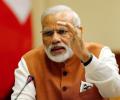
Economists want the government to focus on jobs, farms, and fiscal consolidation. They also favour re-imposition of the long-term capital gains tax on listed securities and mutual funds.

Finance Commission has got new team who are committed to growth initiatives.

'While the GST is structured to be an all-encompassing tax and to create a vastly expanded digital network of recorded transactions, no one knows how traders long used to avoiding taxes will apply their ingenuity,' says T N Ninan.

Reform ideas do not occur overnight and evolve over the years.
 © 2026 Rediff.com - Investor Information - Advertise with us - Disclaimer - Privacy Policy - Sitemap - Feedback - About us - Terms of use - Grievances