
'Political protection allow groups to recruit, rearm and operate with reduced operational pressure. That increases their bargaining power and their ability to destabilise.'
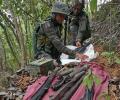
They had earlier been arrested by the Manipur police in September last year when they were allegedly extorting money by wearing police uniforms and carrying sophisticated weapons, the officials said.

'There is a list with the Ministry of Home Affairs that has the details and names of the terrorist organisations that attack the Indian Army.'

An alleged member of the banned People's Liberation Army of Manipur was arrested from Odisha by the National Investigation Agency, which is probing the nexus between Maoists and terror groups of the northeast.
The government on Wednesday said the cadre strength of the Maoist organisations is around 8,500 and they have forged tactical understanding with some insurgent groups in the Northeast for procuring arms and ammunition.

Naga splinter groups impatient with stalled talks as well as rebel Manipuri groups who have a stake in disrupting upcoming elections to the state assembly, are believed to be regrouping in the borderlands of China's Yunnan province and Myanmar, taking advantage of the turmoil in the latter by using it as a transit corridor.

The Naxals are trying to set up organisational bases in the Northeast to forge ties with other insurgent groups to meet their military needs and the Assam-Arunachal Pradesh border has emerged as another theatre of Maoist activities, the government said on Wednesday.

The government declared NSCN-K, all its front organisations and formations as a terrorist organization under the Unlawful Activities (Prevention) Act, 1967, a home ministry spokesman said.

Indian intelligence agencies have often claimed that left-wing extremists are trying to make inroads in the militancy-hit regions of north-east to foment further unrest. But Jaideep Saikia, noted terrorism and conflict analyst, claims, "People who speak of Maoism taking roots in the north-east have not read history".
 © 2026 Rediff.com - Advertise with us - Disclaimer - Privacy Policy - Sitemap - Feedback - About us - Terms of use - Grievances