
'The China opportunity, the digital opportunity and the end of geography opportunity are the three pieces of luck India got due to Covid.'

In the backdrop of an over four-decade high inflation, the US Federal Open Market Committee has raised its key policy interest rate by 75 basis points to 2.25-2.50 per cent, anticipating that the increase in the interest rates will be "appropriate". Hiking interest rates typically cool demand in the economy, thereby putting a brake on the inflation rate. The US Federal Reserve in its June meeting too raised the interest rate by 75 basis points, which was the steepest hike since 1994.

India's urban unemployment rate declined in Q4FY23 to 6.8 per cent - the lowest in over four years -- after it stagnated at 7.2 per cent in the previous October-December quarter, reflecting improvement in the labour market, according to the Periodic Labour Force Survey (PLFS) released by the National Statistical Office (NSO) on Monday. The unemployment rate in current weekly status (CWS) terms for all ages in the March quarter was the lowest recorded in more than four years, from the time the NSO released India's first quarterly urban jobless rate for the December quarter in 2018. The jobless rate in urban areas had been on a continuous decline since the peak of 20.8 per cent in the April-June quarter of FY21.

More than 70 per cent of Indian youth aged between 15 and 29 can't!

Fresh formal job creation declined sequentially for a third straight month in February to fall to a 21-month low, signaling pressure in the employment market. These are the findings from the latest payroll data released by the Employee Provident Fund Organisation (EPFO) on Thursday. The number of new monthly subscribers under the Employees' Provident Fund (EPF) declined 10 per cent sequentially to 738,052 in February from 819,659 in January.

'As China's reopening euphoria fizzled out on the back of some disappointing economic data, we saw inflows coming back to India with full force in the past 3-4 months.'

India, along with Southeast Asian countries such as Indonesia, is expected to sustain growth in the medium-term in Asia region, replacing China as the key growth driver, Morgan Stanley and Nomura said in two separate reports released on Monday. While Morgan Stanley projected a 6.2 per cent gross domestic product (GDP) growth forecast for India in FY24, Nomura estimated the Indian economy to grow at 5.9 per cent in 2023. "Even with a slowing China, we expect GDP growth in Asia to sustainably outperform other emerging markets and the US. India and Southeast Asia are set to be the fastest-growing economies this decade.

India's services sector growth accelerated in April, as strong demand conditions resulted in the fastest increase in new business and output in close to 13 years, a monthly survey said on Wednesday. The pick-up in demand occurred in spite of escalating price pressures. The seasonally adjusted S&P Global India Services PMI Business Activity Index rose from 57.8 in March to 62.0 in April, signalling the fastest expansion in output since mid 2010, amid a pick-up in new business growth and favourable market conditions.

In the jobs created in 2022, the share of those in the age group 18-25 increased to at least a five-year high of 56 per cent. A Business Standard analysis of the monthly Employees' Provident Fund Organisation (EPFO) payroll data shows in 2018 the share of youths among the new EPFO subscribers was 50.9 per cent. The National Statistical Office is releasing the monthly EPFO payroll data since April 2018 as part of the government's effort to track formal-sector employment by using payrolls as an instrument.

The Economic Survey will remain a documentation of the government's resolve to not recognise the severe stress on the labour markets and on the livelihoods of Indian households arising out of the pandemic and the consequent lockdown, observes Mahesh Vyas.

Households with only one employed person can be considered to be somewhat vulnerable. Their proportion is rising. Also rising is the proportion of highly vulnerable households with no person employed, observes Mahesh Vyas.

The rupee depreciated 31 paise to an all-time low of 80.15 against the US dollar in early trade on Monday tracking the strength of the American currency and firm crude oil prices. At the interbank foreign exchange, the rupee opened at 80.10 against the dollar, then lost ground to quote at 80.15, registering a fall of 31 paise from the last close. On Friday, the rupee closed at 79.84 against the dollar.

'RBI is already late in addressing inflation pressures.'

The government's step could push investors to choose riskier equity, or to fall back on bank deposits, thereby negatively impacting the debt market which actually needs to grow, points out T N Ninan.

Amazon has reclaimed the top spot as the world's most valuable brand despite its brand value falling 15 per cent this year from $350.3 billion to $299.3 billion, said a new report. According to brand valuation consultancy Brand Finance's report, "Global 500 2023", while Amazon is back at No 1, its brand value has fallen by over $50 billion this year, with its rating slipping from AAA+ to AAA. This is as consumers evaluate it more harshly in the post-pandemic world. Brand Finance's research has found that perception of customer service at Amazon has fallen - at the same time as delivery times have lengthened.
Six states out of 22 major states and Union Territories (UTs) generated fewer formal jobs for the youth in the September quarter than they did in the corresponding quarter a year ago, a Business Standard analysis of the data released by the Employees Provident Fund Organisation (EPFO) shows. States like Punjab (-12.4 per cent), Himachal Pradesh (-10.3 per cent), Jharkhand (- 7.2 per cent), Assam (-3.7 per cent), Gujarat (-3.4 per cent) and Rajasthan (-.1.1 per cent) saw further decline in the number of net new subscribers in the second quarter (Q2) of FY23 compared to the last year. The analysis did not include northeastern states, except for Assam. This is crucial as the subscribers in the 18-28 age group are seen as first-timers in the labour market, thus reflecting the robustness of the job market.

Corporate India is indicating cautious hiring in the March quarter of 2023 as concerns rise over possible recession and steady inflation, a survey said on Thursday. According to the ManpowerGroup Employment Outlook Survey, based on interviews with nearly 3,030 public and private employers, hiring intentions will decrease in the quarter both on year-on-year and quarter-on-quarter basis. During the quarter, 48 per cent employers expect to increase their staffing levels, 16 per cent anticipate a decrease in hiring intent and 34 per cent do not anticipate any change in hiring, resulting in a net employment outlook of 32 per cent.

The International Monetary Fund (IMF) has said India and China will account for half of the global economic growth in 2023, as the multilateral agency retained its growth forecast for Asia's third-largest economy for 2023-24 (FY24). "India remains a bright spot. Together with China, it will account for half of global growth this year, versus just a tenth for the US and euro area combined," the IMF said in its latest update to the biannual World Economic Outlook. Growth in India is set to decline from 6.8 per cent in 2022 (FY23) to 6.1 per cent in 2023 (FY24) before picking up to 6.8 per cent in 2024 (FY25), the global lender said while citing "resilient domestic demand despite external headwinds".

India's GDP growth will slow down to 5.5 per cent in FY24 from the 6.9 per cent expected in the current fiscal 2022-23, a Swiss brokerage said on Wednesday. The slowdown was attributed to slowing global growth and tightening of monetary policies in the report by economists at UBS India. It said India will be among the "lesser affected economies" in the world, but made it clear that the world's fifth largest economy is not immune from global headwinds.

The World Bank has appointed Indermit Gill, an Indian national, chief economist and senior vice-president for development economics at the multilateral development bank. "Indermit Gill brings to this role a combination of leadership, invaluable expertise and practical experience working with country governments on macroeconomic imbalances, growth, poverty, institutions, conflict, and climate change," World Bank President David Malpass said in a statement. His appointment will be effective September 1, 2022.
Fitch Ratings on Tuesday retained India's economic growth forecast at 7 per cent for the current fiscal, but cut projections for the next two financial years saying the country is not impervious to global developments. In its December edition of the Global Economic Outlook, Fitch projected India's GDP to grow at 7 per cent in the current fiscal, at a slower rate of 6.2 per cent in 2023-24 and at 6.9 per cent in 2024-25. In September, Fitch projected 7 per cent growth for the current fiscal, followed by 6.7 per cent in 2023-24 and 7.1 per cent growth in 2024-25.

Urban employment rate increased to 34.96 per cent in February. This is the highest employment rate recorded in urban India since September 2020.

'The economic impact of this lockdown is evidently huge.' 'Its impact on the livelihood of vulnerable sections of the society is immeasurably bigger,' observes Mahesh Vyas.

'Returns can be very variable in equity markets.' 'That is why I tell small investors don't put 100 per cent of your money in equities, even if you are young.'

US President Donald Trump has extended the freeze on the most sought-after H-1B visas along with other types of foreign work visas by three months to protect American workers, saying while therapeutics and COVID-19 vaccines are recently available, their effect on the labour market and community health has not yet been fully realised. The decision will impact a large number of Indian IT professionals and several American and Indian companies who were issued H-1B visas by the US government for the fiscal year 2021 beginning October 1. The freeze on various categories of work visas was ordered by Trump through two proclamations on April 22 and June 22 last year.

'Investors should hold equity assets for 3 to 5 years.'

Of $90 billion remittances that India is expected to receive in 2022, only $27.4 billion has come in the first half of the year.

Panagariya also pointed out that COVID-19 pandemic may lead to integration of global labour market.

After being caught in the perfect storm and conquering near death at sea four years ago, Abhilash Tomy has made seafaring history by coming second in the world's most difficult ocean race. As he sailed to the finish line to welcoming cheers, holding the Indian flag, his remarkable story tells us the amazing things human beings can do.

The only real solution to the jobs crisis, whether in India or abroad, is to direct tech innovation towards job enhancing sectors, and disincentivising job-replacing ones, observes R Jagannathan.

Sharma was the president of the conference, the first since the Paris Agreement of COP21 that expected parties to make enhanced commitments towards mitigating climate change.

Leading players from top countries are clearly already struggling to cope with the demands of international cricket's packed calendar.

As the Ukraine conflict impacts the global GDP, India is projected to grow by 6.4 per cent in 2022, slower than the last year's 8.8 per cent but still the fastest-growing major economy, with higher inflationary pressures and uneven recovery of the labour market curbing private consumption and investment, according to a UN report. The UN Department of Economic and Social Affairs said in its World Economic Situation and Prospects (WESP) report released on Wednesday that the war in Ukraine has upended the fragile economic recovery from the pandemic, triggering a devastating humanitarian crisis in Europe, increasing food and commodity prices and globally exacerbating inflationary pressures. The global economy is now projected to grow by only 3.1 per cent in 2022, down from the 4.0 per cent growth forecast released in January 2022.

The biggest worry is not the shrinking of the labour market, but the collapse of good jobs.

The return of the unemployment rate to pre-lockdown times is not worth celebrating because it is more a reflection of a shrinking labour force than a decline in the count of the unemployed, observes Mahesh Vyas.

In the past 12 months, since September 2020, the net cumulative increase in employment has been just 44,483. This is negligible -- just 0.04 million on a base of over 400 million jobs, reveals Mahesh Vyas.

'Last year, India exported more software than Saudi Arabia exported oil.' 'Last year India got $83 billion of private equity.' '50 percent of India's FDI has come in the last five years.'
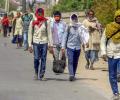
The count of the unemployed mounted to 38.7 million in December 2020 compared to 27.4 million in November, registering a massive increase of 11.3 million, reveals Mahesh Vyas.

Employment fell by 2.5 million in February, 0.1 million in March, 7.4 million in April and then by 15.3 million in May, explains Mahesh Vyas.

Union Labour Minister Bhupender Yadav has exuded confidence that four labour codes, which would bring another wave of reforms, will soon be implemented as around 90 per cent of states have already come out with draft rules. In 2019 and 2020, 29 central labour laws were amalgamated, rationalised and simplified into four labour codes, viz, the Code on Wages, 2019; the Industrial Relations Code, 2020; the Code on Social Security, 2020; and the Occupational Safety, Health & Working Conditions Code, 2020, noted the Survey. During an interaction, Yadav told reporters that around 90 per cent of the states have already published draft rules on four labour codes and he expects the four legislations would become operational soon.
 © 2026 Rediff.com - Advertise with us - Disclaimer - Privacy Policy - Sitemap - Feedback - About us - Terms of use - Grievances