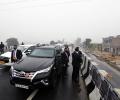
A bench headed by Chief Justice N V Ramana also appointed the Inspector General of the National Investigation Agency, Director General of Police of Chandigarh, the Registrar General of the Punjab and Haryana high court and the Additional DGP (Security) of Punjab as members to the Justice Malhotra panel.

The Supreme Court on Friday allowed women of all ages in the Ayyappa temple at Sabarimala in Kerala. While Justices R F Nariman and D Y Chandrachud concurred with Chief Justice of India Dipak Misra and Justice A M Khanwilkar on the ruling that banning the entry of women in the temple is gender discrimination and the practice violates the rights of Hindu women, Justice Indu Malhotra gave a dissenting verdict. Here are highlights of her judgment.

"Don't know any finer judge than Justice Indu Malhotra," Chief Justice S A Bobde said on Friday as the first woman lawyer to be appointed directly as a judge of the Supreme Court sat on the bench along with him for the last time before her retirement.

A Supreme Court-appointed committee to probe the security breach during Prime Minister Narendra Modi's visit to Punjab in January has found that the Ferozepur Senior Superintendent of Police failed to discharge his duty though sufficient force was available.
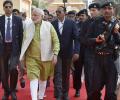
The Supreme Court on Wednesday said the provisions of the Special Protection Group Act and contents of the Blue Book are "comprehensive" in ensuring proximate security of the prime minister and other SPG protectees, and any lapse in following these can lead to "devastating and serious consequences".

Prior to the swearing-in of Justices Hima Kohli, Nagarathna and Bela M Trivedi, only eight women judges, including sitting judge Justice Indira Banerjee, were appointed as apex court judges.

The apex court said banning entry of women to Kerala's Sabrimala temple is gender discrimination and the practice violates rights of Hindu women.
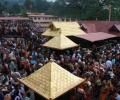
'We will talk to Muslim, Christian organisations and form a broad alliance so that every temple, church and mosque will have freedom to manage their affairs and not to be intervened upon.'
While recusing herself from the matter, she said that she had earlier represented a party in the case as a lawyer.

The government had on April 26 declined to accept the recommendation of the collegium and asked it to reconsider his name.
Justice S A Bobde, who is heading the inquiry panel, has appointed Justice Malhotra to the committee.

The review petitions would be heard by a constitution bench comprising Chief Justice Ranjan Gogoi and Justices R F Nariman, A M Khanwilkar, D Y Chandrachud and Indu Malhotra.
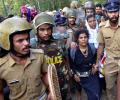
A bench comprising Chief Justice Ranjan Gogoi and justices L N Rao and Dinesh Maheshwari said it was only going into the aspect of security of the two women and would not like to entertain any other prayer made in the petition.

Observing that an environment has been created in the Indian society over the years that has led to deep-rooted discrimination against the community, a five-judge constitution bench, hearing petitions seeking decriminalisation of 158-year-old colonial law under Section 377 of the Indian Penal Code, said discrimination against such people has also adversely impacted their mental health.
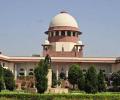
Along with her, Uttarakhand high court Chief Justice K M Joseph has also been cleared for elevation to the apex court.
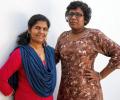
In the plea, one of the women, who had been attacked by her mother-in-law following her entry into the hilltop shrine, has sought security for both the women.
Apart from Joseph, Justices Indira Banerjee, Vineet Saran sworn in as judges of the Supreme Court in the order of seniority notified by the Centre.
The apex court struck down Section 497 of the Indian Penal Code dealing with the offence stating it was archaic and violative of right to equality.

A notice by the office of Supreme Court Secretary General also said that the report of the committee constituted as part of the in-house procedure is not liable to be made public.

'What the Sabarimala majority verdict has done is to elevate the principle of equality over all others, including the right to worship, and declared that this will be the litmus test of all practices, and re-emphasise that practices that are ultra vires will be junked,' says Saisuresh Sivaswamy.
 © 2026 Rediff.com - Investor Information - Advertise with us - Disclaimer - Privacy Policy - Sitemap - Feedback - About us - Terms of use - Grievances