
The constitution amendment Bill on a national GST is likely to be tabled in the current session of Parliament. However, the government is not confident of passing the Bill this session.

While consumers feel that petrol pinches directly, diesel hurts indirectly, as it is an input in almost all the goods and services we use.

'So far, the government has sanctioned more than Rs 300 billion as GST refunds,' Ansh Bhargava and Aditya Singhania point out.

India has in recent months stepped up enforcement of tax collections as it looks to raise revenue to help plug its widening fiscal deficit.

The author suggests eight reforms that all parties competing in this year's general elections should embrace.

Warning that the new year will be riskier than the previous two in terms of growth, inflation and the perils of monetary policy normalisation on consumption demand in particular, along with other external risks, a Wall Street brokerage has pencilled in an 8.2 per cent GDP growth next fiscal, with more downside risks to the projection. The biggest risk to the projection is a derailed consumption demand that has been the main growth driver in the past many years, said the Bank of America Securities India house economists who still believe that consumption demand will remain the key driver of growth next fiscal as well.

The CAG audit and other data suggests it could be far from the efficient new alternative that was once conceptualised. A conclusive review remains elusive till the government begins to release more granular and comparable data on the complex backend of GST to a deeper scrutiny, by researchers, auditors and the public.

Stocks and sectors impacted most by GST.

GST mop-up likely to fall in May, June after touching record levels in April and March.

GST reform has been hanging fire since 2006-07.
Rajan also expressed hope that a stable government after the Lok Sabha elections will continue the broad fiscal policies of the current regime and India may finally get the Goods and Services Tax, an ambitious indirect tax reform measure.

E-way bill generation, which is related to paying Goods and Services Tax (GST) and a key high-frequency indicator of economic activity, may have fallen to a five-month low in April as more cities experience lockdowns due to a surge in Covid-19 cases. In April e-way bill generation may decline to 55-58 million, which is the lowest since at least November. On the higher side, it is a 17 per cent decline over March.

Data on the new series given by a panel on real sector statistics shows that GDP grew by 10.23 per cent in 2007-08 and 10.78 per cent in 2010-11. There are some years for which the new figures show a deceleration in growth as well. The new series has 2011-12 as the base year while the earlier series had 2004-05 and 1993-94.

The wholesale price-based inflation rose for the second consecutive month in February to 4.17 per cent, as food, fuel and power prices spiked. The WPI inflation was 2.03 per cent in January and 2.26 per cent in February last year. After witnessing months of softening of prices, the food articles in February saw 1.36 per cent inflation. In January it was (-) 2.80 per cent.

The previous United Progressive Alliance government had undertaken some decisions, like introduction of retrospective tax amendments and GAAR, which had dented investor sentiments.
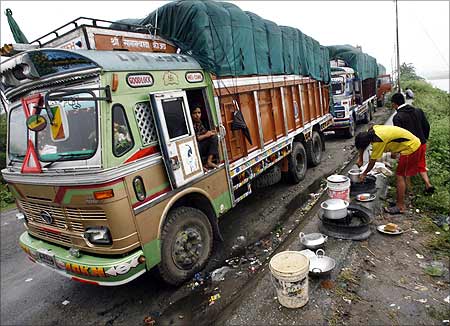
The Cabinet on Wednesday approved amendments to the GST bill to compensate states for revenue loss for five years on introduction of the uniform nationwide indirect tax regime.

Any business that makes inter-state supply is outside the ambit of the scheme
For every rupee in the government coffer, 70 paise will come from direct and indirect taxes, while the government will spend 23 paise towards the states' share of taxes and duties.

According to DBS, GST has growth, inflation and fiscal implications.

Early GST rollout to help create more jobs, boost output, says IMF.

FM had proposed an enabling provision to levy cess at 2%

By November 3, only 17,000 applications with tax payable amounting to Rs 1,100 crore have been received by the government, under the Sabka Vishwas Legacy Dispute Resolution Scheme. The scheme gives a deep discount of 70 per cent for cases pending appeal where tax demand is more than Rs 50 lakh, and 50 per cent waiver beyond that amount.

But their trajectory and direction have been largely influenced by politics and the political leadership's understanding of how the economy needs to be managed, explains A K Bhattacharya.
Businesses with monthly turnover of over Rs 50 lakh will have to mandatorily pay at least 1 per cent of their GST liability in cash, the finance ministry said as it moved to curb evasion by fake invoicing. The Central Board of Indirect Taxes and Customs (CBIC) has introduced Rule 86B in Goods and Services Tax (GST) rules which restricts use of input tax credit (ITC) for discharging GST liability to 99 per cent. "... The registered person shall not use the amount available in electronic credit ledger to discharge his liability towards output tax in excess of 99 per cent of tax liability, in cases where the value of taxable supply ... in a month exceeds Rs 50 lakh," the CBIC said.
Jaitley said future transactions would be substantially digital as India moves towards a less-cash society

Modi also reached out to traders, saying their past records will not be checked by the income tax department if they join the formal economy by getting themselves registered under the GST regime.

'Higher than expected inflation in the US or the European Union, faster than expected tightening by the major central banks, break out of a war in Europe, and withdrawal of portfolio equities from the emerging markets are factors which can result in equity market corrections.'

The GST will be a national sales tax that will be levied on consumption of goods or use of services

The stalemate over compensating states for the shortfall in GST collections continued on Monday with a meeting of the GST Council ending without reaching any consensus. The panel, which is the highest decision-making body on indirect taxes, for the second time in a week failed to reach a consensus on the Centre's proposal of states borrowing against future GST collections to make up for the shortfall.

The minister said he was able to build consensus on VAT when he was the Finance Minister during the UPA-I term.

The government has budgeted for total expenditure of Rs 34.83 lakh crore or 6.8 per cent of GDP. While the net tax revenue rose from Rs 5,75,697 crore in October 2020 to Rs 10,53,135 crore till October 2021, a growth of 82.93 per cent annualized, total expenditure rose only by 9.95 per cent, led by infra spending to Rs 18,26,725 crore from Rs 16,61,454 crore during the same period, the RBI said in the financial stability report.

After discussions, there may be changes the Bill.

On the basis of Budget projections, the Centre needs Rs 7.3 trillion revenue during December-March and its expenditure must be limited to Rs 6.7 trillion.

Conformity assessment procedures will be put in place to verify that goods and services sold on e-commerce platforms meet required standards and technical regulations, according to the draft e-commerce policy. The policy, which is under discussion, also stated that actions and things which cannot be done by the online platform entities "can also not be done" by any of its associates and related parties. Government may, from time to time, notify parties which fall in the definition of associates and related parties, it said.
Finance Minister Nirmala Sitharaman will present the much-awaited 2022-23 Union Budget on February 1. While there has been strong recovery in some sectors, touch services like hospitality, tourism and leisure continue to suffer after two Covid-19 waves. Household savings have been hit due to increased spending on health care. Consumption has still not reached pre-pandemic levels.
There was no law that prevented the government from presenting a sixth full Budget, or something similar to it.

The Indian stock markets may turn bearish after the US Fed decides to raise interest rates.

Insurance companies are seeking a separate deduction limit of Rs 1 lakh for insurance premium payment under Section 80C of the Income Tax Act in the upcoming Union Budget to bring in more people under the ambit of insurance. The insurers also want reduction in the goods and services tax (GST) rate of 18 per cent currently applied on health insurance products to 5 per cent to make such products more affordable to common people. Finance Minister Nirmala Sitharaman will present the Union Budget for 2022-23 on February 1.

In a Facebook post on the second anniversary of demonetisation, Jaitley said in first four years of the National Democratic Alliance government, the number of income tax returns filers has gone up to 6.86 crore from 3.8 crore in May 2014.

In order to deal with the issue of accumulation of wealth, Finance Minister P Chidambaram had said the time has come for a debate on imposition of inheritance tax.
