
Finance Minister Nirmala Sitharaman on Thursday said there are no changes in tax rates for direct and indirect taxes, including import duties. She also said the number of tax filers has swollen 2.4 times and the direct tax collection has trebled since 2014.

The US Trade Representative noted that India's average applied tariff rate stood at 17% per cent, the highest of any major world economy.

The government's initiative to migrate SEZ data from NSDL software to ICEGATE system for streamlined reporting of import data caused double counting of gold imports, resulting in inflated figures and the issue has now been largely rectified, government sources said. The downward revision has provided the actual picture of trade deficit (difference between imports and exports), which was earlier looking very high. The deficit for November will now be revised downwards from $37.84 billion to about $32.8 billion. Similarly, there will be a revision in overall import numbers as well.
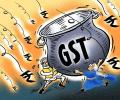
Gross GST collections in August grew 10 per cent to about Rs 1.75 lakh crore, reflecting higher domestic consumption. As per the government data released on Sunday, gross GST revenues from domestic transactions grew 9.2 per cent to about Rs 1.25 lakh crore. Revenues from import of goods were up 12.1 per cent to Rs 49,976 crore.

The Central Board of Indirect Taxes and Customs (CBIC) has stepped up its watch on the import of unbranded gold jewellery amid a spurt in seizures on international borders and from importers. During FY24, the CBIC and Directorate of Revenue Intelligence (DRI) jointly seized about 5 tonnes of gold, 30 per cent more than what they did in FY23. In FY23, 3.5 tonnes of gold was confiscated.
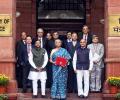
Finance Minister Nirmala Sitharaman on Thursday presented her sixth Budget in a row, equalling the record of former Prime Minister Morarji Desai.

'Peninsular Indians could ask 'Why should we contribute half of India's tax revenues if we account for only a quarter of the seats in the Lok Sabha?'.' 'The rest of the country seems likely to counter that 'democracy means one vote per person irrespective of where that person resides in India'.' 'With no easy answers to this thorny debate, the south's economic ascendancy could end up creating a Hobson's choice.' A revealing excerpt from Nandita Rajhansa and Saurabh Mukherjea's book, Behold the Leviathan: The Unusual Rise of Modern India.

'The bull market cycle ran for five years. It's the end of that cycle.' 'The next cycle is a down cycle, and in that down cycle, you will see the Sensex falling from their highs of around 68,000 to maybe 40,000-50,000 at the bottom of the cycle.'
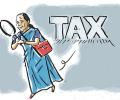
Net direct tax collection grew 21 per cent to over Rs 4.62 lakh crore so far this fiscal, on higher advance tax payment by corporates.

The government on Tuesday sought to address a significant concern stemming from the 2024-25 Budget announcement by introducing flexibility in the computation of long-term capital gains (LTCG) tax on unlisted assets, including properties. For any assets, such as land or buildings, acquired before July 23, taxpayers can choose between the new and old regimes, opting for whichever results in a lower tax liability. Under the new LTCG regime, the tax rate is set at 12.5 per cent without the benefit of indexation.
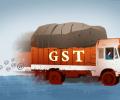
Goods and Services Tax collections jumped 10.4 per cent to over Rs 1.72 lakh crore in January, reflecting buoyant economic activity and setting the stage for the next phase of GST reforms. This is the second-highest monthly collection ever and marks the third month in this financial year with a collection of Rs 1.70 lakh crore or more, a finance ministry statement said on Wednesday.

The steep cut in Customs duty on silver in the FY25 Budget to 6 per cent from 15 per cent may provide the government temporary relief by checking the spurt in silver imports from the United Arab Emirates (UAE) under the Comprehensive Economic Partnership Agreement (CEPA). In FY24, silver imports from the UAE jumped to $1.7 billion from only $11.18 million in FY23, according to commerce department data. In May, about 87 per cent of India's silver imports came from Dubai.

About 1.2 trillion tax evasion cases have been detected and as many as 59,000 entities identified for verification in order to ascertain whether they are fake.

There is a need to incentivise R&D investments, offer corporate tax concessions and establish an effective intellectual property rights regime in order to push the growth of domestic pharmaceutical industry, as per the industry bodies. Outlining the sector's wish list for the upcoming Union Budget, Organisation of Pharmaceutical Producers of India (OPPI) Director General Anil Matai urged the government to explore methods to incentivise R&D investments, such as deductions on R&D expenses, research-linked incentives for MNCs, and corporate tax concessions.
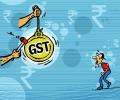
GST authorities have identified about 17,000 non-existent GSTINs and cancelled over 4,900 registrations in the ongoing pan-India drive against fake registration, a senior tax official said on Wednesday. Currently, there are 1.40 crore businesses registered under Goods and Services Tax, nearly double the number of businesses registered in indirect tax regime pre-GST rollout. Central Board of Indirect Taxes and Customs (CBIC) member Shashank Priya said in the drive against fake registration, till July 4, over 69,600 GST Identification Numbers (GSTINs) have been selected for physical verification by field tax officers.

A day ahead of the interim Budget, India slashed import duty on spare parts, like battery cover, lens and SIM socket, used in mobile phone manufacturing to 10 per cent, from 15 per cent. The duty cut is aimed at boosting local production and exports, as well as reducing prices in local markets. The finance ministry on January 30, notified the cut in duty on all goods for use in manufacture of cellular mobile phones to 10 per cent.

A day after it received Rs 32,403 crore GST demand, Infosys on Thursday said Karnataka state authorities have withdrawn the 'pre-show cause' notice to the company and directed it to submit further response to the Directorate General of GST Intelligence (DGGI) on the issue. India's second largest IT company had made headlines on Wednesday after GST authorities slapped a Rs 32,403 crore notice on it for services availed by the company from its overseas branches for five years starting 2017.
The Goods and Services Tax (GST) Council, scheduled to meet on June 22, could take a call on ending uncertainty on taxing foreign airlines and shippers as regards certain services, a senior official in the know told Business Standard. He said the Council was expected to decide on exempting the services in question from GST - aircraft lease rentals, maintenance, crew salaries, etc. These services are provided by foreign airlines to their Indian operations.

Concerned over huge revenues in form of customs, services and excise duties locked up in litigations, Finance Minister Pranab Mukherjee has constituted a committee to suggest steps to bring down such cases.

Four special benches will start functioning in the Supreme Court from next week to hear criminal appeals, direct and indirect tax and land acquisition matters and motor accident claim cases, Chief Justice of India Justice D Y Chandrachud said on Wednesday.

India's economic growth slowed to a 15-month low of 6.7 per cent in April-June 2024-25, mainly due to poor performance of the agriculture and services sectors, government data showed on Friday. The gross domestic product (GDP) expanded by 8.2 per cent in the April-June quarter of 2022-23. India, however, remained the fastest-growing major economy, as China posted a 4.7 per cent growth in April-June 2024.

Insurance companies may soon face goods and services tax (GST) audits as tax authorities plan a "deep dive" into their business practices to check for the possibility of a raft of tax-linked irregularities. Several insurance companies are being probed for wrongly availing of the input tax credit without the underlying supply of goods and services based on fake invoices generated by their channel partners and intermediaries. "We want to deep dive into the overall business and see if there are further taxation issues besides commissions, which are already being investigated," a senior official of the Central Board of Indirect Taxes and Customs said.
'We crossed Rs 1.7 trillion in three months this financial year.'

All eyes will be on whether Sitharaman provides the much-expected tax relief for the middle class, leaving more money in their hands, as there is tax buoyancy
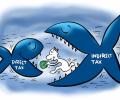
Before 2019, an estimated 22 million individual income-tax returns did not have to pay any taxes. But after the change in the exemption level, another 13 million individual tax returns did not require to pay taxes. Thus, of about 58 million returns, as much as 63 per cent or 35 million went out of the direct tax net, A K Bhattacharya points out.

The fitment committee under the Goods and Services Tax (GST) Council, comprising central and state officials, has begun a rate rationalisation exercise afresh, checking the possibility of dropping some of the rates, particularly the 12 per cent slab, to achieve a revenue-neutral structure, a senior official with direct knowledge of the matter

Taking both direct and indirect taxes, the gross collection is expected to grow 10.45 per cent to Rs 33.61 trillion in 2023-2024.
GST collection rose 11 per cent to over Rs 1.65 lakh crore in July as a result of anti-evasion measures and higher consumer spending. This is the fifth time since the rollout of the Goods and Services Tax (GST) regime that monthly collections have crossed the Rs 1.60 lakh crore mark -- making it the new normal. "Gross GST revenue collected in July is Rs 1,65,105 crore of which CGST is Rs 29,773 crore, SGST is Rs 37,623 crore, IGST is Rs 85,930 crore (including Rs 41,239 crore collected on import of goods) and cess is Rs 11,779 crore (including Rs 840 crore collected on import of goods)," the finance ministry said in a statement.
Over 100,000 small and medium-sized businesses are non-compliant with e-invoicing norms under the goods and services tax (GST) regime, a mandatory requirement for businesses with an annual turnover of over Rs 5 crore. E-invoicing provides real-time access to invoices that are prepared by the supplier on the purchase of goods, allowing faster accessibility to input tax credit, thereby limiting the manipulation of fake credit as it has to be generated before the transaction. "The default has been reported mainly in businesses with a turnover between Rs 5 crore and Rs 20 crore," a senior official informed
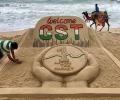
Six years after the rollout of the biggest indirect tax reform in India, Goods and Services Tax (GST) revenue of Rs 1.5 lakh crore every month has become a new normal and tax officers are focusing on dealing with fraudsters who are adopting newer modus operandi to game the system, causing loss to the exchequer. To apprehend black sheep, who operate as syndicates and create fake entities on the basis of forged documents to claim input tax credit (ITC), tax officers have started using data analytics, artifical intelligence and machine learning aiming to curb evasion, which was over Rs 3 lakh crore since inception of GST. It was over Rs 1 lakh crore in 2022-23. Thinktank Global Trade Research Initiative (GTRI) said the most critical pending GST reform is upgradation of GST Network to prevent fake supplies and fraudulent claims of Input Tax Credit (ITC).

Union Finance Minister Nirmala Sitharaman, along with her team of bureaucrats, delved into the fine print of the 2024-25 Budget documents in a press conference, detailing the government's road map on bringing down the debt-to-GDP ratio and bold tax measures.

On Thursday, the bench, after perusing the plea copy, noted that Wankhede had approached the Central Administrative Tribunal, too, against the notices issued to him by the NCB.
The gross tax revenues have touched 65 per cent of the Budget estimates at Rs 17.81 lakh crore during the first eight months of the current fiscal till November, propelled by corporate and personal income tax mop-up, according to the Economic Survey 2022-23 presented in Parliament on Tuesday. The survey, authored by Chief Economic Advisor V Anantha Nageswaran, said the 'substantial reforms' in India's taxation ecosystem post-2014 and policy reforms have removed the distortionary incentives from the economy. Reforms like GST, reduction in corporate taxes, exemption of sovereign wealth funds and pension funds from taxes, and removing Dividend Distribution tax have reduced the tax burden on individuals and businesses.

The Bombay high court on Monday said no coercive steps shall be taken against IRS officer Sameer Wankhede till April 10 on notices issued to him on the NCB's preliminary inquiry over irregularities in a drugs case related to actor Sushant Singh Rajput's death.
The principal commissioner has been made responsible for developing and approving any intelligence, conducting search, and completing investigations and relevant subsequent actions, including at the lower field formations, points out T N C Rajagopalan.

What stood out in his 15-year journey as a member of the political executive at the Centre was his glowing record as India's most successful and effective finance minister. Both as prime minister and finance minister, he understood the importance of gradualism, except when the economy or the polity was in a crisis.
The decision to impose a 28 per cent tax on the full face value of bets placed on online games will be implemented from October 1 even though there was demand for a review from states like Delhi and Goa, finance minister Nirmala Sitharaman said on Wednesday. The GST Council -- the highest decision making body of the new indirect tax regime that comprises Union finance minister and representatives of all states -- discussed the language of amendments that will be needed to enabling taxing online gaming, she said after the panel meeting.
India can sustain 8 per cent annual GDP growth and the conducive macroeconomic configuration may become a launching pad for a step-up in the country's growth trajectory, said an article on the 'State of Economy' in the central bank's March Bulletin published on Tuesday. Over the period 2021-24, gross domestic product (GDP) growth has averaged above 8 per cent. The global economy is losing steam, with growth slowing in some of the most resilient economies and high frequency indicators, pointing to further levelling in the period ahead, said the article authored by a team led by RBI Deputy Governor Michael Debabrata Patra.

Adding petrol and diesel to GST was a challenging task due to their significant role as revenue generators for both the central and state governments.

'We have now drastically simplified it, primarily to two rates in long-term capital gains: 20% and the applicable rates. Similarly, in short-term capital gains.' 'For listed shares, there is a slight increase, but for unlisted shares, where indexation benefits are removed, there is a reduction in rates, benefiting unlisted companies, venture capital firms, etc.' 'Similarly, in real estate, wherever returns are higher, the new structure is beneficial. In very few cases, returns are lower, and those are more of an exception.'
