
rediffGURU T S Khurana answers readers' personal income tax queries.

Foreign portfolio investors (FPIs) have invested Rs 25,300 crore through the anchor book for IPOs in 2024, surpassing the Rs 20,351 crore invested by domestic mutual funds (MFs). FPIs accounted for 46.6 per cent of shares sold in the anchor category, the highest share since 2021, according to PRIME Database.

Towards the end of February, the Reserve Bank of India (RBI) restored the risk weighting on banks loans to non-banking financial companies (NBFCs; including to microfinance institutions, or MFIs) to 100 - back to its November 2023 position - from 125. It is only a partial relief though. "Higher risk weighting on unsecured lending continues to be in place while the same on bank funding to NBFCs has been done away with. "This is a positive step by RBI," says Rajiv Sabharwal, managing director (MD) and chief executive officer (CEO), Tata Capital.

From the 30-share blue-chip pack, Adani Ports jumped over 5 per cent. NTPC, Tata Steel, Bajaj Finserv, Zomato, Bajaj Finance, Tata Motors, State Bank of India, IndusInd Bank and Maruti were among the other big gainers. From the 30-share pack, Hindustan Unilever, Titan, Tata Consultancy Services, Infosys and UltraTech Cement were the other laggards.

rediffGURU Vipul Bhavsar answers readers' personal income tax queries.

The weaker rupee will push the country's import bill due to higher payments for crude oil, coal, vegetable oil, gold, diamonds, electronics, machinery, plastics, and chemicals, economic think tank GTRI said on Friday. Citing an example, it said the depreciating domestic currency will increase India's gold import bill, especially as global gold prices have jumped 31.25 per cent, rising from $65,877 per kg in January 2024 to $86,464 per kg in January 2025.

Quick commerce (qcom) industry is poised to lead gig workforce hiring in 2025, propelled by a surge in demand for faster deliveries, expansion by existing players, entry of new competitors, and evolving consumer preferences in the post-pandemic era, according to industry experts. The qcom industry currently employs nearly 260,000 people - around 200,000 delivery personnel and 60,000 dark store workers, according to TeamLease Staffing.
Value mutual funds have witnessed robust investor interest, garnering Rs 22,757 crore in inflows in 2024, nearly double the amount seen in 2023, fueled by impressive returns generated by the segment. This surge reflects a shift in investor focus towards fundamentally strong yet undervalued stocks.

'Investment by insurers in the Bima Sugam India Federation is illegal as it is a private limited company.'

Inflows into mutual funds' equity schemes increased by over 14 per cent on-month to Rs 41,156 crore in December, even as market volatilities continued. The small and midcap schemes of mutual funds continued to attract investor interest with inflows touching record highs during the month, despite the concerns being expressed about the two segments for the risk they portend, industry body Amfi said.

The last time these two indexes recorded a negative performance on a calendar year basis was in CY19.

Gross GST collections grew 8.5 per cent to over Rs 1.82 lakh crore in November on account of increased sales spurred by the festive season.

State Bank of India, HDFC Bank and ICICI Bank have again been named as Domestic Systemically Important Banks (D-SIBs) by the Reserve Bank of India. The Reserve Bank on Wednesday came out with the list of D-SIBs.

Corporate India's struggle with subdued revenue and earnings growth persisted in the October-December quarter of 2024-25 (Q3FY25). The combined net sales (gross interest earnings for lenders) of listed companies grew in single digits for the seventh consecutive quarter, while their combined net profit rose by a single digit for the third straight quarter.

With rising disposable incomes in cities beyond metros, the penetration of credit cards - and consequently, credit card spending - is growing at a much faster pace than in traditional metro cities, primarily driven by e-commerce spending.

DIIs owned equities worth Rs 73.5 trillion, just 1.9 per cent less than FPIs. This marks a significant change from a decade ago.

Purchase health insurance early while you are disease-free. 'It might become very difficult to get a comprehensive health cover for someone who has already had cancer.'

In today's rapidly evolving digital payment landscape, security concerns remain a top priority for stakeholders across sectors.

'Doctors feel they have a duty to prolong a heartbeat at all costs.' 'And a son or a daughter feels, I can't let my mum die. I have to save her at all costs.' 'They think saving is just prolonging life. But the person suffers.'

rediffGURU Yogendra Arora answers readers' personal income tax queries.

The Indian insurance industry is set to focus on customer-centric technological adoption and expansion into rural areas to drive growth in 2025.

The rapid rise of quick commerce is anticipated to create a substantial increase in the need for blue-collar workers, with India projected to require 2.4 million jobs by 2027, according to job matching and hiring platform Indeed. Quick commerce companies hired over 40,000 employees in the last quarter to handle increased festive shopping and e-commerce demand, Indeed India Sales Head Sashi Kumar said.

Budget 2025 lays down a transformational roadmap for India's digital and economic future, focusing on AI-driven enterprise modernisation, workforce skilling, and sustainable innovation. With bold investments in AI, digital infrastructure, and ease of doing business, the government has set the stage for businesses to scale, innovate and compete on a global level.

India's healthcare and pharmaceutical sectors raised Rs 14,811 crore through initial public offerings (IPOs) in 2024, the largest since 2019, driven by strong domestic demand amid expanding global opportunities. According to data, key contributors to the record fundraising included Sai Life Sciences (Rs 3,043 crore), IKS Health (Rs 2,498 crore), and Sagility India (Rs 2,107 crore).

To ease the potential liquidity stress, the Reserve Bank on Friday slashed Cash Reserve Ratio (CRR) by 50 basis points to 4 per cent, a move that would unlock Rs 1.16 lakh crore bank funds. The RBI on May 4, 2022 had raised CRR to 4.5 per cent from 4 per cent in an off-cycle Monetary Policy Committee (MPC) meeting, with effect from May 21 the same year.

All that you must know about the pros and cons of gift deeds, tax implications, essentials, documents required, conditions, etc...

Bank of Baroda, a state-owned bank, in its quarterly update on Friday said its domestic deposits grew 9.23 per cent year-on-year (Y-o-Y) in October-December (Q3FY25) at Rs 11.65 trillion, while advances increased 11.76 per cent Y-o-Y at Rs 9.63 trillion, outpacing deposit growth during the period. Domestic retail advances grew at a robust 19.5 per cent Y-o-Y to Rs 2.43 trillion.
Private sector banks that announced their earnings for the October-December quarter (Q3) of 2024-25 (FY25) reported a rise in credit costs due to higher provisions, mainly for unsecured retail loans.

The Union Budget 2025-26, while promising a new framework for smoother mergers and acquisitions (M&As), has plugged a major loophole on carry-forward losses for a total of eight assessment years between amalgamating company and amalgamated company from the date of loss instead of date of the merger. For all mergers effected on or after April 1, 2025, the losses can be carried forward only for the residuary period (counting from the date of loss).

UPI-related frauds have accounted for a cumulative loss of Rs 2,145 crore across 2.7 million reported incidents.

rediffGURU T S Khurana answers readers' personal income tax queries.

Around Rs 1 trillion, or a fifth of the investments made by alternative investment funds (AIFs) are questionable in terms of the intent behind the investments and are under the scanner for circumvention of regulations, said Ananth Narayan, whole-time member of Securities and Exchange Board of India (Sebi). AIFs are pooled investment vehicles that invest in a variety of assets including real estate, startups, unlisted companies, and derivative strategies in the listed space.

Trading activity of foreign investors and global trends will be the major driving factors for the equity markets in a holiday-shortened week ahead, according to analysts. Leading stock exchanges BSE and NSE have declared a trading holiday on November 20 for assembly elections in Maharashtra. Elections to the 288-member state legislative assembly will be held on November 20, and votes will be counted on November 23.

It is not just the secondary market that is witnessing a revival in fortunes. Even the initial public offering (IPO) market have roared back to life, with investors submitting bids worth over Rs 2.2 trillion on the three IPOs that wrapped up on Friday. Fashion retailer Vishal Mega Mart (VMM)'s IPO (fifth largest of the year) garnered 27.3x subscription, with bids exceeding Rs 1.6 trillion.

ICICI Bank, Tata Motors, Tata Steel, NTPC, JSW Steel, State Bank of India and Adani Ports were the other big gainers. Asian Paints, Nestle, Tech Mahindra, HCL Technologies, Hindustan Unilever, Infosys and ITC were the other big laggards.

The Centre on Wednesday increased the Dearness Allowance (DA) by 3 percentage points effective from July 1 this year, benefitting more than 1 crore employees and pensioners ahead of the Diwali festival. The Union Cabinet has approved to increase Dearness Allowance (DA) to central government employees and Dearness Relief (DR) to pensioners by three percentage points of the basic pay/pension ahead of Diwali, Union Minister Ashwini Vaishnaw said after the Cabinet meeting.
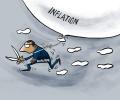
Wholesale price based inflation declined to a 3-month low of 1.89 per cent in November on cheaper food items, and experts predicted a 0.25 per cent interest rate cut by the RBI in the policy review in February. The Wholesale Price Index (WPI) based inflation was 2.36 per cent in October 2024. It was 0.39 per cent in November, last year. In August, 2024, it was 1.25 per cent.

When investing in fixed-income products, balancing considerations like safety, liquidity, and income is essential.

Ask rediffGURU and PF expert Milind Vadjikar your insurance, stocks, mutual fund and personal finance-related questions.

The advance/decline ratio (ADR) - a gauge of market breadth - has remained negative (below 1) for a second consecutive month. In other words, the number of stocks declining is outpacing those rising, as a brutal selloff by overseas investors and lofty valuations weigh on sentiment. According to BSE data, the ADR for October stands at 0.98 for the second month in a row.
 © 2026 Rediff.com - Investor Information - Advertise with us - Disclaimer - Privacy Policy - Sitemap - Feedback - About us - Terms of use - Grievances