
The risk-reward for the Indian markets, Morgan Stanley said, is turning favourable.

The general elections in April/May 2024 are expected to add volatility to the Indian markets, keeping investors on their toes.

The outcome of the general elections, the Morgan Stanley note says, has enough firepower to sway the markets on either side.

With the Nifty50 just about 3 per cent away from its all-time closing high of 18,812 points, analysts at BofA Securities suggest investors book profit. Their reasons for the advice include risks like the possibility of a cut in corporate earnings growth forecasts, high valuation (one-year forward P/E of 19.5x), interest rates staying elevated for longer-than-expected and credit tightening. Going ahead, they expect the Nifty50 index to drop to 16,000 levels - down nearly 12 per cent from the current level of 18,255 points, which they believe would be a good time to buy.

FPIs have turned net sellers in 2022 after being net buyers in the last three years.

The bull run in the Indian equity markets is intact, said analysts at Morgan Stanley in a recent note. They expect the S&P BSE Sensex to hit 80,000 levels by December 2023 in their bull-case scenario, to which they have assigned a 30 per cent probability. From the current level, this translates into an upside of nearly 29 per cent.

India will need $223 billion of investment to meet its goal of wind and solar capacity installations by 2030, according to a new report by research company BloombergNEF (BNEF). The government has set a target of increasing non-fossil power capacity to 500 GW by 2030. It wants non-fossil fuel power sources to provide half of its electricity supply by 2030. "To achieve this target, India needs to massively scale up funding for renewables," the report said, adding that $223 billion is required over the next eight years just to meet the solar and wind capacity targets.

BofA Securities has revised its year-end Nifty target from its earlier projection of 16,000 to 14,500 now - down over 6 per cent from the current levels. Fast tightening monetary conditions, slowing growth/fears of US recession and the likely Nifty EPS (earnings per share) cuts, BofA Securities said, are the key headwinds for the markets in the near-term. However, clarity on macro and monetary policy outlook in the US/India, it said, is the silver lining that could see markets bottom out by August/September 2022.

Despite headwinds, it remains "structurally bullish" on India and expects the Sensex to scale up to the 70,000-mark by December 2022; 80,000 level in a bull-case scenario and hover around the 50,000-mark as a bear-case, the brokerage house said in a report.

In a bull-case scenario it sees the Sensex at 61,000 levels, while it's bear case scenario pegs the Sensex at 41,000 levels by December 2021.

Experts say, investors will be better off exiting them at higher levels and investing in stocks of fundamentally sound companies.

Portfolio returns, say analysts at Morgan Stanley, are more likely to be driven by bottom-up stock-picking rather than top-down macro forces.

The trend in corporate earnings suggests that index earnings could fall to the levels last seen in early 2014.

'Our discussions with investors and the market's multiples suggest that Prime Minister Narendra Modi winning 2019 is being priced in,' says a UBS report.

Analysts caution a non-BJP government is not an impossible scenario. In case of a Modi-led coalition, they advise investors to focus on discretionary consumption, select private banks and financials, RIL, housing, and IT.

Coalition governments aren't necessarily a negative for the economy, though they can result in negative outcomes in the stock market if not already priced in before elections.

The best-case scenario -- to which Morgan Stanley attaches 30 per cent probability -- pegs the S&P BSE Sensex at 41,500 levels in the next 12 months.

Being one of the early commentators to flag economic slowdown and caution investors on corporate earnings, Gautam Chhaochharia, head of India research, UBS Securities, in an interview with Hamsini Karthik says the markets remain in an expensive zone despite the recent correction.

Thus far in 2017-18, FIIs and MFs have invested Rs 198.91 billion and Rs 1,119.49 billion in the Indian equity markets. Of this, around Rs 152.46 billion has come in January alone.

Aptech, Lumax Industries, Vedanta, Indian Bank, Venky's India have appreciated over 200% in a year

While analysts predicted the Sensex to cross 30,000 in 2016, the index currently stands 12% lower at 26,400.

Liquidity pushed benchmark indices 22% higher to become the best performing equity market globally

Market players said the sell-off was triggered by pessimism that the government may not be able to balance growth with macro-stability.

It won't be an easy ride for the markets, reckon experts, considering the multiple state elections in 2018 and general elections next year.

While companies having fewer visa holders in the US seem to be less exposed to rising protectionism, most front-line IT stocks are trading at attractive levels and, to a large extent, factor in near-term headwinds.

Buying stocks during bad times can lead to good returns.

'...and defensive until the global macro headwinds turn more benign.'

India's macroeconomic environment is improving, but it is still not past the point where it can ignore the developments in the global markets

Local businesses are fretting over reform setbacks.
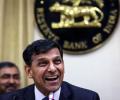
Growth acceleration will be gradual and it is still early days for a sharp recovery, says Gautam Chhaochharia, executive director and head of India research, UBS.

Although the markets could see a knee-jerk reaction, they rule out a sharp fall.

Cashi Crisis: Day 9: Aaj ki Taaza Khabar!
 © 2026 Rediff.com - Investor Information - Advertise with us - Disclaimer - Privacy Policy - Sitemap - Feedback - About us - Terms of use - Grievances