
Acknowledging the killing of its leader Mullah Akhtar Mansour, the Afghan Taliban have announced Mawlawi Haibatullah Akhundzada as his successor.

An audio message has been released in Pushto, circulated by Taliban commanders, where Akhundzada said, "Taliban will never bow their heads and will not agree to peace talks," reports Dawn.

The Taliban have been forcing women to cover themselves up since returning to power in August.

'Every evidence we have in hand shows that IS-K cells have their roots in Talibs & Haqqani network particularly the ones operating in Kabul. Talibs denying links with ISIS is identical/similar to the denial of Pakistan on Quetta Shura. Talibs have learned very well from the master. #Kabul,' Saleh said in a tweet.
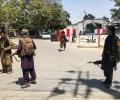
Despite dependence on the ISI for years of sustenance, Taliban leaders may harbour resentment over the ISI's excessive control, notes Rana Banerji, who headed the Pakistan desk at the Research and Analysis Wing.
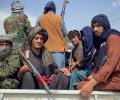
Even though the Taliban has managed to capture Afghanistan and form a government, an internal rift between the faction has started emerging, according to media reports.

Abdul Ghani Baradar, the Taliban leader freed from a Pakistani jail on the request of the US less than three years ago, has emerged as an "undisputed victor" of the 20-year war in Afghanistan, according to a British media report.
Some commanders have refused to pledge allegiance to Akhundzada, according to interviews with Taliban commanders and officials.

The Taliban's official spokesman, Abdulqahar Balkhi, claimed responsiblity for the attack on Twitter.

If New Delhi finds itself out in the cold in Afghanistan, both the Congress-led UPA and BJP-led NDA have only themselves to blame. Each has been in power for a full decade from 2001, without reaching out to the Taliban, points out Ajai Shukla.

Pakistan was earlier reluctant to confirm Mullah Mansour's killing. On Tuesday, Interior Minister Chaudhry Nisar Ali Khan had said that the body recovered on Pakistani soil, near the Afghan border, was charred beyond recognition.
Afghanistan will remain a frontline state for Washington for a foreseeable future in terms of the potential threats to US national security from terrorist groups, asserts Ambassador M K Bhadrakumar, who played a stellar role in beginning India's dealings in Afghanistan in 1994.
India has demanded the United Nations to slap sanctions against the new Taliban leader in Afghanistan, saying it is "sheer folly" that the leader of a proscribed entity is not yet designated as a terrorist individual.

In a veiled reference to Pakistan, India said perpetrators of violence in Afghanistan must not be allowed safe havens in its neighbourhood, as it slammed the United Nations Security Council's sanctions regime for not designating the leader of Taliban as terrorist, calling such an approach a "mystery."
 © 2026 Rediff.com - Advertise with us - Disclaimer - Privacy Policy - Sitemap - Feedback - About us - Terms of use - Grievances