
The exodus of FPIs from the Indian equity markets continued unabated, as they withdrew over Rs 7,300 crore (about $840 million) in the first week of this month due to global trade tensions, with the US imposing tariffs on countries such as Canada, Mexico, and China. This came following an outflow of Rs 78,027 crore in the entire January. Before that, they invested Rs 15,446 crore in December, data with the depositories showed.

The share of total health expenditure as part of the gross domestic product (GDP) went down to 3.3 per cent in 2017-18 from 3.8 per cent in the previous two years, according to the national health account data released on Monday by the health ministry. The share of government expenditure as part of total expenditure as well as GDP has gone up from from 3.78 per cent to 5.12 per cent between 2013-14 and 2017-18, which could also explain a decline seen in out of pocket expenditure in 2017-18. Health ministry also emphasised the increase in the government health expenditure as part of the total GDP from 1.15 per cent in 2013-14 to 1.35 per cent in 2017-18.

Shares of state-owned bank stocks were under pressure on Monday due to muted deposit and credit growth numbers reported by these lenders in the October-December quarter (Q3) of 2024-25 (FY25). The Nifty PSU Bank index was down 4 per cent, with Union Bank of India emerging as the biggest loser as its shares fell 7.5 per cent to close at Rs 114.7, followed by a 5.7 per cent drop in shares of Bank of Baroda (BoB) to Rs 228 and a 4.7 per cent slide in shares of Bank of India to Rs 99.8 on the National Stock Exchange.

Foreign investors have pulled out Rs 44,396 crore from Indian equities this month, driven by strength of the dollar, rising bond yields in the US, and expectations of a weak earnings season. This came following an investment of Rs 15,446 crore in the month of December, data with the depositories showed.

Personal income tax as a percentage of GDP has gone up from 2.11 per cent in 2014-15 to 2.94 per cent in 2021-22 fiscal, indicating that taxpayer base is widening as a result of the steps taken by the present government led by Prime Minister Narendra Modi.

Analysts are warning of growing risks to the market's sustained momentum, and even to the possibility of consolidation at current levels. Domestically, markets are grappling with several challenges, including a slowing economy, as indicated by the latest GDP data for the July-September (Q2) quarter of 2024-25 (FY25), sticky inflation, fluctuations in the rupee, waning consumption, and high interest rates.

If the fiscal deficit target of 4.9% of GDP has to be met for 2024-2025, which the government must in view of the uncertainties and challenges emerging both domestically and globally, the finance ministry may see in the composition of the current year's capex a sliver of hope, notes A K Bhattacharya.

With its age-old fascination for education, southern states have done better than the North. Start-ups, IT hubs, and industry majors setting up shop have changed the face of the South. Nearly 79% of global offices set up by international conglomerates in India are in the South. Almost 46% of tech unicorns are from the South. The GDP per person in the South is 4.2 times higher than the North. None of these indicators can be ignored by any central government, whatever the political compulsions, notes Ramesh Menon.
'As the Budget has taken some measures to spur growth, similar action from the MPC may be expected.'

'The intensity and frequency of heatwaves will be much higher than in previous years over Punjab, Haryana, Rajasthan, Gujarat, Madhya Pradesh and Odisha.'
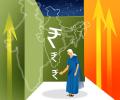
S&P Global Ratings on Tuesday retained India's growth forecast at 6.8 per cent for the current fiscal and said it expects the RBI to start cutting interest rates in its October monetary policy review. In the economic outlook of Asia Pacific, S&P Global Ratings also retained its GDP growth forecast for the 2025-26 fiscal at 6.9 per cent and said solid growth in India will allow the Reserve Bank to focus on bringing inflation in line with its target.

From the 30-share pack, Adani Port, Bharti Airtel, Asian Paints, IndusInd Bank, Bajaj Finserv, Reliance Industries, Infosys, UltraTech Cement, HDFC Bank, HCL Technologies and ICICI Bank were among the laggards. Tata Motors, Axis Bank, Maruti, Larsen & Toubro, ITC and Tata Steel were among the gainers.

'Peninsular Indians could ask 'Why should we contribute half of India's tax revenues if we account for only a quarter of the seats in the Lok Sabha?'.' 'The rest of the country seems likely to counter that 'democracy means one vote per person irrespective of where that person resides in India'.' 'With no easy answers to this thorny debate, the south's economic ascendancy could end up creating a Hobson's choice.' A revealing excerpt from Nandita Rajhansa and Saurabh Mukherjea's book, Behold the Leviathan: The Unusual Rise of Modern India.

This will be the first full-year Budget of the BJP-led National Democratic Alliance government since it came to power for a third consecutive term in July last year.

Global factors and FII activity will dictate trends in domestic equity markets this week while assembly poll results of Maharashtra and Jharkhand may impact stocks on Monday, say analysts. Stock markets witnessed a spirited recovery on Friday with benchmark Sensex and Nifty notching the best single-day gains in more than five months and offering relief after weeks of correction.

The Centre's fiscal deficit at the end of the first seven months of financial year 2024-25 touched 46.5 per cent of the full-year target, government data showed on Friday. In absolute terms, the fiscal deficit -- the gap between government's expenditure and revenue -- was at Rs 7,50,824 crore during April-October period, according to data released by the Controller General of Accounts (CGA). The deficit stood at 45 per cent of the Budget Estimates (BE) in the corresponding period of 2023-24.
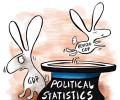
The Economic Survey 2022-23 (FY23), to be presented a day before Union Budget 2023-24 (FY24), is likely to project India's real gross domestic product (GDP) growth between 6 per cent and 7 per cent for FY24, Business Standard has learnt. The broader theme of the Survey could be on how India has dealt with two years of a global pandemic and the ongoing geopolitical disturbance, the strengths and weaknesses that emerged, and what lessons may be learnt. The much-awaited Survey will be the first one by Chief Economic Advisor V Anantha Nageswaran and his team in the finance ministry's economic division.

'When people have money in their hands, they make their judgment about whether they want to spend it entirely or spend some out of it.'

Sanjay Malhotra on Wednesday took charge as the 26th Governor of the Reserve Bank of India. Malhotra, a career bureaucrat, arrived at the central bank's headquarter this morning, where he was welcomed by senior RBI staffers. The central bank confirmed Malhotra's appointment through a post on the microblogging site "X" and also shared a few pictures.

The first wave of COVID-19 last year impacted households as their financial savings moderated to 8.2 per cent of GDP in December quarter from 10.4 per cent in the previous three-month period, revealed an RBI data released on Wednesday. The preliminary estimate of household financial savings is placed at 8.2 per cent of GDP in October-December 2020-21, exhibiting a sequential moderation for the second consecutive quarter after having spiked in the pandemic-hit June quarter, RBI said in a release. "The moderation was driven by a significant weakening in the flow of household financial assets, which more than offset the moderation in the flow of household financial liabilities," it said.

India has its share of both large tech companies and large national laboratories, but why is it that these don't seem to be at the forefront of any innovation news headlines? asks Ajit Balakrishnan.

As India faces slowing economic growth, HSBC Global Research has downgraded the Indian stock market outlook from "overweight" to "neutral". In a report, the global financial services firm said profits at India Inc appeared to have softened while valuations are elevated. After annualized growth of 25 per cent in recent years, profits appear to have softened while valuations are elevated at 23x forward earnings.

I'...additional concessions, such as opening government procurement, reducing agricultural subsidies, weakening patent protections, and allowing unrestricted data flows -- demands India has resisted for decades.'

'If our Budget allows, we may implement both measures -- making income up to Rs 10 lakh tax-free and introducing a 25 per cent slab for income between Rs 15 lakh and Rs 20 lakh.'

The World Bank on Tuesday raised the growth forecast for the Indian economy to 7 per cent for the current fiscal year on the back of recovery in agri sector and rural demand. World Bank had in June projected India to grow at 6.6 per cent for FY24. According to the World Bank Report released on Tuesday, India's growth continues to be strong despite a challenging global environment.

Indian economy is in a sweet spot, with a mix of solid growth and moderating inflation, Moody's Ratings said, forecasting a 7.2 per cent GDP growth in the 2024 calendar year and 6.6 per cent in the next. In its Global Macro Outlook 2025-26, the rating agency said the global economy has shown remarkable resilience in bouncing back from supply chain disruptions during the pandemic, an energy and food crisis after the Russia-Ukraine war began, high inflation and consequent monetary policy tightening.

'There will be no change of seats for Delhi, Assam and Maharashtra.' 'Andhra, J&K, Kerala, Punjab, Karnataka, Tamil Nadu, Odisha, West Bengal and Telangana will lose seats while there will be an increase for MP, UP, Bihar, Haryana, Gujarat and Chhattisgarh.' 'It is a big mistake if you make it a north-south issue.'

Large investors track high-frequency data that is immediately available today. That data has been bullish, points out Debashis Basu.

The country's GDP is likely to grow at 1.3 per cent in the fourth quarter of 2020-21 and may see a contraction of around 7.3 per cent for the full financial year, according to an SBI research report 'Ecowrap'. The e-National Statistical Office (NSO) will release the GDP estimates for the March 2021 quarter and provisional annual estimates for the year 2020-21 on May 31. "Based on our 'nowcasting model', the forecasted GDP growth for Q4 would be around 1.3 per cent (with downward bias) as against NSO (National Statistical Office) projection of a negative (-)1 per cent," the research report said.

S&P Global Ratings on Tuesday said the Indian economy is set for "resilient growth" in 2025 and projected inflation pressure to recede which will lead to "modest" easing of the monetary policy by the RBI. In its India outlook for 2025, S&P also retained India's growth forecast for current fiscal at 6.8 per cent, followed by 6.9 per cent growth in 2025-26.

'If it doesn't, it will continue with measures to infuse liquidity, signalling a new cycle,' predicts Tamal Bandyopadhyay.

China on Saturday lowered its GDP target to 5.5 per cent for this year bringing it down from last year's 6.1 per cent. The new target for the second-largest economy was announced by Premier Li Keqiang in his work report presented to the National People's Congress (NPC), the country's Parliament which opened its annual session in Beijing on Saturday. In 2021, China's economy grew by 8.1 per cent 2021 to about $18 trillion stated to be the best in a decade.

Quick commerce (qcom) industry is poised to lead gig workforce hiring in 2025, propelled by a surge in demand for faster deliveries, expansion by existing players, entry of new competitors, and evolving consumer preferences in the post-pandemic era, according to industry experts. The qcom industry currently employs nearly 260,000 people - around 200,000 delivery personnel and 60,000 dark store workers, according to TeamLease Staffing.

'Suddenly we had a new comprehension of affairs, which reminded that the luxury of politics floated atop a foundation by economics.' 'Along with this, finance ministers became crucial in molding the perception and reputation of Union Cabinets.' 'Governments couldn't afford a wrong person in that portfolio,' asserts Shyam G Menon.

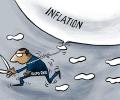
'Inflation is not good for industry. Nor for the economy as a whole.'

'As we navigate uncertain waters, a conservative approach to largecap investing could provide a strategic advantage.'

The share of equity and investment funds in the total financial wealth of households increased by more than 50% between 2011-2012 and 2022-2023.

Looking under the hood, I see India on the terrible, but commonplace, road to prosperity failure, warns Rathin Roy.

Warning that the new year will be riskier than the previous two in terms of growth, inflation and the perils of monetary policy normalisation on consumption demand in particular, along with other external risks, a Wall Street brokerage has pencilled in an 8.2 per cent GDP growth next fiscal, with more downside risks to the projection. The biggest risk to the projection is a derailed consumption demand that has been the main growth driver in the past many years, said the Bank of America Securities India house economists who still believe that consumption demand will remain the key driver of growth next fiscal as well.

India's current account deficit (CAD) may dip further in the March quarter of FY24 as pressure from the negative net exports during the January-March period eased to an 11-quarter high. A part of the gross domestic product (GDP) data, net export- which is usually negative for India - captures the difference between exports and imports of both goods and services, while the CAD data, released by the Reserve Bank of India (RBI), also factors in private transfer receipts.
