
'Our discussions with investors and the market's multiples suggest that Prime Minister Narendra Modi winning 2019 is being priced in,' says a UBS report.

Swiss brokerage UBS said Nifty will scale the 8,000-mark by December even though market expectations from government remain "unrealistically" high.

Experts say, investors will be better off exiting them at higher levels and investing in stocks of fundamentally sound companies.

Analysts caution a non-BJP government is not an impossible scenario. In case of a Modi-led coalition, they advise investors to focus on discretionary consumption, select private banks and financials, RIL, housing, and IT.

Many developers are facing financial challenges after the IL&FS defaults, after which non-banking finance companies - the major financiers to real estate firms - slowed disbursals.

The trend in corporate earnings suggests that index earnings could fall to the levels last seen in early 2014.

Global markets could correct 5-10 per cent. If that happens, Indian markets will correct about 10 per cent

The wide-based NSE sensitive index is currently hovering around 7,900.

Experts said concerns over the Union Budget, too, had weighed on the market performance.

If the rupee falls further, it would negatively impact the dollar-based returns of foreign investors, and could influence foreign flows into India.

Aptech, Lumax Industries, Vedanta, Indian Bank, Venky's India have appreciated over 200% in a year
UBS reiterated its Nifty target of 9,200 by December as it expects growth to gather steam
'It is easy to dramatise the events of today, but it is far more important to focus on the fact that we have a radically overvalued financial sector. It is a house of cards.'

Being one of the early commentators to flag economic slowdown and caution investors on corporate earnings, Gautam Chhaochharia, head of India research, UBS Securities, in an interview with Hamsini Karthik says the markets remain in an expensive zone despite the recent correction.

Liquidity pushed benchmark indices 22% higher to become the best performing equity market globally

This time, the global appetite for risk is in favour of India.

'It is unlikely that foreign portfolio investors (FPIs) might increase their India allocation, given the overweight status for most FPIs.' 'Given the commentary from the Republican Party, an anti-imports approach means money will not flow out of the US.'

Market players said the sell-off was triggered by pessimism that the government may not be able to balance growth with macro-stability.

Morgan Stanley expects RBI to cut rates sharply rather than "dribble down".

A total of 183 stocks rallied 10 per cent, of which 32 stocks saw price appreciation of 20 per cent each.

Rupee, bonds may see knee-jerk reaction, as Urjit Patel is considered an inflation warrior

Experts believe volatility is here to stay for some time, at least till China stabilises and clarity regarding the US Fed's interest rate move emerges.

The markets will remain choppy ahead of RBI policy.

In a conversation with Vishal Chhabria and Hamsini Karthik, Gautam Chhaochharia, executive director & head, India Research, UBS, explains why implementing goods and services tax (GST) may not be as disruptive as many perceive it to be. But, he warns investors shouldn't have high expectations on corporate earnings.

A section of analysts feel now may not be a bad time to buy select PSBs.

Experts feel select companies in banking, automobiles, financial services & real estate will gain from lower interest rates

Local businesses are fretting over reform setbacks.
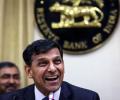
Growth acceleration will be gradual and it is still early days for a sharp recovery, says Gautam Chhaochharia, executive director and head of India research, UBS.
