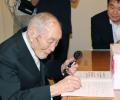
Momoi, the former high school principal and father of five children, died at a Tokyo hospital on Sunday where he had lived for many years.

Summary of sports events and persons who made news on Tuesday

Olympic softballers hunt roaming bear, no luck finding it so far

Let's take a look at some nations, including India, that depend on nuclear power to provide energy needs.

The torchbearer's face will likely be seen by hundreds of millions of people watching around the world.

Tokyo 2020 organisers held an earthquake drill on Thursday at Ariake Gymnastics Centre, a newly built venue for next year's Olympics, to test their readiness

Hellenic Olympic Committee President Spyros Capralos told reporters a meeting had been held with a Greek health risk management company to be ready 'in case anything happens'.

Japanese actress Satomi Ishihara performed the first 'torch kiss' handover of the Tokyo 2020 Summer Olympics torch relay on Saturday during a rehearsal on the outskirts of the capital. The rehearsal comes amid worries the coronavirus outbreak could throw cold water on the Games. Japan, among the worst affected outside China where the virus is believed to have originated, reported its first death from the virus on Friday.

The torch was designed with input from children from the areas most severely damaged by the 2011 earthquake and tsunami.

The volcano is located about 50 kilometres from the Sendai nuclear plant that began operations last year after it was shut down along with other nuclear plants in Japan following the 2011 earthquake and Fukushima nuclear disaster.
A 111-year-old Japanese was recognised as the world's oldest man by Guinness World Records on Wednesday, following the death in June of a Polish-born New Yorker.

Japan beat China 3-1 in the final of the women's team event to secure the country's first badminton gold medal at an Asian Games since 1998.
Here's a peek into the future of auto and consumer electronics.

The prestigious awards recognise the achievements of the elite badminton players
Tokyo had been seen as an early favourite, with Madrid hurt by Spain's ongoing economic woes and Istanbul suffering from anti-government protests, the escalating war in neighbouring Syria and a series of doping scandals.
President Francois Hollande's visit to India on Thursday saw a protest against French-assisted Jaitapur nuclear power plant by activists who alleged that proper safety measures had not been adopted in the project to prevent a Fukushima like disaster.

Japan is still preparing to host the Olympics, Prime Minister Shinzo Abe said on Saturday, despite rising global concern about the viability of the summer Games due to the coronavirus outbreak. He said Japan has a relatively low infection rate and has not seen an explosion in cases as seen in South Korea, China, Italy, Iran and elsewhere. He said delaying the peak of infections is vital to ensure treatment of those in critical condition.
Meet the group of engineers, scientists and volunteers who are working inside the Fukushima nuclear plant in Japan to contain the nuclear crisis
Prime Minister Manmohan Singh on Tuesday said that nuclear power was an essential component of India's energy mix and he will ensure that the safety and livelihoods of people are not jeopardised in its pursuit.
India's nuclear operator has started loading enriched uranium fuel in the first reactor of the Kudankulam Nuclear Power Project after getting the final clearance from the Atomic Energy Regulatory Board (AERB) on Tuesday.

Japanese electronics major sources 60% of requirement from India.

The next challenge for Tokyo organisers is developing measures to help prevent a COVID-19 outbreak during the Games and how much the delay will cost Japanese taxpayers.
Plans to build India's biggest indigenous nuclear power plant have failed to impress villagers in Haryana's Fatehabad district, who fear a Fukushima-type disaster. The shoddy way in which the government agencies have handled the issue has not helped matters either. Gopal Krishna reports.
Lashing out at anti-nuclear activists, a former Atomic Energy Commission chief on Wednesday said that "certain professional agitators" had worked against the project at Kudankoolam which was "one of the best sites" for a nuclear power station.

Defending champion Kidambi Srikanth beat compatriot Sameer Verma 22-20, 19-21, 23-21 in an absorbing men's singles quarter-final to enter the semi-finals of the Denmark Open, in Odense, on Friday night. The Indian ace will meet second seeded Japanese and world No 1 Kento Momota, who got the better of Thailand's Khosit Phetpradab 21-13, 21-9 in another quarter-final.
A year after a meltdown at Fukushima, Japan on Saturday ordered country's nuclear reactors to go online to head off a summer energy crunch.

We bring you a collection of some of the best photographs taken this week by ace Reuters photographers.
Two women chief ministers in India have taken a statesman like courageous stand against nuclear projects Bengal. This sets the precedent for other states and visionary leader to take decisive steps to save present and future generation of Indian from unpredictable and inevitable nuclear emergencies, says Gopal Krishna.
Batting for the Jaitapur Nuclear Power Plant, Atomic Energy Commission chief M R Srinivasan has said Maharashtra needs the new generation capacity to meet its industrial and agricultural demands and assured locals that effluents from the plant will not affect the ecology.
The rising prices of fossil fuels and the unreliability of alternative sources like solar and wind power means that the charms of nuclear power may still returns, thanks to improvements in safety and technology, says Dr K S Parthasarathy.
Protestors of Koodankulam nuclear plant are evoking memories of Hiroshima and Nagasaki, the Chernobyl disaster and the recent Fukushima tsunami to warn people, reports A Ganesh Nadar
Russia's Ambassador to India Alexander Kadakin has said that his country's stand on American non-government agencies stalling the 1,000 megawatt Kudankulam project in Tamil Nadu has been vindicated by a statement made by Prime Minister Manmohan Singh during an interview with a science magazine on Thursday.
India's target of nuclear power generation of 20,000 megawatt by 2020 has been quietly lowered by the Nuclear Power Corporation of India Limited (NPCIL), the only government agency setting up the nuclear power plants in the country, to 11,080 MW.
With a moment of silence, prayers and a vow to rebuild the nation, Japan on Sunday marked the first anniversary of the massive earthquake and tsunami that killed nearly 19,000 people and triggered the world's worst nuclear crisis since 1986.
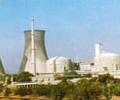
'The leak is likely to continue for some time before it becomes stable, but this is something that NPCIL, who is the plant operator, will have to do. For this, we have to plan very carefully.'
Amid demands for scrapping the Koodankulam nuclear power project, a top atomic scientist on Saturday vouched for its safety, saying all types of exigencies including a Fukushima-type mishap have been factored in.
Terming as "unfortunate" the resistance to the commissioning of Indo-Russian joint venture Koodankulam nuke plant in Tamil Nadu, Russia on Tuesday said all safety norms have been taken into consideration in view of the Fukushima accident in Japan.
Not taking any chance of India facing Fukushima-type nuclear disaster, the government is gearing up India's nuclear power plants and other reactors for automatic shutdown, requiring no human intervention, if any earthquakes of the least intensity strikes.
Grappling with Japan's worst atomic crisis, workers at the crippled Fukushima nuclear plant on Wednesday kept removing highly toxic water from a reactor as a new test showed the radiation levels in nearby seawater had risen, amid protests by angry evacuees demanding compensation.

The biggest storm -- Typhoon Hagibis -- to hit Japan in decades left deaths and destruction in its wake, as it battered the central and eastern parts of the country. The storm flooded rivers and caused secondary weather patterns like tornados that destroyed homes and public property in areas east of Tokyo. Hagibis hit the capital, where streets were largely deserted and people were bunkered down, moving past the city by midnight, but not before flooding some sections. Reports state that the storm killed as many as 33 people and injured 186 others.
 © 2026 Rediff.com - Advertise with us - Disclaimer - Privacy Policy - Sitemap - Feedback - About us - Terms of use - Grievances