
Indian growth in the rest of this fiscal year and next will be propelled by robust domestic consumption as consumer confidence improves, and by investment, including large increases in government capital expenditure, according to the Asian Development Outlook September 2023. "As slowing exports could foment headwinds for the economy, and erratic rainfall patterns are likely to undermine agricultural output, the growth forecast for FY2023 is revised down marginally to 6.3 per cent," ADB said.

Showing the effect of the slowdown in global economic activity, the equity foreign direct investment (FDI) into India declined sharply to $13.9 billion in April-July 2023 from $22.04 billion a year ago. The net FDI, inflows minus outflows, declined from $17.28 billion in April-July 2022 to $5.70 billion in April-July 2023 on account of moderating gross FDI and a rise in repatriation. Gross FDI into India moderated to $22.0 billion during April-July 2023 from $29.6 billion a year ago, according to Reserve Bank of India data.

India's current account deficit declined sharply to 1 per cent of the GDP or $8.3 billion in the second quarter of this financial year, mainly due to lower merchandise trade deficit and growth in services exports, according to a RBI data released on Tuesday. The current account deficit (CAD), which represents the difference between the total amount of money sent abroad and money received from overseas across the economy, was 3.8 per cent of GDP or $30.9 billion in the July-September quarter in 2022-23. CAD was $9.2 billion or 1.1 per cent of GDP in the first quarter (April-June) of the current financial year 2023-24.

Could it be about clout? Given its size and influence, RIL doesn't need the media for that, notes Vanita Kohli-Khandekhar.

Prices may go up because of higher energy costs, caused by the rise in shipping charges, with commercial vessels taking a longer route to avoid the troubled Red Sea region, the finance ministry said on Monday. Iran-backed Houthi rebels of Yemen are repeatedly attacking ships in the Red Sea. While the global economy is grappling with challenges such as sticky inflation, sluggish growth, and mounting fiscal pressure, India's external sector could face "potential risks" due to the ongoing geopolitical tensions, according to the finance ministry's report on the review of the Indian economy.

Startup founders need to sit up and think about how not to take stardom for granted and how not to disappoint their fans who have stood in long queues for those precious selfies with popular entrepreneurs, notes Nivedita Mookerji.

This is despite the fact that total FDI into India has fallen by 22 per cent from $58 billion in FY22 to $46 billion in FY23, according to the Reserve Bank of India.

Internet shutdowns by law enforcement agencies like the one in Manipur and Punjab cost $1.9 billion to the Indian economy in the first half of 2023, a report said on Thursday. The shutdowns also led to a loss of nearly $118 million in foreign investment and triggered over 21,000 job losses, the global non-profit Internet Society said in its report 'Netloss'. The non-profit arrived at the financial impact of the shutdown going beyond the loss of output and included factors like change in the unemployment rate, Foreign Direct Investment (FDI) lost, risks of future shutdowns, population in the working age etc.

Neither the BJP, nor the Congress before it, made any manifesto commitments on defence spending, even though allocations have plummeted from 4 per cent of gross domestic product (GDP) in the late 1980s to less than 2 per cent today, points out Ajai Shukla.

If Modi wants to leave a real legacy, breaking India's strategic triangulation would be the real gift, notes Shekhar Gupta.

The BJP lost 15 of the 80 Lok Sabha seats in 2019. Union ministers have been deployed in all 15, tasked with turning the result around.

India's outward Foreign Direct Investment (FDI) nosedived to $11.12 billion in January-June (H1 2023) from $23.57 billion in the same period last year, indicative of the slowdown in the global economy, according to the Reserve Bank of India (RBI) data. The outward FDI expressed as the total financial commitment, has three components, namely equity, loan and guarantees. The sharp contraction in the commitments (outward FDI) was prominent in the April-June 2023 period.

The exports in 2022-2023 was $79 billion, compared to imports of $50 billion.
Reflecting subdued global economic growth, India's outward foreign direct investment (FDI) fell by 33.3 per cent sequentially to $1.21 billion in August, compared to over $1.82 billion in July.

The talks for a free trade agreement (FTA) between India and Canada may have taken a pause but will resume once the political row between the two countries is resolved as the pact has economic benefits for both the nations, trade experts and exporters said on Friday. However, they said that India may not hurry for the trade agreement as 60 per cent of New Delhi's exports are already entering Canada at zero duty. Earlier this month, India and Canada paused the negotiations for the agreement due to political reasons.
Interrupting a two-month streak of decline, outward foreign direct investment (FDI) rose sequentially to $1.85 billion in July over $1.07 billion in June, an increase of 73 per cent. However, it was lower than the $2.18 billion in July last year, according to the Reserve Bank of India data. Outbound FDI, expressed as financial commitment, has three components - equity, loans, and guarantees.

More Indians renounced their citizenship and took citizenship in other countries in 2022 than ever before, according to data. Answering multiple questions in Parliament - the last on March 31 this year - Minister of State for External Affairs V Muraleedharan told the Lok Sabha that more than 200,000 Indians gave up Indian citizenship in 2022. The question was asked by Congress Members of Parliament Kodikunnil Suresh and M K Raghavan, and All India Majlis-e-Ittehadul Muslimeen chief Asaduddin Owaisi.
Improved monsoon, solid fiscal performance, and capex push by the public and private sectors augurs well for India's macroeconomic stability and growth, the finance ministry's monthly economic review for June 2023 said. But the report said that while India's domestic fundamentals remain strong, negative cross-border spillovers and adverse global developments could act as a deterrent in achieving the high growth path this financial year. "An improved matching of aggregate supply and aggregate demand in the Indian economy underpins the progress made in the control of domestic inflation and the consequent strengthening of macroeconomic stability," the review said.

'My understanding is that by the time President Xi Jinping came for the Chennai summit [2019], he had already instructed his army to undertake the action in Galwan in the summer of 2020.'

Foreign Direct Investment (FDI) equity inflows into India contracted by 14 per cent to $26.9 billion during the April-September this fiscal, according to the data of the Department for Promotion of Industry and Internal Trade (DPIIT). The inflows had stood at $31.15 billion during the corresponding period of the previous year. The total FDI inflows (which includes equity inflows, re-invested earnings and other capital) too declined to $39 billion during the first six months of the current fiscal year as against $42.86 billion in the year-ago period.

India, the US and 12 other members of the IPEF grouping have signed a supply chain resilience agreement that would help mitigate risks of economic disruptions from supply chain shocks and improve crisis coordination. The agreement would help member countries like India to reduce their dependence on China and provide timely information to the IPEF member countries about potential supply disruptions. The COVID outbreak severely disrupted the global supply chain, as most countries were dependent on China for various products like pharma raw materials.
The US replaced Mauritius as the second largest source of foreign direct investment into India during 2020-21 with inflows of $13.82 billion, according to government data. Singapore remained the top source of foreign direct investment (FDI) into the country for the third consecutive fiscal at $17.41 billion. During the last financial year, India attracted $5.64 billion in FDI from Mauritius, according to the data by the Department for Promotion of Industry and Internal Trade (DPIIT).

The Delhi high court on Friday sought the stand of news portal NewsClick and its editor-in-chief on a plea by the Enforcement Directorate (ED) seeking vacation of an earlier order granting them protection from coercive action in a money laundering case.

If it continues to do well economically, develops a large manufacturing sector, gains in technological heft, builds a more capable defence industry, improves its human development indicators, becomes more of a trading nation, and has greater internal cohesion. In short, it is a work in progress, suggests T N Ninan.

Putin made these remarks on Thursday at a forum in Moscow organised by Russia's Agency for Strategic Initiatives (ASI).

JP Morgan's decision last week to include Indian government bonds in its Government Bond Index-Emerging Markets (GBI-EM) index and the index suite from June 2024 may be a sort of blessing for India, as the move is estimated to result in an inflow of $25 billion of foreign portfolio investments into the country. The development comes at a time when the spread between the benchmark 10-year government of India bond and the 10-year US government bond has declined to its lowest level in more than 17 years. Low yield spreads make Indian bonds less attractive to foreign portfolio investors (FPIs).

The government is confident of meeting the fiscal deficit target of 5.9 per cent of gross domestic product (GDP) and the nominal GDP target of 10.5 per cent despite pressure in the initial months of FY24, Economic Affairs secretary Ajay Seth told Business Standard. Normally the initial months of any financial year see proportionally a higher fiscal deficit because the expenditure is evenly paced while revenue picks up in the later months, he said. "This year the proportional fiscal deficit so far is much closer to the target than in most other years.

India's outward foreign direct investment (OFDI) nearly halved to $3.39 billion in April on an annual basis, as per data released by the RBI on Monday. The OFDI stood at $6.71 billion in April 2021. On sequential basis too, the outward investment from India in April was lower compared to $3.44 billion in March 2022.

Swedish furnishing major IKEA, part of the Ingka Group, is inviting its investment arm - Ingka Investments - to India, a senior company executive said during an interaction in New Delhi. The move suggests that the group is looking at India as a priority market. The areas of investments being considered by Ingka Investments could range from taking stake in companies across sectors such as renewables, recycling, real estate, and software which synergise with IKEA's broader retail requirements.

A new era of Indian equity market outperformance compared to China "appears to be dawning", according to Morgan Stanley. The firm has upgraded India to overweight in its Asia Pacific-excluding Japan (APxJ) list, making it their most preferred market not only in the region but also in the global emerging market (GEM) pack. India now holds the top position in this category, with an overweight of 75 basis points, a significant increase from nil previously.

The Enforcement Directorate (ED) is probing alleged fraudulent foreign funds infusion of more than Rs 86 crore into a company that runs the NewsClick portal even as it is expected to soon file a charge sheet in the case being probed under the anti-money laundering law, official sources said on Monday.

India appears poised to sustain its growth in a more durable way than before with the economy carrying the momentum from FY23 into the current fiscal year, the Annual Economic Review for 2022-23 released by the finance ministry on Thursday said. However, the report cautioned that escalation of geopolitical stress, enhanced volatility in global financial systems, sharp price correction in global stock markets, a high magnitude of El-Nino impact, and modest trade activity and FDI inflows, are factors that could constrain the pace of growth. "Should these developments deepen and dampen growth in the subsequent quarters, the external sector may challenge India's growth outlook for FY24," the finance ministry said.
India's current account deficit narrowed to $1.3 billion or 0.2 per cent of GDP in the January-March quarter of FY23, mainly due to moderation in the trade deficit and a robust increase in services exports, RBI data showed on Tuesday. However, for the 2022-23 fiscal, the current account balance recorded a deficit of 2 per cent of GDP compared to 1.2 per cent in 2021-22. "India's current account deficit (CAD) decreased to $1.3 billion (0.2 per cent of GDP) in Q4:2022-23 from $16.8 billion (2.0 per cent of GDP) in Q3:2022-231, and $13.4 billion (1.6 per cent of GDP) a year ago [Q4:2021-22]," as per the RBI's 'Developments in India's Balance of Payments during the Fourth Quarter (January-March) of 2022-23'.
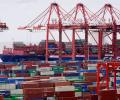
After topping it for two consecutive years, Gujarat slipped three places on the NITI Aayog's Export Preparedness Index (EPI) for 2022, as Tamil Nadu emerged as the most export-ready state, the central think tank said in its report released on Monday. In a continuing trend, coastal states were found to have the most robust export infrastructure, which officials attributed to the integration of maritime trade into the core of their economies. Maharashtra and Karnataka retained their positions -- second and third, respectively; Haryana was ranked first among landlocked states and fifth overall.

In a dramatic turn of events in May 2019, an Emirates aircraft en-route to Dubai was asked to stop while it was taxiing for a take off in Mumbai. The pilot was given no reason and ordered to immediately return to the parking bay. As the aircraft returned to the terminal, two passengers from the first class - Naresh Goyal and his wife Anita - were offloaded by the immigration authorities, who said the duo cannot leave the country. Goyal, founder of Jet Airways, was stunned. The man, who ruled the aviation sector for two and a half decades with an iron hand, did not expect to be offloaded in this fashion.

The federal probe agency has also called for documents and the recording of statements of some company executives under provisions of the FEMA, they said.
About 281 cases have been taken up for investigation by the Directorate of Enforcement regarding suspected violations of foreign direct investment (FDI) norms all over the country during April 2019 to March this year, Parliament was informed on Wednesday. Necessary action as per provisions of Foreign Exchange Management Act, 1999 (FEMA) has been taken, which includes issuance of show cause notices, adjudication and imposition of penalty, Minister of State for Commerce and Industry Som Parkash said in a written reply to the Lok Sabha. In these cases, following the due process of adjudication, penalties of more than Rs 2,600 crore have been imposed under the FEMA, he said, adding the Reserve Bank of India (RBI) has done compounding of contraventions of FDI related FEMA provisions in total of 1,421 cases across the country during the last three years.

The Enforcement Directorate on Saturday said it has searched the Bengaluru-located office and residential premises of Edtech major BYJU's and its CEO and co-founder Raveendran Byju and seized 'incriminating' documents and digital data as part of a foreign exchange violation probe.
Total foreign direct investment into India rose 2 per cent to the "highest ever" $83.57 billion in 2021-22 on account of various measures like policy reforms and ease of doing business taken by the government, the commerce and industry ministry said on Friday. Total FDI comprises equity inflows, reinvested earnings and other capital. In 2020-21, the inflow stood at $81.97 billion. It was $74.39 billion in 2019-20 and $62 billion in 2018-19. "India has recorded the highest ever annual FDI inflow of $83.57 billion in 2021-22," the ministry noted in a statement.

The central government is on track to meet its fiscal deficit target of 6.4 per cent of the GDP for 2022-23 on the back of strong growth in revenue collections, the World Bank said in its India Development Update on Tuesday. High nominal GDP growth in the first quarter supported strong growth in revenue collection, especially Goods and Services Tax (GST), despite tax cuts on fuel. Notwithstanding an increase in spending due to expanded fertilizer subsidies and food subsidies for vulnerable households in response to the commodity price shock, the government is on track to meet its FY22/23 fiscal deficit target of 6.4 per cent of GDP and the general government deficit is projected to decline to 9.6 per cent from 10.3 per cent in FY21/22 and 13.3 per cent in FY20/21.
 © 2026 Rediff.com - Investor Information - Advertise with us - Disclaimer - Privacy Policy - Sitemap - Feedback - About us - Terms of use - Grievances