
With rupee touching a life-time low of 57.77 against dollar, global buyers are putting pressure on exporters to offer discounts between 10 per cent and 15 per cent.
Imports too declined 26 per cent to $29.47 billion in August, leaving a trade deficit of $6.77 billion.
Imports also fell for the eighth consecutive months, down 0.75 per cent to $41.14 billion in January, widening the trade deficit to a seven-month high of $15.17 billion.

Despite the slowdown in world economies, the government expects exports to increase 20 percent in the current fiscal, a senior commerce ministry official said here on Friday.

Sectors with positive growth during the month include rice, iron ore, oil seeds, oil meals, meat, dairy and poultry products, pharmaceuticals, coffee, engineering goods, and plastic.
Sectors, which, recorded healthy export growth included electronics, engineering, chemicals, pharma and tea.
India's exports fell for the fourth straight month in June as shipments of key segments like petroleum and textiles declined but the country's trade turned surplus for the first time in 18 years as imports dropped by a steeper 47.59 per cent.

Indian exporters on Monday said the fluctuating rupee will not only raise imports bill but would also lead to volatility affecting their businesses.
The large drop was for export orders that were meant to be delivered until October.
Imports increased by 4.5 per cent, the highest growth in the last six months as crude oil and gold shipments shot up in the month.
Import segments which recorded negative growth include gold, silver, transport equipment, coal, fertiliser, machinery and machine tools. However, exports of oil seeds, coffee, rice, tobacco, spices, pharma, and chemicals reported positive growth in June.

Reversing a concession given by the commerce ministry to the embattled exporters in the midst of recession in the West last year, the Central Board of Excise and Customs has directed chief commissioners of customs and excise to recover the drawbacks from exporters who have not realised their proceeds.

Out of 30 key export sectors, as many as 22 showed negative growth in September.

India's export basket for Pakistan has a limited portfolio as Pakistan has not given 'most favoured nation' status to New Delhi and such goods have ready market in South Asia and the Middle East.
Exports of petroleum products, chemicals, pharmaceuticals, gems and jewellery, and engineering goods registered a positive growth.

After a 13-month contraction following the slowdown in demand in the western markets, India's exports started recovering from November.

An online system generates import-export code.
Finance Minister Pranab Mukherjee on Tuesday met exporters, a day after the release of the April export data which showed the sharpest fall in overseas shipments in 14 years, assuring them he would do his best in the Budget.
Imports too contracted by 28.72 per cent to $31.16 billion. Dip in exports and imports narrowed the trade deficit -- the difference between imports and exports -- in March to $9.76 billion, the lowest in the last 13 months.
For the current financial year, trade deficit would be around $21 billion, where in exports would be about $182 billion and imports would be about $303 billion, Dun & Bradstreet said. Though the government has taken proactive and timely steps but there has been a significant dip in confidence level.

India Inc on Tuesday expressed disappointment over the Reserve Bank increasing the key rate by 0.25 per cent and hoped that banks would refrain from hiking lending rates as such a move will scuttle economic recovery.
Imports too declined by 16.31 per cent to $37.39 billion.

Saudi Arabia is insisting on 'In Kingdom' total value-addition requirements
Export-Oriented Units (EOUs) in the country are likely to continue to enjoy income-tax benefits even after the ensuing deadline of March 2009.

Removal of this status means India can now enhance customs duties to any level on goods coming from Pakistan.
India's exports dipped deeper in the negative zone.
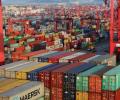
India's exports dipped after a gap of four months in March but finished 2017-18 with a healthy rise of 9.78 per cent to $302.84 billion.
With the rupee expected to continue to appreciate, sops cannot be given endlessly, and exporters will have to learn to hedge their exposures.
Imports rose by 1.44 per cent to $43.44 billion in March 2019.
Global buyers are putting pressure on exporters to offer discounts between 10 per cent and 15 per cent.
While the import of gold fell by about 11 per cent to $2.58 billion in February as against $2.89 billion in the corresponding month last fiscal, inward shipments of petroleum products were down by nearly 8 per cent to $9.37 billion.

The Swadeshi Jagaran Manch has pointed out that these firms pose a threat to domestic manufacturing and retailing as they do not pay relevant taxes such as GST, giving them a huge edge over local players.

On the occasion of Chinese president Xi Jinping's two-day visit, Indian exporters are looking for a big boost in export of agricultural commodities, especially the ones that have been impacted by the ongoing trade war between the United States and China.

While an official in the Commerce Department indicated a trade war was in the offing, till now the government has been in wait-and-watch mode.
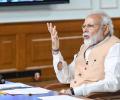
The prime minister is likely to talk about its possible extension.

The Reserve Bank of India also banned with immediate effect issuance of letters of comfort which, like LoUs, are used by importers to fund their overseas purchases.
September import growth was the second lowest this fiscal year, after the April growth figures of 4.6 per cent, bringing the trade deficit down to $13.98 billion

The trade gap - difference between imports and exports - was $11.39 billion in March 2015.
 © 2026 Rediff.com - Advertise with us - Disclaimer - Privacy Policy - Sitemap - Feedback - About us - Terms of use - Grievances