
'It's a changing world and the opening up doesn't mean that concerns with regards to security have gone away.'

'India is often skipping legacy cycles and moving directly to advanced AI-driven operations.'

Companies have been approached to set up incubation centres that will offer financial and non-financial support to manufacturing startups at various levels.

Investors and startup executives are calling for extending the period for an entity to be recognised as a startup from 10 to 15 years for deep-tech companies.

The Bharatiya Antariksh Station represents the next phase of India's human spaceflight ambitions, enabling long-duration presence in space, advanced microgravity research and technology development, and supporting future human exploration missions.

FDI inflows into India are expected to register robust growth in 2026, supported by strong macroeconomic fundamentals, big-ticket investment announcements, sustained efforts to improve the ease of doing business, and a new generation of investment-linked trade pacts.

India's new national accounts will leverage new data sources and surveys to enhance the measurement of the country's informal economy, and introduce double deflation methods across sectors, replacing the current system that relies on a single deflation mechanism in Gross Domestic Product (GDP) calculations.

The government has identified critical sectors, including electronics, chemicals, leather and footwear, and toys, where value chains can be strengthened to facilitate and drive foreign direct investment (FDI) into the country. Invest India, the investment promotion and facilitating agency under the Department for Promotion of Industry and Internal Trade (DPIIT), has been actively identifying key value chains to focus on.
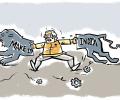
The Department for Promotion of Industry and Internal Trade (DPIIT) has proposed to raise the minimum local content under public procurement order in government contracts. But several local suppliers and multinational companies (MNCs) are saying such a steep target is not attainable. Class-I suppliers, whose goods, services or works offered for procurement has local content equal to or more than 50 per cent may see it hiked to 70 per cent, while it may go up to 50 per cent from 20 per cent for Class-II suppliers.

The Department for Promotion of Industry and Internal Trade (DPIIT), under the Ministry of Commerce and Industry, has entered into a partnership with the Startup Policy Forum (SPF), a premier industry organisation representing India's leading new-age companies.

From the launch of the 'Startup India' initiative in 2016, to the abolition of angel tax and easing of reverse flipping norms, the startup ecosystem is evolving.

The government is at a "fairly advanced stage" of finalising a well-coordinated e-commerce policy and consumer protection rules, which will incorporate provisions of Open Network for Digital Commerce (ONDC), Department for Promotion of Industry and Internal Trade (DPIIT) secretary Rajesh Kumar Singh said on Thursday. "E-commerce rules and e-commerce policy will be congruent with each other... That exercise is at a fairly advanced stage," Singh told reporters. The remarks come on a day the number of daily transactions on the platform has gone up 500 times since the beginning of this year with the number of retail merchants added to its roster growing 40-fold.

Foreign direct investment in India dipped by 5.6 per cent year-on-year to $10.9 billion in October-December quarter of this fiscal due to global economic uncertainties, according to the government data. FDI inflows during October-December 2023-24 stood at $11.55 billion.

The government on Saturday announced a host of measures such as setting up of a new Fund of Funds Scheme (FFS) with Rs 10,000 crore corpus; and extension of period of incorporation by five years with a view to promote growth of budding entrepreneurs.

Since India relies heavily on specialised imported fasteners for critical applications in industries, such as automobiles, aerospace, electronics, and defence, their sudden unavailability will jeopardise production.

The government has set up an inter-ministerial group to monitor a possible surge in imports from countries like China, Vietnam and Thailand, fearing a surge in inbound shipments following the imposition of high reciprocal tariffs by the US on these countries, sources said. The product categories that may see an upsurge in diversion of imports from the US to India include consumer goods, electronics, chemicals and steel.

The Union Finance Ministry on Friday announced key amendments to foreign exchange (forex) regulations, including mandating government approvals for all investments originating from countries that share land borders with India. The latest amendments also seek to simplify cross-border share swaps and streamline key definitions, such as "control". The updated regulations have aligned the treatment of downstream investments made by overseas citizen of India (OCI)-owned entities with those owned by non-resident Indians (NRIs) on a non-repatriation basis.

Also, a dedicated cell, headed by a member of the Central Board for Direct Taxes (CBDT), will be set up to address concerns faced by start-ups.

Foreign direct investment in India jumped 47.8 per cent to $16.17 billion in April-June this fiscal on healthy inflows in services, computer, telecom and pharma sectors, according to government data. FDI inflows were at $10.94 billion in April-June 2023-24. The data showed that overseas inflows in May rose to $5.85 billion and in June to $5.41 billion from $2.67 billion and $3.16 billion, respectively, in the year-ago period.

The Modi government's flagship initiative 'Make in India' launched 10 years ago has helped the country boost exports, push investments and promote manufacturing. Under the initiative, launched on September 25, 2014, a series of measures have been taken by the government to boost local manufacturing. These initiatives include the rollout of production linked incentive (PLI) schemes for 14 sectors, easing foreign direct investment (FDI) norms, reducing compliance burden to improve business climate, all approvals through single window, and rolling out of the national logistics policy.

The course comprises 36 weeks of classroom study, which includes lectures, case studies, tutorials, lab sessions, videos, individual and team assignments, guest lectures from the Japanese faculty, industry experts and business leaders, totalling 1,173 interaction hours.

'Before you work on your business plan, before you build your team, you should have a clear idea about what your product is, who your customer is, how valuable the product is, and whether the market is deep and wide.'

Canada's foreign direct investment (FDI) into India doubled after the pandemic years even as India's own investments into Canada show signs of slackening in recent years. The cumulative equity FDI inflows from Canada rose from $1.8 billion in March 2019 to $3.9 billion in March 2024, shows data from the Department for Promotion of Industry and Internal Trade (DPIIT). The overall share is up from 0.42 per cent to 0.57 per cent during the same period, suggesting that Canadian FDI grew faster than overall FDI during this period

Foreign direct investment (FDI) inflows into India have crossed the $1 trillion milestone in the April 2000-September 2024 period, firmly establishing the country's reputation as a safe and key investment destination globally. According to data from the Department for Promotion of Industry and Internal Trade (DPIIT), the cumulative amount of FDI, including equity, reinvested earnings and other capital, stood at $1,033.40 billion during the said period.

The government is expediting visa-related issues to bring technicians to India from any country, not just China, as and when required, to ensure the smooth implementation of the flagship production-linked incentive (PLI) scheme aimed at boosting domestic manufacturing. "If those under the PLI scheme need to get their equipment installed, we try to expedite the ability to get technicians into India from any country, whichever it may be," Union Commerce and Industry Minister Piyush Goyal told Business Standard in an interview.

'80% of start ups fail because they don't have a support system to help them in the very early phase.' 'It's not just an idea that takes an entrepreneur through the initial three years of journey.' 'What plays a definitive role in making a start-up successful is idea+team+capital+mentors+access to a larger ecosystem.'

The government is planning to tweak its procurement policy to give a fillip to domestic manufacturing. The industry department has floated a proposal to raise the minimum local content requirement for public procurement for Class-I and -II suppliers from 50 per cent currently to 70 per cent, and 20 per cent as of now to 50 per cent, respectively.

'I tell young entrepreneurs if you don't have a great idea, if you don't have a good business model, don't think of a start-up.'

Of the Rs 1.97 trillion that the government intends to spend on all 14 production-linked incentive (PLI) schemes, around Rs 41,000 crore remains unutilised as of now, according to a senior government official. This means that 80 per cent of the total allocated amount, or Rs 1.56 trillion, will be used to pay incentives to companies eligible to claim benefits over the next few years. The unutilised amount/savings result from undersubscription, lukewarm responses in the case of schemes such as textile, as well as a reduction in the allocation of schemes.

'It is the responsibility of industry to take the very bright talent whose knowledge of software engineering basics is very high, and then give them additional skills.'

Another priority in the first 100 days could be the launch of an e-platform -- Trade Connect -- to help exporters connect with stakeholders of international trade.

For the startup ecosystem in India, the scorecard so far has been a mixed bag, observes Akhil Gupta.
Net inflows were $18.4 billion for the rolling 12-month period ended January 2024 compared to $32.7 billion for the rolling 12-month period ended January 2023.

The credit guarantee cover under the scheme would be both transaction-based (for single eligible borrowers) and umbrella-based (for a group of eligible borrowers).

The message is clear: The 60-year-old wise uncles need to handhold the 40-year-old entrepreneurs when, obsessed with ambition and greed for growth, they become a victim of hubris, points out Tamal Bandyopadhyay.
In a big push to the production-linked incentive (PLI) scheme, the government has nearly doubled (increase of 81 per cent) the allocation in five key industry segments from Rs 8,405 crore in the Revised Estimate of FY24 to Rs 15,198 crore in the Interim Budget for FY25. The segments cover over eight PLI schemes, including mobile phones, IT hardware, pharma (PLIs for medical devices, intermediates and pharmaceuticals), food processing, telecom hardware and, auto and auto components. In FY24, DPIIT officials, however, said that the disbursements would be much higher at around Rs 11,000 crore than what has been budgeted for the year.
Foreign direct investment (FDI) equity inflows in India declined 24 per cent to $20.48 billion in April-September 2023, dragged by lower inflows in computer hardware and software, telecom, auto and pharma, according to government data. FDI inflows stood at $26.91 billion during the first six months of the last fiscal. Inflows during January-March 2023 also contracted 40.55 per cent to $9.28 billion.

US-based retail giant Walmart is looking to source toys, shoes and bicycles from Indian suppliers as the company is targeting to increase its exports from India to USD 10 billion annually by 2027. The company also wants to develop new suppliers in categories such as food, pharmaceuticals, consumables, health and wellness, and apparel and home textiles, a company spokesperson told PTI. Officials from the Bentonville-headquartered firm recently held a virtual meeting with several domestic toy manufacturers in India.

The official said that the National Statistical Commission (NSC) is examining the working group report on the roadmap for introducing the PPI and their recommendations are awaited. "It is with Statistical Commission, so we will wait for the panel recommendation," the official, who did not wish to be named, said.

The Centre is unlikely to offer new direct tax incentives for units operating in special economic zones (SEZs) and may instead allow the grandfathering of previous exemptions that such units were entitled to, according to proposed amendments to the SEZ Act, 2005, people aware of the matter said. The amendments, proposed by the commerce department, will soon be considered by the Cabinet for approval. This represents a departure from the department's earlier plan to introduce these changes through the Development Enterprises and Services Hubs (DESH) Bill, 2023, which faced strong criticism from the ministry of finance.
 © 2026 Rediff.com - Investor Information - Advertise with us - Disclaimer - Privacy Policy - Sitemap - Feedback - About us - Terms of use - Grievances