
A last-ditch attempt to rescue the Doha round of world trade talks is likely to be made towards the end of July at a Geneva meeting of 30 trade ministers from among the 150-member countries of the World Trade Organisation (WTO).
Aiming for a breakthrough in the Doha Round of negotiations, trade ministers of the G-4 group of countries (India, the United States, Brazil and the European Union) will meet in Delhi on April 12.
India has rejected the World Trade Organisation's proposal to conclude the negotiations on the Doha Round by June-end.
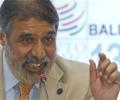
A visibly elated Sharma said the decision gave India complete protection even if it breached the food subsidy limit under WTO rules
Hitting out at the developed nations for their attitude towards the World Trade Organisation negotiations, India on Monday warned against the Doha round being hijacked by the European Union and the United States.
With the Bali deal settled, countries should now focus on long pending issues such as market access and reduction in green goods tariff
Barack Obama is the worst US president as far as outsourcing is concerned, says Jagdish Bhagwati.
Prime Minister Manmohan Singh arrived in New Delhi today after a four-day trip to Italy where he attended a summit of G-8 and G-5 leaders.

Gloom over ministerial, courtesy US-China spar, conflict between cotton-producing African nations.
Union Trade Minister Anand Sharma said on Monday that the impasse has been broken over the World Trade Organisation's long-running Doha round of trade talks.
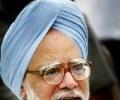
The TERC, which comprises, among others Finance Minister Pranab Mukherjee, Commerce and Industry Minister Anand Sharma and External Affairs Minister S M Krishna, will also review the state of play in the Doha Round of talks for a multilateral trade agreement under the aegis of World Trade Organization, sources said.
India plans to cut transaction costs for exporters and ensure the availability of dollar finance, as it looks to reverse a decline in exports and double outbound sales of goods and services over the next five years.

If the World Trade Organisation lost credibility, developing markets would take a hit.
A high-level expert group will provide recommendations on boosting global business through trade liberalisation.
Trade ministers of key WTO member countries, including India would meet on the sidelines of the Organisation for Economic Cooperation and Development meeting in Paris in the last week of May.

Nine years after New Delhi started implementing its Plan B - bilateral trade agreements - to beat the impasse at the World Trade Organisation's Doha Round of liberalisation talks, India seems to be finally rolling.

India and 24 other trade ministers agreed to step up efforts to conclude a multilateral trade deal under the Doha Round this year itself.
Even as the debate around whether the Doha Round of global trade talks would be concluded by the year-end or not gain momentum, a cohort of developing countries, specifically India, has refused to accept the April 21 texts which call for mandatory sectoral tariff cuts as the basis of negotiations, despite US pressure.
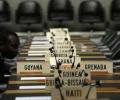
The differences between the rich and developing nations have always been at the core of the World Trade Organisation, set up in 1995 to facilitate greater trade flows across the world, and it came as a major breakthrough when the US and India reached a deal over food security issues in 2014.

Sharma met US trade representative Ron Kirk, agriculture secretary Tom Vilsack and deputy assistant to the president and deputy national security advisor for International Economic Affairs Michael Froman and other senior Obama Administration officials.
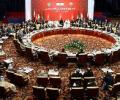
The run-up to the G20 meeting in Seoul, South Korea in November will be busy for members of the World Trade Organisation (WTO). Starting mid-September, various small group meetings will be convened in Geneva to discuss and possibly resolve the outstanding issues in the Doha Round so that the political leaders of the G20 countries can provide a road map for concluding the stalled multilateral trade negotiations and help, revive and sustain global economies.
An Indian American has been appointed the chief agriculture negotiator of the United States, who would carry out all critical negotiations for the country in the crucial Doha round and other bilateral discussions.
The successful conclusion of the Doha round of trade negotiations would substantially augment global trade, Indian Minister of Commerce and Industry Anand Sharma said here.

The US has emphasised on the need for an "ambitious and balanced outcome", even as the World Trade Organization (WTO) is gearing up to circulate another set of texts to push all its 153 members to wrap up the Doha Round of global trade talks by the end of this year.

India will make yet another effort at the ministerial level to give a push to Doha Round of WTO trade talks before leaders of the G-20 meet in Seoul next month.

The fresh initiative by Commerce Minister Anand Sharma to meet ambassadors of the key members of the World Trade Organisation (WTO) in Geneva, in a bid to revive the deadlocked Doha round of trade negotiations, is well-timed though a positive outcome may be doubtful.

The Seoul meeting could provide an opportunity to sort out differences between the US and emerging economies within the larger framework of global adjustment.
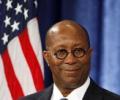
Noting that Obama Administration is fundamentally committed to developmental premise of Doha Round, US Trade Representative Ron Kirk has said that advanced developing countries like China and India need to come in the same spirit as the United States for its success.

Dr Siddiqui is currently the vice president, Science and Regulatory Affairs at the Washington, DC-based CropLife America, where he is responsible for regulatory and international trade issues related to crop protection chemicals.
Trade ministers from 162 WTO countries will gather in Kenya's capital from Dec. 15-18 to work on an agreement to liberalise global trade.
India today asked the World Trade Organization (WTO) chief to explain how he arrived at the figure of $150 billion as "being the Doha Round's contribution to the global stimulus", a demand that was supported by the United States.

The Pittsburgh summit could determine the timing of a calibrated winding down of public spending, now that the signs of a global economic recovery are evident.
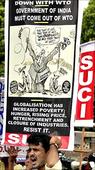
The World Trade Organisation ministerial meeting broke the 'impasse' over resumption of Doha Round of talks, with 35 trade ministers agreeing to take forward negotiations from where they left in Geneva in July last year.

Commerce and Industry Minister Anand Sharma, who took the initiative of hosting the informal meeting of important countries and blocs like the US, European Union, Brazil, China and Australia, remained busy today with officials. While it is being seen as a bold step by India to re-energise the Doha talks after they collapsed at Geneva in July 2008, New Delhi is consciously keeping the pitch low so as not to raise expectations from the meeting on Thursday and Friday.
India on Monday emphasised the need for resuming talks on the WTO's stalled Doha Round, stating that the negotiating text for global trade can be the staring point for further talks.
Accusing a "handful" of "advanced developing countries" of "masking" their "narrow interests" behind claims for speaking for the rest of the developing world, the US said it is concerned the way trade negotiations are moving ahead of crucial talks for concluding Doha round.
Country's apex business chambers -- CII, Ficci and Assocham -- have said the WTO draft on Non-Agriculture Market Access under the Doha Round of trade talks was in complete disregard to the mandate of the round, which had to revolve around lesser obligation on the developing countries for duty reduction.

On his maiden visit to New Delhi to attend the two-day informal ministerial meet on Doha round, Kirk told reporters in a teleconference that he would be back to New Delhi in just over a month for 'continued talks' relative to the Trade Policy Forum.

The aim at the meeting, which will see participation from negotiators of 37 countries, is to generate an agreement on clear directions to negotiators to re-energise the multilateral process at the World Trade Organization. The approach followed, so far, in the negotiations has been to get member-countries to agree on modalities for cutting tariffs on agricultural and industrial goods, gradually eliminating export subsidies and reducing agricultural subsidies.
On July 21, trade ministers from nearly 50 countries will converge at Geneva to finalise proposals on agriculture and non-agricultural market access (Nama) which are part of the Doha Round of world trade talks. World Trade Organisation Director General Pascal Lamy tells Business Standard why the ministerial is crucial.
 © 2026 Rediff.com - Advertise with us - Disclaimer - Privacy Policy - Sitemap - Feedback - About us - Terms of use - Grievances