
The branch managers have come out of their glass cabins and the sellers' market has transformed into a buyers' market, but there is no end to the harassment of customers, asserts Tamal Bandyopadhyay.

If only you had thought ahead, you would have stocked snacks and biscuits, bread and cake, and vegetables suited for Amma or pondatti to make your favourite bajji and pakoda, observes N Sathiya Moorthy.

Private sector banks reported a robust profile with healthy growth in net interest income (NII), credit offtake and reduction in provision burden for the fourth quarter ended March 2023 (Q4 of FY23). However, as a pack, their net profit declined by 9.7 per cent year-on-year (YoY) at Rs 25,317 crore in Q4. This is because Axis Bank posted losses due to its one-time hefty charge for the acquisition of Citibank India's consumer business.

Many senior citizens fail to disclose certain incomes like interest, commissions, or dividends in their ITRs.

A plea that the banking regulator's stress should be on the strategic role of boards and an increase in the remuneration of independent directors were among the issues put forward to the Reserve Bank of India's (RBI's) top brass in its interaction with the full boards of state-run banks held on Monday. The meeting, the first leg of first-of-its-kind interactions with the boards of state-run banks, will now be followed by those of private banks in Mumbai on May 29. The RBI's press release, issued late on Monday, did not refer to the specific points that found mention in the deliberations, but top sources told Business Standard the twin concerns were taken up in the open-house interaction with the banking regulator's brass.

The UK government announced on Monday that it has facilitated London-based banking major HSBC to buy the embattled UK arm of Silicon Valley Bank for 1 pound, securing the deposits of more than 3,000 customers worth around 6.7 billion pounds. Santa Clara, California-based Silicon Valley Bank - which specialised in lending to technology companies - was shut down by US regulators on Friday in what was the largest failure of a US bank since 2008. According to experts, although the UK arm of SVB was small with only around 3,000 business customers, its collapse would have presented a risk for the tech sector which is seen as crucial to Britain's economic growth.

But the industry's chief executives remain confident of the long-term growth potential of NBFCs in India, given their specialised lending on the asset side, last-mile reach, and a well-capitalised balance sheet. "Over the years, NBFCs have faced many crises.

'80% of the rural and urban population don't have enough purchasing power.'
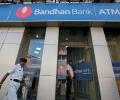
Bandhan Bank has declared disappointing results for the first quarter of the 2023-24 financial year (Q1FY24). While the market has been braced for known issues around microfinance exposures in West Bengal and Assam, there is higher stress in the portfolio. This means higher credit costs and poorer asset quality, leading to target downgrades by analysts.

'It is nice that the banking system is in good shape.' 'It is a little early to call it too good because I think it was too bad in the past.'

By the end of March 2022, only 2,140 million pieces of Rs 2,000 denomination currency notes were in circulation, or 13.8 per cent of the total value of notes.

Public sector banks have raked in more profits in the three months ended June on the back of a persistent decline in bad loans and the trend may have a positive bearing on their balance sheets in the coming quarters. In the June quarter, Bank of Maharashtra (BoM) and State Bank of India (SBI) were in the lowest quartile as far as Gross Non Performing Assets (NPAs) and net NPAs were concerned, according to an analysis of the quarterly financial numbers published by the public sector lenders. Cumulatively, all the 12 public sector banks reported a profit of about Rs 15,306 crore in the three months ended June, registering an annual growth of 9.2 per cent. However, leading public sector lenders -- SBI and PNB -- posted lower profits in the June quarter.

Benefitting from the economic rebound, banks are expected to report a healthy bottom-line and asset quality profile in the quarter ended March 2023 (Q4FY23). The net profit of listed commercial banks is projected to grow by an average 43.6 per cent year-on-year (YoY) in Q4FY23 amid better net interest margins (NIMs) and declining credit costs. This is based on a combined assessment of analyst estimates for 17 banks on Bloomberg database.

The Uttarakhand government on Friday decided to waive for six months electricity and water bills of families and individuals affected in the subsidence-hit Joshimath.

With the Nifty50 just about 3 per cent away from its all-time closing high of 18,812 points, analysts at BofA Securities suggest investors book profit. Their reasons for the advice include risks like the possibility of a cut in corporate earnings growth forecasts, high valuation (one-year forward P/E of 19.5x), interest rates staying elevated for longer-than-expected and credit tightening. Going ahead, they expect the Nifty50 index to drop to 16,000 levels - down nearly 12 per cent from the current level of 18,255 points, which they believe would be a good time to buy.
Be wary of co-operative banks which have historically been most vulnerable.

Unlike any other business, banking is a turf where the captain's role is the most critical. Often a bank is defined by the personality of the CEO who runs it. Both HDFC Bank and Kotak Mahindra Bank are the creation of their CEOs, notes Tamal Bandyopadhyay.

Reserve Bank of India on Friday said it has imposed a penalty of Rs 93 lakh on Axis Bank for various violations, including those related to KYC guidelines. The central bank has also slapped a fine of Rs 90 lakh on IDBI Bank. A monetary penalty of Rs 93 lakh has been imposed on Axis Bank for non-compliance of certain directions issued by RBI, the regulator said in a release.

Commercial banks in the country continued with their improving asset quality trend in the October-December 2021 quarter with slippages remaining under control coupled with healthy recoveries and upgradation of asset classification. The 28-listed banks reported improvement in bottom line with net profits rising 64.1 per cent year-on-year (YoY) and 21.5 per cent sequentially. This is mostly on account of a fall in provisions and contingencies.

A top-class board is important from a systemic point of view, more so at a time when the wider financial world and India Inc is chasing the same talent as banks.

About 150 years ago, in British India, big farmers in the western region of Maharashtra agitated over unfair lending practices and demanded a more fair and inclusive financing structure. People say this is where the seeds of the cooperative movement, now omnipresent in the country, were sown. Today, more than 800,000 cooperative societies thrive in India, with 300 million members, a number close to the population of the United States. Despite a reach this deep--grass roots as they call it--cooperatives do not occupy a lion's share in the Indian economy.

Recently, Slice, a payment app, acquired a 5 per cent stake in North East Small Finance (NESF) for $3.42 million - the first such deal by a fintech in a small finance bank. Slice (valued at $1.5 billion, and backed by Tiger Global, Blume Ventures and Axis Bank) will technically get a toehold in a scheduled commercial bank if NESF were to get a licence to morph into one down the line Such a transition is well within the banking regulator's declared framework. The transaction has to be seen in a larger context.

For the first time in 21 years, the Reserve Bank of India (RBI) will revise norms for investment portfolios of commercial banks to reflect changes in global standards on valuation and measurement, and progress in the domestic market. This could pave the way for banks to transition to the new accounting standards (Ind-AS). The outstanding investment portfolio of commercial banks was at Rs 45.84 trillion as of November 19 this year.

Land attachment and auction is being undertaken by banks that are controlled by the RBI, Gehlot said, urging the Centre to waive farmers' loans.

Banks have written off bad loans worth Rs 10,09,511 crore during the last five financial years, finance minister Nirmala Sitharaman informed Parliament on Tuesday. The non-performing assets (NPAs), including those in respect of which full provisioning has been made on completion of four years, are removed from the balance sheet of the bank concerned by way of write-off, she said in a reply to Rajya Sabha. "Banks write off NPAs as part of their regular exercise to clean up their balance sheet, avail tax benefit and optimise capital, in accordance with RBI guidelines and policy approved by their boards.

The recent run on the US-based Silicon Valley Bank (SVB) and the subsequent seizure of its assets by the regulators may have sparked a global wave of risk aversion, particularly for start-ups. However, the Indian banking sector is unlikely to be a victim of any contagion effects, said analysts. he bank, which played a big role in financing start-ups and technology players, faced stress after incurring huge losses on its holdings of US bonds, following the most-aggressive monetary tightening cycle by the Federal Reserve in around four decades.

The average time lag between the date of occurrence of a fraud and its detection is 23 months; for large frauds (Rs 100 crore and above), it was 57 months.

While rising interest rates and tighter liquidity are giving negative signals for the financial sector, increasing economic activity could mean higher business volumes for lenders. Liquidity in the banking system has moved from Rs 8 trillion surplus into a deficit of Rs 33,000 crore over the 2022 calendar year. By the end of November, bank credit had grown 17.5 per cent YoY (year-on-year).

Amid China's economic slowdown, the country's economic challenges may increase manifold and its economy may be hit harder in the wake of the Ukraine-Russia crisis.

It may sound bizarre, but incidents of public sector bankers dying by suicide could probably equal the number of such bankers quitting their jobs, reveals Tamal Bandyopadhyay.

Bank credit offtake is expected to pick up following normalisation of economic activities aided by the government thrust on public expenditure in current fiscal year, a report said. According to the Care Edge report, the gross non-performing assets (GNPA) ratio hit a six-year low of 5.9 per cent in FY22 but remained above the pre-asset quality review of 2015-16. However, it said, India's NPA ratio is one of the highest among the comparable countries despite gradual decline.

Reserve Bank Governor Shaktikanta Das said on Monday that fair and impartial auditing is essential for a resilient economy as it instils confidence among citizens. Addressing officers at the National Academy of Audit and Accounts, Das said that audit is important for the country as public expenditure decisions are based on these reports. Observing that there is a need to improve the quality and depth of audit, he said the Reserve Bank has taken a host of steps in consultation with the Institute of Chartered Accountants of India (ICAI) for improving the audit of banks and financial institutions.

Believe it or not, the regulator is even stretching its arm to identify stressed borrowers and gauge the 'distance to default' as a measure of a particular bank's fragility, reveals Tamal Bandyopadhyay.

Chanda Kochhar, who was arrested for a cash-for-loan scam on Friday, was once a powerful banker and instrumental in making ICICI Bank the country's biggest private sector lender. Kochhar, a regular feature on Forbes top global honchos lists, was arrested by the Central Bureau of Investigation (CBI) along with her husband Deepak Kochhar in connection with alleged cheating and irregularities in loans sanctioned by ICICI Bank to Videocon Group companies. Kochhars were called to the agency headquarters and arrested after a brief questioning session. Her chapter at ICICI Bank ended abruptly in 2018 when the board of directors approved a request from Kochhar to seek early retirement following allegation of corruption and quid pro-quo while extending loans to the now bankrupt Videocon Industries.

Probably 35 bps. There could be even an encore in February 2023 to take the policy rate to 6.5% before the financial year ends, predicts Tamal Bandyopadhyay.

The credit guarantee cover under the scheme would be both transaction-based (for single eligible borrowers) and umbrella-based (for a group of eligible borrowers).

Surplus liquidity in the banking system as measured by absorption of excess funds by the Reserve Bank of India (RBI) fell sharply at the end of the last week due to outflows on account of advance tax payments. According to the RBI data, the net liquidity absorbed by the central bank on September 16 was at Rs 3,243.57 crore, much lower than the average of Rs 56,809.92 crore in the preceding four days of the week. The average absorption of funds by the RBI so far in September is at Rs 1.13 trillion, against the average of Rs 1.2 trillion in the previous month, the data showed.

A statement from the finance ministry said, 'it shall be the policy of the Sri Lankan government to suspend normal debt servicing...shall apply to amounts of affected debts outstanding on April 12, 2022'.

The drop in net interest margin will separate the men from the boys, explains Tamal Bandyopadhyay.

The government's total liabilities rose to Rs 128.41 lakh crore in December quarter from Rs 125.71 lakh crore in the three months ended September 2021, according to the latest public debt management report. The increase reflects a quarter-on-quarter increase of 2.15 per cent in October-December 2021-22. In absolute terms, the total liabilities, including liabilities under the 'Public Account' of the government, jumped to Rs 1,28,41,996 crore at the end of December 2021.
 © 2026 Rediff.com - Investor Information - Advertise with us - Disclaimer - Privacy Policy - Sitemap - Feedback - About us - Terms of use - Grievances