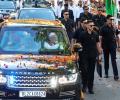
'It is important India to stay focussed on its primary national objectives: Combating terrorism; not losing sight of other security and strategic concerns (on the Sino-Indian front for instance); ensuring a strong economy and registering growth which includes improving the lot of common people; and finally making certain that the social fabric remains intact and harmony among people is not jeopardised, at least any further,' asserts Nilanjan Mukhopadhyay.

While data can empower communities, it reinforces identities, making local politics more caste-centric, with decisions increasingly contested on the grounds of representation.
Such dynamics could lead to shifting alliances and, in the worst case, local governance getting paralysed as each group demands proportional power-sharing, explain Amitabh Kundu and Mehebub Rahaman.
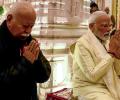
Much drama is likely to continue in the coming year, within the Sangh Parivar as well as involving the Opposition parties and, of course the BJP's allies, predicts Modi biographer Nilanjan Mukhopadhyay.

The lack of clarity on who is next in line, when the time comes, as indeed it will one day some day, reflects poorly on the management of the world's largest political party. It scarcely need be said that a squabble between the contenders, Shah and Yogi, is exactly what the doctor ordered for the Opposition, notes Krishna Prasad.

'The dissemination of violence, of terrorism, has its origin in Pakistan,' says Christophe Jaffrelot.

One hopes, though one is not optimistic, that this action to some extent corrects the lunacy which has infected our national media and has damaged our nation, notes Aakar Patel.

India's voting pattern in the United Nations with regard to the Israel-Palestine conflict is lately marked by a calibrated distancing from Israel, observes Ambassador M K Bhadrakumar.

Ahead of the court verdict on Ayodhya dispute, a French writer on India says it would be a moment of reckoning and an opportunity for Indian leadership to bring Muslims back into mainstream.

Modi is seen as exceptional not only on account of his acts but also owing to his style. He appears to sacrifice his life for the people -- like a fakir, a figure he came to epitomize even more in 2020 by growing a long white beard. Charisma is above accountability, and Modi has grasped these dynamics.

'The way discrimination against Muslims has become almost normalised is very upsetting.'

The events of the last few years shows that pessimism about where we have arrived and where we are headed is justified, asserts Aakar Patel.

'Consider Mrs Gandhi's view of her opponents: Traitors, anti-nationals, rumour-mongers.' Does the spirit of the Emergency-era Indira Gandhi still rule India? asks Vir Sanghvi.

'Modi cannot content himself anymore with merely indulging in Congress bashing and referring to the Gujarat 'miracle'. He'll have to show that his party is as clean and as innovative as the AAP. And this is impossible because AAP is new and the BJP is now old: the people have tried it already. What they have not tried already is Modi, and this is what may make the difference,' says the respected political scientist Christophe Jaffrelot.

The Emergency greatly influenced the RSS' makeover from a fringe force in the Indian political imagination to one that could have its own man sworn in as prime minister in two decades' time. A riveting excerpt from Christophe Jaffrelot and Pratinav Anil's India's First Dictatorship: The Emergency, 1975-1977.
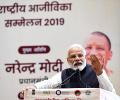
Saisuresh Sivaswamy tells us what we must know from the election news in the print and television media.

'It has also underestimated the striking force of the Opposition. It has been complacent and paralysed. That may be due to the compulsions of coalition politics and the arrogance of a party which looked at itself as entitled to rule,' says political scientist Christophe Jaffrelot.
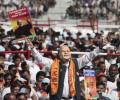
'The Congress era was already over anyway! The real question is: Has India opened a new, post-coalition era and I'm very doubtful about that,' Christophe Jaffrelot, author of several books on Indian politics, tells Archana Masih/Rediff.com, analysing Mandate 2014.
'The osmosis between Hinduism and Islam that really gave birth to the Hindustani or Indo-Islamic civilisation was due to the conversation between Muslim mystics and yogis.'

'Extravagant new promises can buy him time, but far from solving the problem, they compound the risk.' 'His main alternative is to stress not aspirations, but resentments.' 'He has already de-emphasised aspirational appeals: Nothing has been heard for over two years of the coming of achhe din,' points out James Manor.

'The country has moved beyond the likes of Yogi Adityanath and his medieval thinking. The results of the by-elections are early warning signals by impatient Indians. It's up to the BJP to learn its lesson or face the consequences,' says Ashutosh.
The million dollar question that begs for an answer is: Why is it that an amateurish attempt to convert a handful of Muslims by fringe Hindu elements garners so much attention while large scale systematic attempts to subvert Hinduism go unnoticed or are deliberately overlooked? If this is not double standards then what is, asks Vivek Gumaste.
 © 2026 Rediff.com - Investor Information - Advertise with us - Disclaimer - Privacy Policy - Sitemap - Feedback - About us - Terms of use - Grievances