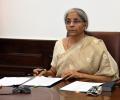
Finance Minister Nirmala Sitharaman on Friday chaired a meeting with chiefs of public sector banks and assessed their readiness to tackle any possible disruptions due to the Omicron variant. In a tweet, the finance ministry said during the meeting with CMDs/MDs, held through virtual mode, the minister also reviewed various steps taken by PSBs in implementing pandemic-related measures initiated by the government and RBI.
The Reserve Bank will go for a "dovish pause" at Wednesday's policy review announcement amid developments such as a rise in inflation, government maintaining the inflation target band and a likely impact on growth due to local lockdowns on rising COVID-19 infections, analysts said on Monday. Economists at American brokerage Bofa Securities said price stability, growth and financial stability will become the prime focus areas for the central bank going forward. "The RBI MPC (Monetary Policy Committee) should deliver another dovish pause on Wednesday," it said. The policy announcement, the first for the fiscal, will come days after the government maintained the RBI's target to ensure inflation to be within 2-6 per cent band for five more years.

The Reserve Bank's rate-setting panel, Monetary Policy Committee (MPC), began its three-day deliberations on Wednesday amid expectations of a status quo on benchmark rate mainly on account of uncertainty over the impact of the second wave of COVID-19 pandemic. Moreover, the fears of firming inflation may also refrain the MPC from tinkering with the interest rate in its bi-monthly monetary policy outcome to be announced on Friday. The RBI had kept key interest rates unchanged at the last MPC meeting held in April.

The financials of six privately held companies associated with Siddhartha show an increase in debt and falling ability to meet short-term obligations.

Due to default in payment, the securities of FICL and NDIL will be valued at zero basis AMFI standard hair cut matrix, and interest accrued and due will be fully provided.

The sudden stop in economic activity led to a sharp decline in employment-intensive sectors like construction, manufacturing and trade, hotels, transport etc.

Industrial production re-entered the negative territory by contracting 1.6 per cent in January, mainly on account of the decline in output of capital goods, manufacturing and mining sectors. The output of the manufacturing sector -- which constitutes 77.6 per cent of the Index of Industrial Production (IIP) -- shrank by 2 per cent in January, as against a growth of 1.8 per cent during the same month last fiscal, as per data released by the government on Friday. The worst performance was witnessed by the capital goods sector, which recorded a contraction of 9.6 per cent during the month under review, compared to a 4.4 per cent decline a year ago.

India's electric mobility goal, which has so far been riding on two wheels, is all set to graduate to four wheels. At least, the journey has begun. Hyundai Motor India said it would invest Rs 4,000 crore till 2028 to launch half-a-dozen electric vehicles (EVs) in India. It would eventually straddle premium and mass segments. The first of these - the electrified version of an internal combustion engine (ICE)-powered model - will go on sale as early as next year.

The real estate sector might have been caught off guard by the second wave of the Covid-19 pandemic, but large listed developers like Godrej Properties and Prestige Estates Projects soldier on undeterred. They aim to have sales bookings of Rs 10,000 crore in the next few years.

Experts say the focus is on preserving liquidity as there is uncertainty over the duration and impact of the 21-day nationwide lockdown imposed to check the spread of COVID-19.

There are various estimates of India's debt to GDP ratio, but the consensus is that that it would be over 80 per cent at the end of the current fiscal year.

Despite sanctioning the loans, bankers are worried whether to disburse the loan because of absence of an investment grade rating.
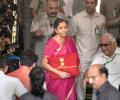
As India emerges from the COVID-19 crisis, the ninth budget under the Modi government, including an interim one, is widely expected to focus on boosting spending on job creation and rural development, generous allocations for development schemes, putting more money in the hands of the average taxpayer and easing rules to attract foreign investments.

The highest domestic package, however, fell 10 per cent

IIM-A saw 36 per cent jump in maximum domestic salary in 2018 placements this year.
 © 2026 Rediff.com - Investor Information - Advertise with us - Disclaimer - Privacy Policy - Sitemap - Feedback - About us - Terms of use - Grievances