
The Supreme Court on Friday upheld JSW Steel's Rs 19,700-crore resolution plan for debt-ridden Bhushan Power and Steel Limited (BPSL), bringing down curtains to a prolonged legal battle that spanned nearly eight years.

In a significant development, the Supreme Court on Thursday recalled its controversial May 2 verdict that had ordered liquidation of Bhushan Power & Steel Limited (BPSL) while setting aside a resolution plan of JSW Steel Limited for the ailing firm. A bench comprising Chief Justice B R Gavai and Justice Satish Chandra Sharma observed that the May 2 judgment, authored by Justice Bela M Trivedi, since retired, did not "correctly consider the legal position as has been laid down in the catena of judgments".

JSW Steel Ltd (JSTL) has announced a restructuring that unlocks value from Bhushan Power & Steel Ltd (BPSL) and changes the balance-sheet. JSTL will do a slump sale of 50 per cent stake in BPSL to Japan's JFE Steel in two equal tranches, totalling Rs 15,700 crore in cash.
The Supreme Court on Friday declared JSW Steel Limited's resolution plan for Bhushan Power & Steel Limited (BPSL) "illegal" and ordered the latter's liquidation, four years after the company was acquired by JSW Steel under the Insolvency and Bankruptcy Code (IBC). Following the ruling, JSW Steel shares fell sharply.
You have to grow, and grow fast - that's the DNA of the JSW group, chairman Sajjan Jindal said as JSW Cement made its debut on the stock market mid-August. The remark captured not just the moment but also the momentum of JSW's growth story.

The Supreme Court's ruling in the BPSL case exposes deep flaws in the IBC's institutional framework and raises concern about judicial overreach, notes Rajeswari Sengupta.

India on Monday imposed a 12 per cent provisional safeguard duty for 200 days on five steel product categories, including hot rolled coils, sheets and plates, to protect domestic players from surge in imports. The decision follows a recommendation for the same by the Commerce Ministry's investigation arm DGTR. Last month, the DGTR suggested to impose the duty.
JSW Steel, owned by Sajjan Jindal, has emerged as the world's most valuable steelmaker, boasting a market capitalisation (mcap) of nearly $30.31 billion, according to Bloomberg data.
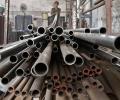
The closure of BPSL would add about three million tonnes capacity to JSW Steel's existing 18 million tonnes.

'The Budget will be positive, continuing on the path of growth taken so far.'
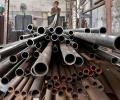
On June 30, mining and metals giant Vedanta, announced that it had decided to initiate a strategic review of its steel and steel-making raw material businesses. The review would begin immediately and evaluate a broad range of options, including but not limited to a potential strategic sale of some or all of the steel businesses, the company said in its stock exchange filing. The signs have been there - approaches had been made to steel players over the past year. Last December, Anil Agarwal, chairman Vedanta group, told Business Standard that the steel plant capacity was about 3 million tonnes (mt).
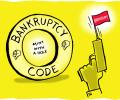
Even as lenders are getting ready to send more companies to bankruptcy courts from this week, several old cases are still awaiting resolution with no clarity on the completion of the process. This includes some high profile cases from the first list of 40 companies including Videocon Industries, Bhushan Power and Steel and Lavasa Corporation, sent by the Reserve Bank of India (RBI) for resolution. The delay is mainly due to litigation and late clarifications by various government agencies including the Reserve Bank of India and litigation by the Enforcement Directorate.

He supervised and handled several major big ticket insolvency cases that includes Essar Steel, Bhushan Power & Steel, Bhushan Steel, Jaypee Infratech, ElectroSteel Steel, Binani Cement, Reliance Communications.

With the stock market entering a bull phase, many believe the Singals can bring in the much-needed equity capital and reduce their debt.

In 2009, ArcelorMittal had picked up a stake in Uttam Galva Steels. A new Section 29A of the IBC prohibits promoters of companies with NPAs of more than a year from bidding for these companies.

Government may also consider giving relief to some of the worst-affected sectors.
Uttam Galva Steels is a part of the Reserve Bank of India's second list of cases, which will be referred to the bankruptcy tribunal for insolvency proceedings after lenders failed to resolve the account by December 2017.

Top companies have grabbed a bigger pie of their sectors in the pandemic period, leading to a further rise in market concentration in many industries as measured by the Herfindahl-Hirschman Index (HHI). The HHI score, which indicates competitive intensity in an industry (or a lack of it), reached a new high in FY21 as bigger firms raised their revenue market shares either organically or through mergers and acquisitions. A higher HHI score indicates a rise in market concentration in favour of a few firms while a lower score means that the industry's revenue is more evenly divided among many companies

As many as 52 Indian companies raised money from external sources in October, of which $719.52 million was raised through automatic route for which no approval is required from the Reserve Bank of India or the government.

The verdict, upholding Centre's November 15, 2019, notification bringing personal guarantors of corporate debtors under the net of the IBC, assumes significance in view of the fact that various high-profile industrialists may now face insolvency proceedings along with their debt-ridden firms under the IBC.

Reports suggest state-owned banks have lapped up Rs 40,000 crore, so far, using both bonds and equity instruments. The question, though, is whether there will be a perceptional change for PSB stocks.
The recent amendments to the IBC practically barred promoters from re-acquiring their own assets, leaving only a small window to convert their non- performing assets into standard assets by paying the overdues.
Sanjeev Gupta of Liberty House, a global supplier of metals and engineering solutions, who has emerged front-runner for a number of stressed companies, plans to fund a string of companies through a mix of equity and debt.

India Ratings expects long products demand growth to be sharp, supported by a demand push from the government-led infrastructure investments in affordable housing, railways, rural electrification and road networks.

The Coal Ministry has issued show-cause to eight firms including Hindalco Industries and Mahanadi Coalfields, and sought explanation from five firms for delays in commencing production from mines allocated to them.

The proposal to increase public float, hike income tax surcharge, move to tax share buybacks and lack of stimulus to shore up economic growth has hurt investor sentiment.
Once Bhushan Steel is into its fold, Tata Steel will increase its capacity from 12.7 million tonnes per annum (mtpa) to 18.3 mtpa

The delay will increase the provisioning burden on lenders and will also postpone the benefit of reversal of money set aside as provisions.

The Income Tax department is understood to have detected an evasion of Rs 502 crore (Rs 5.02 billion) by two major steel manufacturers after it conducted searches and surveys against them in various parts of the country.

Essar group, Bhushan Steel and JSW group likely to be impacted by changes

The Reserve Bank had identified 12 accounts, each having more than Rs 5,000 crore of outstanding loans accounting for 25 per cent of total NPAs or bad loans of banks, for immediate referral for resolution under the bankruptcy law.

Recently, CVC suggested that banks have a monitoring mechanism for bad loan sales to ARCs, with the cash flow statement from stressed assets shared with banks.

Delhi-based Monnet Ispat and Power has bought 27 per cent in the steel company and may make open offer at Rs 320 per share. Backed by P K Mohanty, executive vice-chairman and managing director, Orissa Sponge, and the promoter of the company, Monnet Ispat has now become the frontrunner for acquiring the company by buying a total of 54 million shares.
According to the Securities and Exchange Board of India regulations, if the shareholding crosses 15 per cent, it would trigger an open offer. Bhubaneshwar-based Orissa Sponge is understood to have iron ore and coal reserves of around 120 million tonnes each along with sponge iron and billet making plants.

Analysts said even though the Indian economy is expected to slow down to 7.2 per cent in fiscal 2020, it is still the best bet for investment for foreign investors.

With average capacity utilisation now touching 76 per cent, Indian companies are going back to the drawing board to add capacity but the plans to build new factories and plants are still some months away.
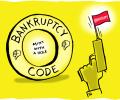
In a major relief to stressed assets, the Cabinet approved the proposed IBC amendment that the licences, permits, concessions, and clearances for a corporate debtor cannot be terminated or suspended or not renewed during the moratorium period. The Cabinet also allowed amending the code to streamline the corporate insolvency resolution process and protect last-mile funding to boost investment in financially distressed sectors.
A total of 4,452 cases have been disposed at pre-admission stage and 66 have been resolved after adjudication. 260 cases have been ordered for liquidation.
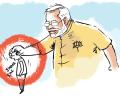
'By not only decriminalising routine business failures, but by ensuring that institutional lending and corporate rescue frameworks are strengthened via the IBC, the prime minister has ensured there is no room anymore for the proverbial 'reckless, prodigal debtor',' notes Sanju Verma.
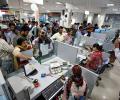
Amid slowdown blues, the government has unveiled a raft of measures over the past few months aimed at improving liquidity in the system, moderating interest rates as well as credit growth apart from addressing stress in the NBFC sector.
 © 2026 Rediff.com - Advertise with us - Disclaimer - Privacy Policy - Sitemap - Feedback - About us - Terms of use - Grievances