
The petition filed by the Association for Democratic Reforms alleged that two political parties -- Congress and the Bharatiya Janata Party have violated the Representation of People's Act, 1951 and Foreign Contribution (Regulation) Act by taking donations from government companies and foreign sources, which is prohibited under both legislations.

The Congress declared Rs 526 crore as income from unknown sources which is 15.57 per cent of the total income of the national parties from unknown sources, the ADR said.

Out of the 69 candidates with declared criminal cases, 30 have declared serious criminal cases like murder, attempt to murder, kidnapping, robbery, extortion, reports Vicky Nanjappa
The Association for Democratic Reforms, an non-government organisation working for electoral reforms, while supporting Election Commission's order to seize unaccounted cash in poll-bound states, has noted that legitimate business transactions based on cash should not suffer.
Latest records show that only one MLA in the newly-elected Gujarat assembly spent more on the election expenses than the limit specified by the Election Commission, reports Vicky Nanjappa.

An analysis of the declarations made by these MLAs reveals that 37 have declared serious charges including those related to rape, attempt to murder and crime against women.
Crores received by the Congress between 2005 and 2009 are unaccounted for, the BJP follows suit. Vicky Nanjappa reports
There has been a national outcry seeking harsher laws for rapists in India. As the outrage grows against the heinous incident of gangrape in Delhi and Parliament discusses the issue, Vicky Nanjappa takes a look at the background of our lawmakers (members of Parliament and members of Legislative Assembly) with respect to rape cases and other crimes against women based on their self-sworn affidavits.
Data put out by the Karnataka Election Watch (KEW) and Association for Democratic Reforms analysed 179 outgoing MLAs who are contesting again in the 2013 Karnataka Assembly elections.
The Election Commission has rejected a demand to make mandatory the filing of affidavits by candidates in the Presidential poll disclosing their assets and criminal record, if any.
Balbir Singh Verma, an independent candidate from Chopal constituency in Himachal Pradesh, has declared the highest income among all candidates -- Rs. 1.41 crore -- in his income tax returns, according to a report prepared by the Himachal Pradesh Election Watch and the Association for Democratic Reforms.
During the last assembly elections held in Himachal Pradesh in 2007, only 16 per cent of the total candidates were crorepatis. According to a report just released by the Association for Democratic Reforms and the Himachal Pradesh Election Watch, today 33 per cent of the total 445 candidates are crorepatis.

The murder of Atiq and his brother and the police encounter with his son have raised many questions about the propriety of how crime is tackled by the Yogi government. But Yogi knows he has the support of the people who are fed up with crime holding the state to ransom for decades, asserts Ramesh Menon.
The Indian National Congress leads the political pack with most number of candidates who will contest the Tripura Assembly elections to be held in March.
A full bench of the Central Information Commission on Monday passed a historic judgment, stating that political parties would under the ambit of the Right to Information Act). While the CIC verdict was made about a case connected to the Communist Party of India, fresh complaints may be filed against all other parties before the CIC to secure a similar verdict and put them under the ambit of the RTI.
There are 57 members with criminal background, one with even charges of rape, and 134 crorepatis (74 per cent) in the newly-elected Gujarat assembly, according to a report by the Association for Democratic Reforms, a non-political group aiming at governmental and electoral reforms. Vicky Nanjappa reports.
A hearing on making the income tax returns of members of Parliament public was held on Thursday at the Central Information Commission premises in New Delhi.
Statistics from the Association for Democratic Reforms analysis of the newly-elected legislative assemblies in Nagaland and Tripura indicate that there are 36 and 8 crorepatis respectively in both the Houses. Vicky Nanjappa reports:
All political parties in India except the Communist Party of India have declined to provide information through a Right To Information application on political donations.
Did you know that 98 politicians with corruption cases have been given election tickets by various parties in the last 5 years?
When a senior minister in Uttar Pradesh makes a statement such as 'steal a little, but don't loot', then this bit of data regarding corporate donations to political parties in the past three years would be interesting to take note of. Vicky Nanjappa reports.
The newly elected Legislative Assembly in Himachal Pradesh has seen a decline in the number of members who are facing criminal cases.
Of the 360 candidates analysed for the 6th phase of Uttar Pradesh assembly elections, 128 candidates or 36 per cent of them have criminal cases registered against them.
Phase two of the Uttar Pradesh elections will see a whopping 118 candidates with a criminal background. The details released by the Association for Democratic Reforms reveals that out of the 337 candidates analysed for the second phase of Uttar Pradesh Assembly Elections, 118 candidates have declared criminal cases against them. Vicky Nanjappa reports.
Five legislators, who are contesting the forthcoming assembly polls, have serious criminal cases like murder, attempt to murder, kidnapping, robbery etc pending against them. This information has been revealed by the Punjab Election Watch which, along with the Association for Democratic Reforms, has assessed the financial and other details of the members of legislative assembly seeking re-election in Punjab.
Of the 258 candidates in the electoral fray in Manipur for the forthcoming assembly elections, only three have criminal charges registered against them. According to the Association for Democratic Reforms, which analyses the affidavits filed by candidates, only three face criminal charges. As many as 33 candidates contesting the assembly polls are crorepatis.
The data provided by the Association for Democratic Reforms states that out of thes 60 members of Legislative Assembly, 36 (or 60 per cent) are crorepatis.
As Gujarat braces for an election this year, it would be interesting to see the donations received by the political parties in the state, and the list of candidates who have a criminal background, says Vicky Nanjappa
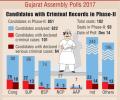
The Gujarat polls are drawing to an end with Tuesday being the final phase of campaigning before the state goes for polling in the second phase on December 14. Results for the 182-seat assembly will be announced on December 18. Ahead of the polling, here's everything you need to know about the candidates.
A report prepared by the Association for Democratic Reforms states that the total tax exemptions received by six national parties during financial years 2006 to 2009 is Rs 510.02 crore. Vicky Nanjappa reports
In Uttarkhand, 71 per cent of the MLAs (50 of 70 analysed) are graduates and have higher qualification and 27 per cent have criminal records, according to a report by the Association for Democratic Reforms.
According to a report by the Uttar Pradesh Election Watch and the Association for Democratic Reforms, Samajwadi Party tops the list parties fielding tainted candidates. Vicky Nanjappa reports

51 constituencies across 7 states go to the polls in the fifth phase of the Lok Sabha election.
Out of the 129 candidates contesting the Goa assembly elections, 30 candidates or 23 per cent declared criminal cases. Vicky Nanjappa reports.
The National Election Watch and the Association for Democratic Reforms states in it report and analysis that out of the 248 candidates 76 candidates or 31 per cent declared criminal cases against them. In 2007 assembly elections for Uttar Pradesh, 27 per cent candidates had declared criminal cases against themselves. Vicky Nanjappa reports.
Of the 114 constituencies going to polls in the first two phases in Uttar Pradesh elections, 41 are red alert constituencies -- they have three or more candidates with criminal records. According to the record of the candidates analysed by the Association for Democratic reforms, 36 per cent of the constituencies in the first two phases of UP polls are red alert ones. Of the 41 red alert constituencies, 28 have three candidates with declared criminal cases.

The third phase will see the maximum number of seats going to the polls in this election spread across 12 states and 2 Union territories.
The Bharatiya Janata Party has received more donations compared to the Congress in Himachal Pradesh in the last seven years, a study has found.

23 of the DMK's 24 candidates are crorepatis!
Nineteen political parties, including the Bharatiya Janata Party and the Congress, received over Rs 1,100 crore during assembly polls in five states and Union territories in 2021 and spent over Rs 500 crore, a big chunk of which went towards advertisements and travel expenses for star campaigners, a study said on Friday.
