
Among Sensex firms, Tata Steel, HCL Tech, Bajaj Finance, Bajaj Finserv, Bharat Electronics and Eternal were the major laggards. However, Maruti, Mahindra & Mahindra, Tata Motors Passenger Vehicles and ITC were among the gainers.
The recent stimulus measures announced by China have seen most analysts sit up and take notice.

State Bank of India, Tech Mahindra, Larsen & Toubro, Tata Steel, Sun Pharma, Infosys, HCL Tech, Axis Bank, Tata Consultancy Services and NTPC were among the biggest laggards among Sensex shares. Nestle, Hindustan Unilever, Titan, Power Grid, UltraTech Cement and ITC were among the gainers.

Asian countries (ex-Japan) including India and China, are now the most expensive region in the world as strong inflows into Asian funds are stretching valuations, according to analysts. Yet, Asian equities continue to attract big money. The region is trading at 29 per cent premium against the developed world and 14 per cent against global emerging markets (GEM) on price to earnings (P/E) multiple, said a report by the Citigroup.

The narrative on China is changing post the recent stimulus measures, and it will be hard for global investors to ignore the Chinese markets.
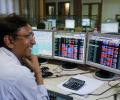
Equity benchmark indices Sensex and Nifty settled higher on Thursday, powered by a rally in banking and power stocks amid a largely firm trend in global markets. The stock markets mostly traded range-bound in the absence of any major trigger and persistent foreign capital outflows, traders said. The 30-share BSE Sensex rose 144.31 points, or 0.18 per cent, to settle at 81,611.41.

Equity markets rallied after softer-than-expected inflation data in the US and UK rekindled hopes of the end of the rate-hiking cycle by major central banks. The soft inflation reading drove down bond yields and the US dollar, whetting the appetite for risky assets. The 10-year US bond yield fell below 4.5 per cent after topping 5 per cent less than a month ago.

The 55 basis point (bps) spike in the US 10-year bond yield, triggered by a combination of FOMC's hawkish commentary and BOJ's relaxation of the yield control curve (YCC) has made analysts cautious on Asian equities and expect them to trade sideways in the short-to-medium term.

Equity investors became richer by over Rs 5.77 lakh crore on Tuesday, helped by a rally in the broader market where the BSE benchmark jumped nearly 2 per cent. The BSE Sensex zoomed 934.23 points or 1.81 per cent to settle at 52,532.07. Driven by the rally in equities, the market capitalisation of BSE-listed firms jumped by Rs 5,77,006.83 crore to stand at Rs 2,40,63,930.50 crore. "Absence of fresh selling triggers in the domestic and global economy along with falling commodity prices relieved the heavily discounted equity market to showcase recovery.
'Overtightening of monetary policy by central banks and the spread of new Covid variants, which may force governments to restart lockdowns or restrict mobility.'

In the Sensex pack, major gainers were Tech Mahindra, Wipro, Bajaj Finserv, Infosys, SBI and PowerGrid. NSE Nifty rallied 237.90 points to 17,339

Equity benchmarks continued their winning momentum for the third day on Thursday and jumped over 1.50 per cent, tracking an overall bullish trend in Asian equities. On the political front, the BJP headed for a second straight win in politically crucial Uttar Pradesh and dominated the trends chart in three other states. The 30-share BSE benchmark Sensex opened in the green and further zoomed 1,595.14 points or 2.91 per cent to 56,242.47 during early trade.

HDFC twins were the top losers in the Sensex pack, shedding over 4 per cent, followed by ICICI Bank, Kotak Bank, Asian Paints, M&M, HUL, TCS and Maruti. NSE Nifty tanked 263.80 points to 14,631.10.

India attracted $1.4 billion FIIs in November, says a report by HSBC.

Axis Bank was the top loser in the Sensex pack, skidding over 3 per cent, followed by IndusInd Bank, Titan, HDFC, ICICI Bank, ONGC and HDFC Bank. On the other hand, Reliance Industries, Sun Pharma, HUL, Bharti Airtel and TCS were among the gainers.
Ultratech Cement was the top gainer in the Sensex pack, surging 4.37 per cent, followed by Tata Steel, IndusInd Bank, L&T, Reliance Industries, SBI, HDFC, HDFC Bank, Axis Bank, ONGC and ITC.

L&T was the top gainer in the Sensex pack followed by M&M, SBI, Titan, Infosys, Bharti Airtel and Ultratech Cement.
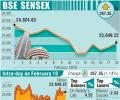
The S&P BSE Sensex surged 267 points to end at 23,649.
Tata Motors was the top gainer in the Sensex pack rallying 5.32 per cent. Among other prominent gainers were Bharti Airtel, IndusInd Bank, Sun Pharma, Axis Bank, Maruti Suzuki, Bajaj Auto and TCS.

Top losers in the Sensex pack included Yes Bank, IndusInd Bank, Tata Motors, RIL, ONGC, Bajaj Auto, Vedanta, Tata Steel, TCS, HDFC Bank and ICICI Bank, which fell up to 3.29 per cent.

Any market correction, analysts say, would be an attractive entry point for risky assets, which should do well over the medium-to-long term.
Yes Bank was the top gainer in the Sensex pack rising 5.80 per cent, followed by Tata Motors, ICICI Bank, IndusInd Bank, Axis Bank, Kotak Bank and Tata Steel.

A weak economy coupled with rising Covid-19 cases and inflation that is above RBI's comfort zone, geopolitical developments, and upcoming India Inc's second quarter results for FY21 could impact sentiment, analysts say.

The Nifty Options would add to SGX's suite of Asian equity derivatives, which include SGX S&P CNX Nifty futures, the dominant Indian product for international participants.

Equity strategists are basing their expectation on strong corporate earnings recovery, supportive global economic growth, and gradual improvement in business sentiment.

Indian funds did better than Asian ones in only four of the 10 months -- till October. Despite much market optimism, presumably around policy interventions and guided by buoyant flows, India's macro backdrop may be turning for the worse.

Axis Bank was the top laggard in the Sensex pack, plunging more than 5 per cent, followed by HDFC, Bajaj Finance, ICICI Bank, Tata Steel, Bajaj Auto, HDFC Bank and IndusInd Bank. On the other hand, M&M, Infosys, Asian Paints, UltraTech Cement and Tech Mahindra were among the gainers.
Despite the toned-down estimates, Sukumar Rajah, MD and CIO -- Asian Equities, Franklin Templeton Investments, tells Business Standard that India maintains the lead in economic growth vis-a-vis most of its peers and the regulatory risk will reduce.

India's premium benchmark equity index, the S&P CNX Nifty, also the fastest growing index on SGX, will be traded for 16 hours on that exchange, compared to the six-and-a-half hours that it traded on the National Stock Exchange in India. The SGX will be traded from 6.30 am to 10.30 pm IST.

Silver followed suit and dropped by Rs 325 to Rs 37,100 per kg.
Global research firm Citigroup, citing data compiled by emerging market fund flow tracker EPFR, said in a report that of the outflows registered by Asian funds, investors put in $209.9 million in China-dedicated funds. Meanwhile, Asian equity funds inflow declined to $46 million in the first week of December, while it was at $350 million in the third week of November.
Foreign investors continued to pull out large sums from the emerging market equity funds last week, with the Asian equity funds witnessing an outflow for the sixth week in a row taking the total exodus to over $18 billion so far is year.
Asian banks, especially the ones engaged in realty and home segment, will be significantly affected due to volatality in the global markets.
In fairly active trade at the Interbank Foreign Exchange (forex) market, the local currency resumed firm at 39.32/34 a dollar from yesterday's close of 39.44/45 a dollar and later surge to 39.31 level on the back of heavy capital inflows into equity.

India, best-performing among emerging markets in the first four months of 2017, has since ceded this position to South Korea.
Maintaining that the Indian equities remain a good asset class in the long-term, Citigroup on Monday said the return on equity of companies in India is one of the best in the world.

Increased demand for the dollar from importers put pressure on the rupee.
 © 2026 Rediff.com - Investor Information - Advertise with us - Disclaimer - Privacy Policy - Sitemap - Feedback - About us - Terms of use - Grievances