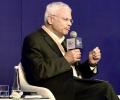
According to the Justice Department, Tellis, 64, the Tata Chair for Strategic Affairs and a senior fellow at the Carnegie Endowment think-tank, served as an unpaid senior adviser to the State Department and was also a contractor with the Office of Net Assessment at the Department of Defense.

'...it should not delude itself into thinking that India's security or its great-power ambitions will be advanced by those partnerships.'
'Instead, what India should focus on is on riding out the next three-and-a-half years of Trump's presidency with minimal damage to itself.'
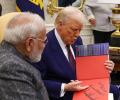
'The current strain in the relationship is serious and likely to be long lasting.' 'Even if Trump suddenly changes his attitude toward India -- which he is entirely capable of doing -- it is unlikely that New Delhi will be able to pick up the pieces and respond as if nothing has happened.'

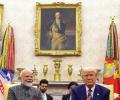
'Modi's intention was to create goodwill that will allow India to be seen by Trump as more than just a bad tariff problem.' 'He succeeded brilliantly on that count but none of these wins are unfortunately permanent.' 'Modi will have to do this again and again if Trump's grievances are to be durably assuaged.'

'He had to change them because he recognises that even with his popularity....could lead to a problem. So, democracy has this way of offering corrections and telling the ruling party or the prime minister that you need to take some steps to compensate for excesses'

Prime Minister Manmohan Singh's presence at the first-ever Nuclear Security Summit hosted by United States President Barack Obama, beginning April 12, will be key for 'critical substantive reasons', believes Dr Ashley J Tellis, an expert on nonproliferation and nuclear security matters.
United States Barack President Obama during his visit to India -- and preferably during his address to India's Parliament -- should do something big, like declaring 'forthrightly' Washington's support for India's bid for a permanent seat on the United Nations Security Council, another report by the Carnegie Endowment for International Peace has said.
Foreign policy expert Dr Ashley J Tellis believes there are three fundamental objectives that Prime Minister Manmohan Singh's visit to the United States can accomplish.
Former Bush Administration official Ashley J Tellis, considered one of US' foremost strategic experts, praised Indian Prime Minister Manmohan Singh for his forbearance in dealing with Pakistan, while the addressing the Congress on the impending threat posed by the Lashkar-e-Tayiba on Thursday.

South Asia experts have called the recent Obama-Singh meet a success, going by the positive signals given by both sides in all major areas of cooperation, both bilateral and multilateral.

'...to prevent this episode from disrupting ongoing cooperation.' 'The discovery of this plot had the potential to derail much of what has been achieved in the relationship during this administration's tenure -- I don't think that fact has been sufficiently appreciated in India.'
In the wake of the movement in recent days with speculation rife that Prime Minister Singh is willing to go ahead with the deal even if the Left allies in the coalition withdraw their support, the Bush administration -- which some perceived was a totally unrealistic statement, but which sources said was consequent to indications from New Delhi that there would be movement on the deal from its current moribund status -- vowed to work to complete the deal.
India's offer of the reported proposal to put a dedicated facility under safeguards, could be a positive contribution to moving the process forward during the talks led by Narayanan, predicts Dr Ashley J Tellis.

'And if the United States, at that time, perceives India to have welched on the deal, not been our friend, when we did so much to make it a friend, that's trouble.'

"A Biden administration will be mostly positive for India," said Rick Rossow from the Centre for Strategic and International Studies think tank. "I expect most positive areas of cooperation -- notably defence -- to be maintained," he said.

If bureaucrats are to implement the policies of the government, they would do so very efficiently if there is a prime minister who can "whip ministers and secretaries into doing their work", former Union Minister Arun Shourie said on Monday.
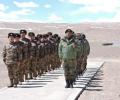
The US hopes that the differences will be resolved peacefully, officials said in Washington.

Noted security expert Ashley J Tellis has said that it was imperative for India and the United States to collaborate on developing the former's naval capability by developing next-generation aircraft carriers.
'Instead of writing NAM's obituary, India should reinvent it,' suggests Dr Rup Narayan Das.

'There is little appetite in the Democratic foreign policy establishment to pick a fight with India.'
'Modi is nobody's fool. He recognises that China has a sort of quality that attracts and repels. It attracts in terms of its performance and it shows in a sense a mirror image to India of what it could be if everything went right in terms of economic performance,' says Ashley Tellis, senior associate, Carnegie Endowment for International Peace, and head of its South Asia programme.

The Obama administration has christened his vision of Indo-US ties that has overcome the "hesitations of history" and working for the betterment of the global good as "Modi Doctrine".

In the light of India's increasingly 'darkening' threat environment and the convergence of strategic interests between China and Pakistan, the IAF's declining combat capabilities are a cause for concern, says Brigadier Gurmeet Kanwal (retd).

Days before Narendra Modi arrives in the US to speak at the UN, meet Barack Obama, gupshup with the likes of Nadella, Pichai, Zuckerberg, and address desis in Silicon Valley, his ministers will help set the commercial and strategic tone for the prime minister's visit.

Ashley J Tellis, a leading authority on Indo-US relations, tells Archis Mohan in an emailed interview that it is time Washington and New Delhi agreed on the contours of their 'strategic partnership', and that India's elite could learn from Prime Minister Narendra Modi in how he has put India's interests first and his own sentiments about the Americans second.

'Diplomatic engagement will continue even as India keeps all its options open with respect to discretely targeting the Pakistani military and its terrorist proxies.'

'Modi's investment in the relationship with Washington is the biggest deliverable of this visit. He means business and that's fantastic!'
 © 2026 Rediff.com - Investor Information - Advertise with us - Disclaimer - Privacy Policy - Sitemap - Feedback - About us - Terms of use - Grievances